

Iceland is arguably the best place on the planet to do a road trip. With gorgeous scenic drives, endless roadside stops, and plentiful campgrounds, it’s the perfect place to explore while on the road. But, with so many epic adventures to choose from, it can be hard to know where to even start!
My husband, Justin, and I have been lucky enough to have visited this stunning country a few times and have crafted the perfect Iceland road trip itinerary if you have one week to pack in as many epic experiences as possible, focusing on the western and southern coastline.
This post may contain affiliate links. If you make a purchase through them, we may receive a small commission, for which we are extremely grateful, at no extra cost to you.
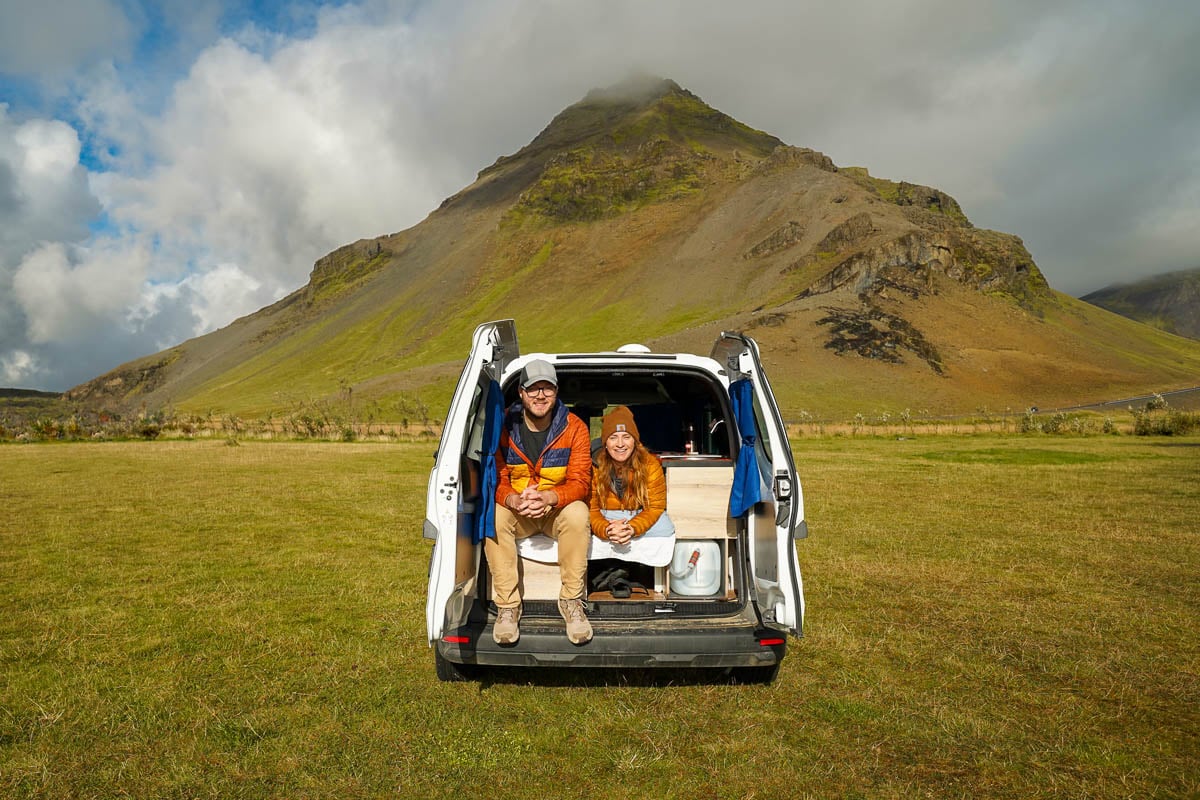

How to get around for your Iceland road trip
Before we jump into the itinerary, it’s important to consider how you’re going to road trip around the country.
Rental car and staying at hotels
If you’re interested in the most luxurious experience, getting a rental car and driving from one hotel to another will be your best option.
The biggest benefit of this option is comfort—you’ll have access to your own private shower, unlimited electricity, and cozy bed every night. Additionally, this can sometimes actually be a more affordable option than renting a campervan.
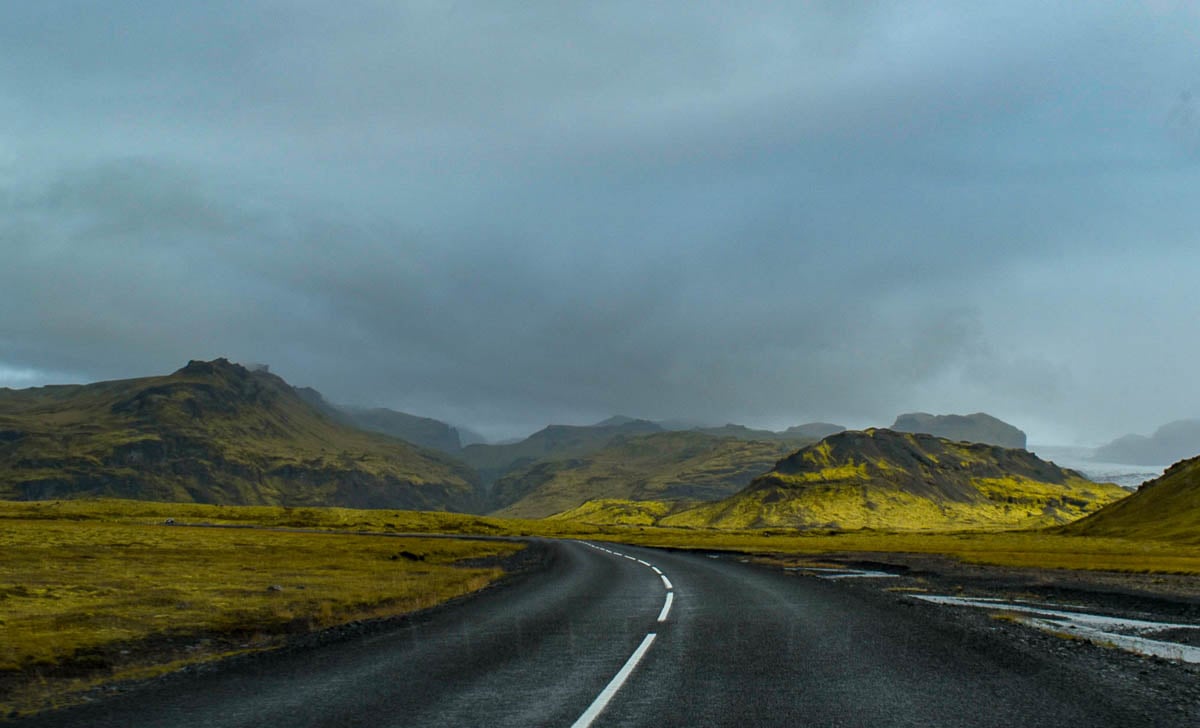
On the flipside, there are some drawbacks of going this route. For example, you’ll have limited flexibility to cancel or rebook hotels if you experience inclement weather during one of the activities you were most looking forward to (which almost certainly will happen!) and it can be kind of a drag to check into a new accommodation every night and pack up every morning. Additionally, if you’re budget conscious at all, you’ll generally be forced to eat out for the vast majority of your meals, which can REALLY add up in a country as expensive as Iceland.
Nevertheless, for all of our comfort queens out there, we’ll suggest an accommodation that you can stay along the route for each of the days of the Iceland road trip itinerary below.
Campervan and staying at campgrounds
In our opinion, the best way to road trip around Iceland is via campervan.
It’s not necessary to make reservations at campgrounds in Iceland, so you’ll have total control and flexibility over your itinerary if the weather doesn’t cooperate or something else comes up. Plus, you don’t have to worry about dragging your suitcase into and out of hotels—you’ll constantly have your home-on-wheels with you!
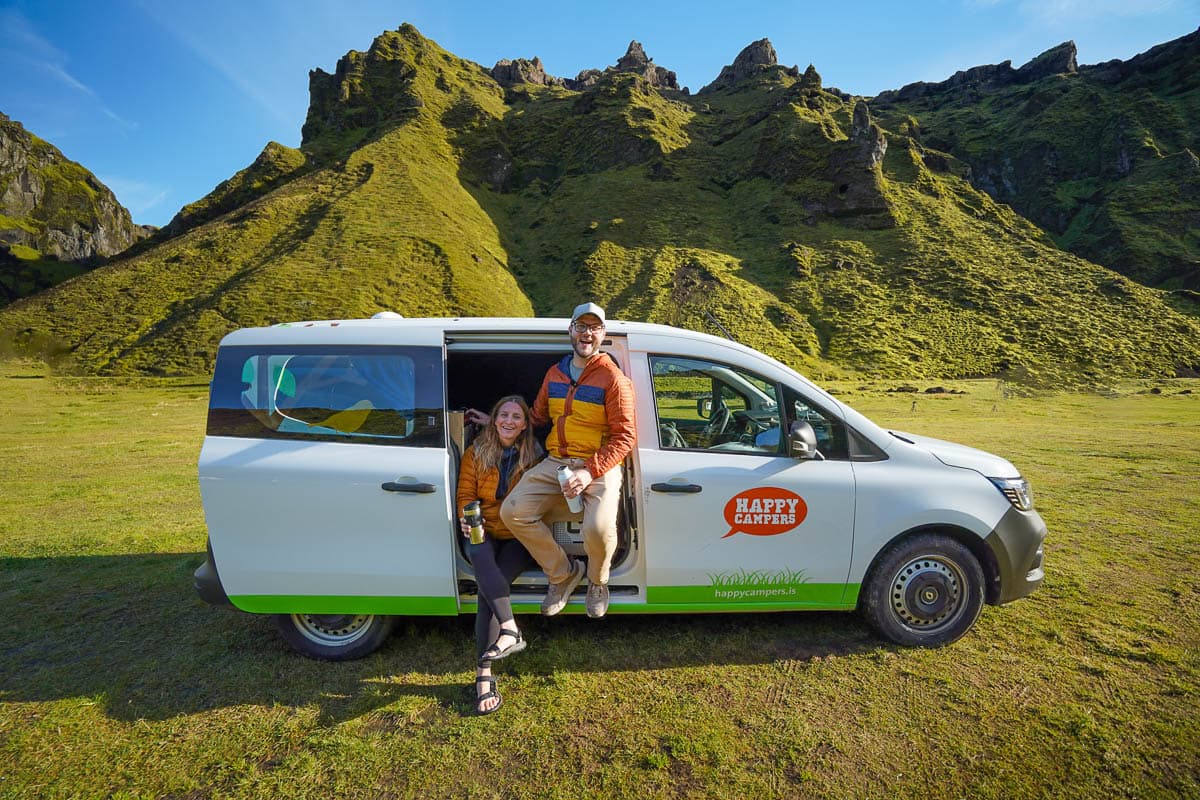
The biggest drawback of having a campervan is their cost. You can definitely luck out with sales and rent an affordable one, but, in many cases, it may actually be more expensive to rent a campervan and stay at campgrounds than it would be for a rental car and hotels.
On the bright side, they can definitely save you money, too. For example, eating out in Iceland can be REALLY expensive—I’d expect to spend at least $50 USD per couple for even the simplest of meals here. But, with a campervan, you can easily cook all of your own food, which will seriously save you hundreds of dollars over the duration of your trip.
We rented a campervan from Happy Campers and had an absolute AWESOME experience with them. They have all kinds of wonderful features, including diesel/gas heaters to keep you warm and toasty at night, in-campervan stoves (so you don’t have to cook outside!), and all of the extras you’d need for your road trip, like pillows, blankets, and utensils.
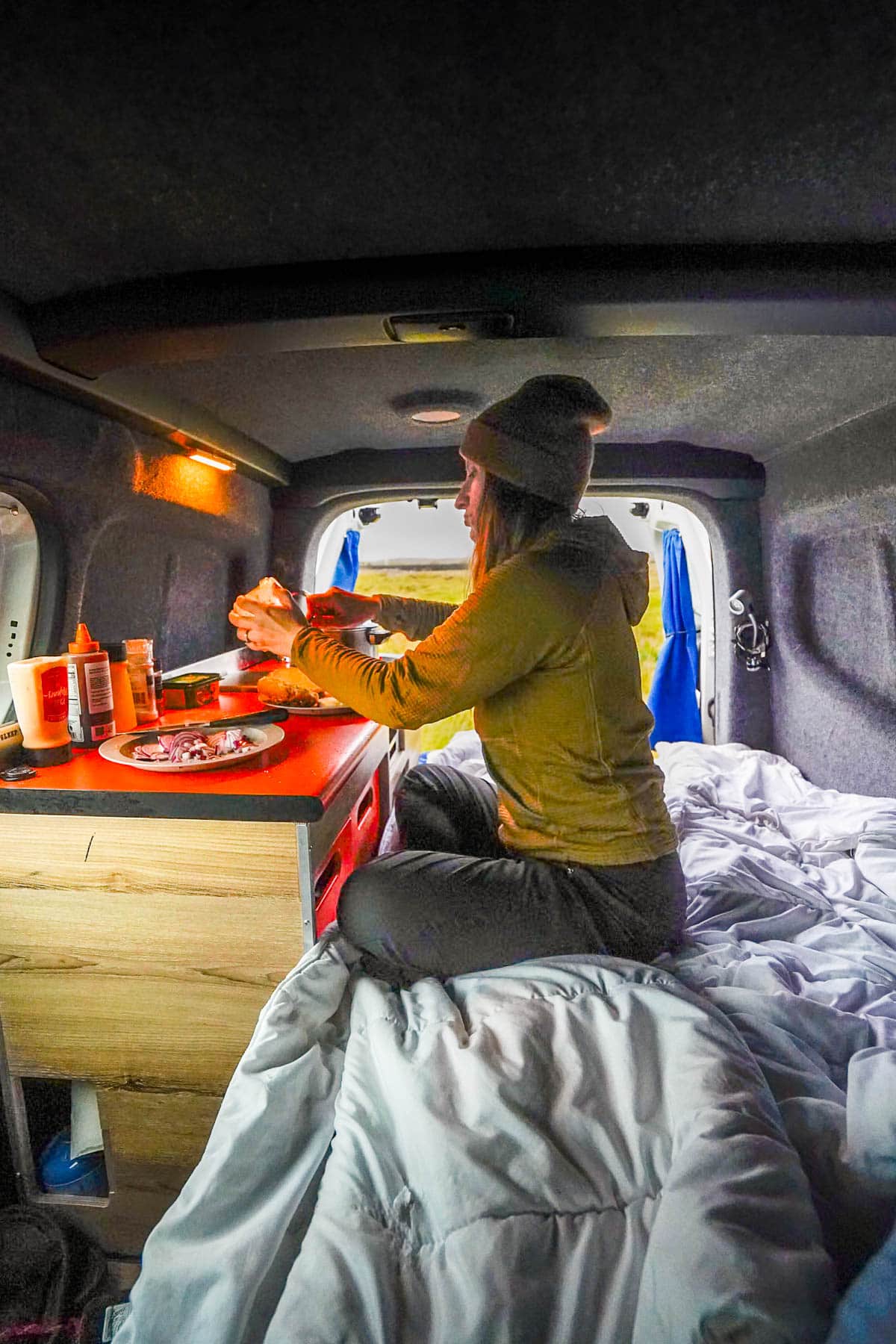
We even scored a discount for our awesome readers—for 5% off Happy Campers, just use the discount code “JUSTINANDJESS”.
It’s also worth pointing out that campervans don’t have all of the creature comforts that you’ll get in a hotel. All campgrounds in Iceland will have bathrooms with running water and most have showers with hot water, but you obviously won’t have a private bathroom at night.
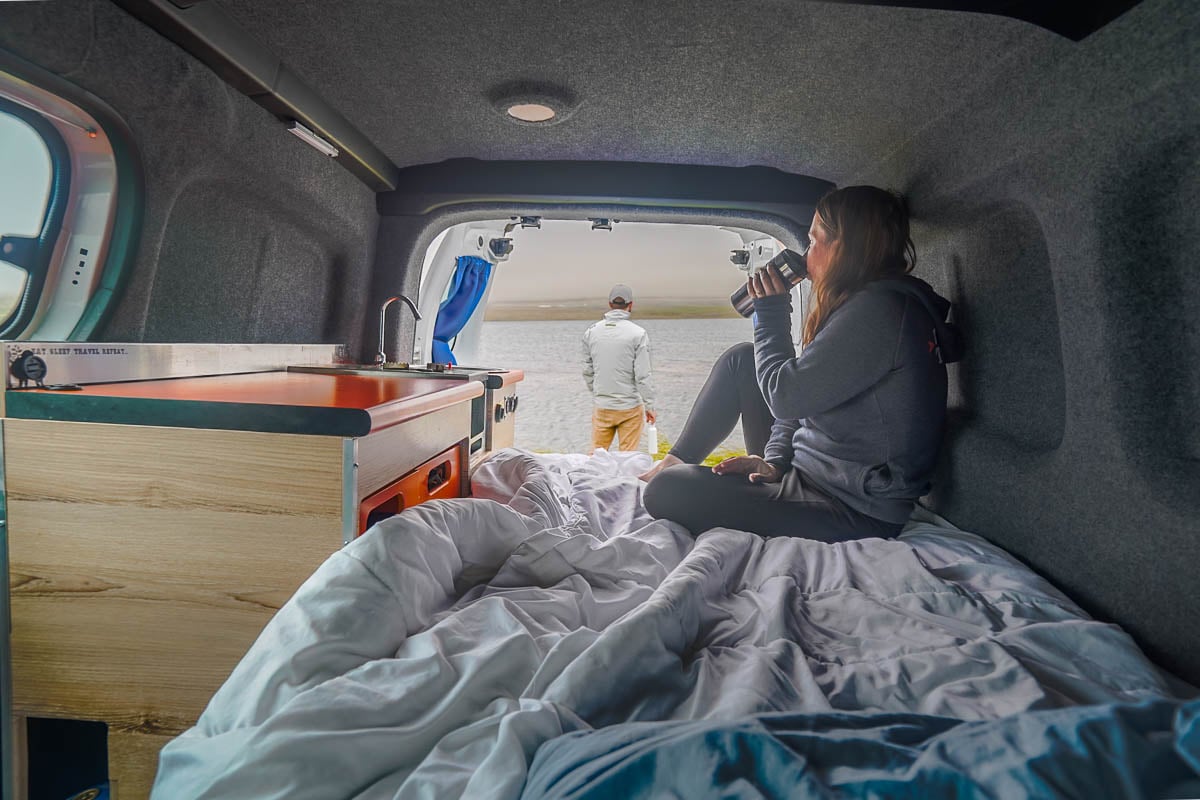
If you want to go the campervan route (good choice!), we’ll also recommend a campground to stay at for each night of the itinerary below.
Rental car and staying in a tent at campgrounds
If you’re on a budget, the cheapest way to road trip around Iceland is to rent a car and bring along a tent to use at campgrounds. We’ve used this one for years for everything from car camping to backpacking trips and love it—just be sure to get a footprint, too, which keeps the tent drier in the rain!
The biggest benefit of this route is the cost savings—there’s really no cheaper way to roadtrip around Iceland!
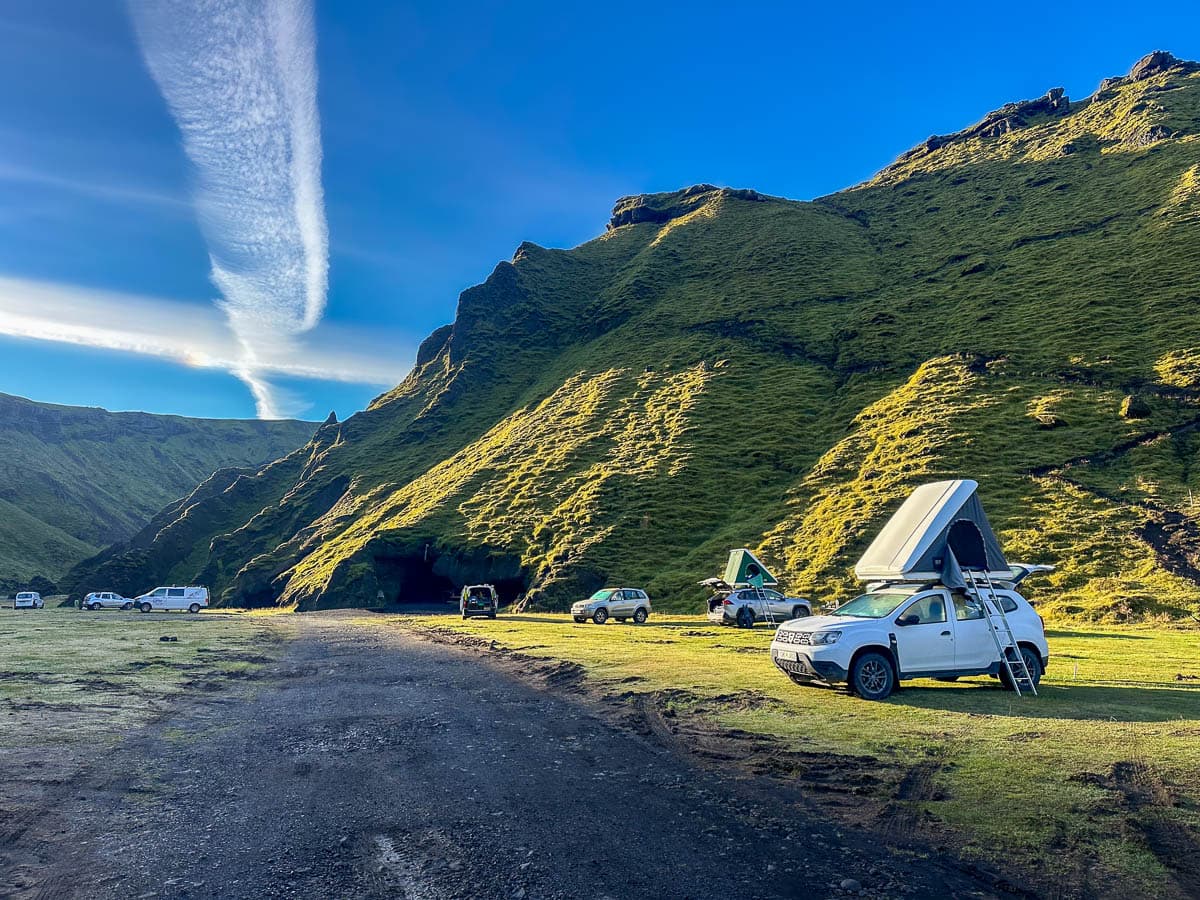
As for the drawbacks, sleeping in a tent in Iceland will definitely not be the most comfortable experience, especially given the unpredictable weather, which is frequently rainy, windy, and cold. I’m not sure how often you’ve packed up a sopping wet tent in the rain, after a night of not so great sleep. As someone who has done this on occasion, I can confirm this isn’t exactly how I’d want to spend my vacation.
You’ll also have limited options of where you cook, hang out at night, charge your electronics, etc.—definitely no creature comforts if you go this route! Plus, you’ll have to bring, rent, or buy all of the gear you’ll need, like pillows, sleeping bags, pots, fuel canisters, and lighters, to name a few.
7 day Iceland road trip itinerary
This Iceland road trip itinerary is intended for travelers that are keen for action-packed days and who are visiting during the summer months, when the days are super long and most attractions are open.

If you’re visiting during the winter season, the days are MUCH shorter, with as little as four hours of daylight. Accordingly, you would need a LOT more time in Iceland to see all of the sites highlighted in this roadtrip itinerary and have an open mindset, given that some of the attractions may be closed or inaccessible in the wintertime.
With that, let’s get into it!
Day 1: Pick up your transportation and explore the Snæfellsnes Peninsula
- Drive time: Three and a half hours
- Distance: 266 km (165 miles)
Land at Keflavik and pick up your rental vehicle
Whether you’re picking up a campervan or a rental car, your rental agency should have a shuttle service from Keflavik International Airport that you may need to arrange ahead of time (just be sure to check with the agency).
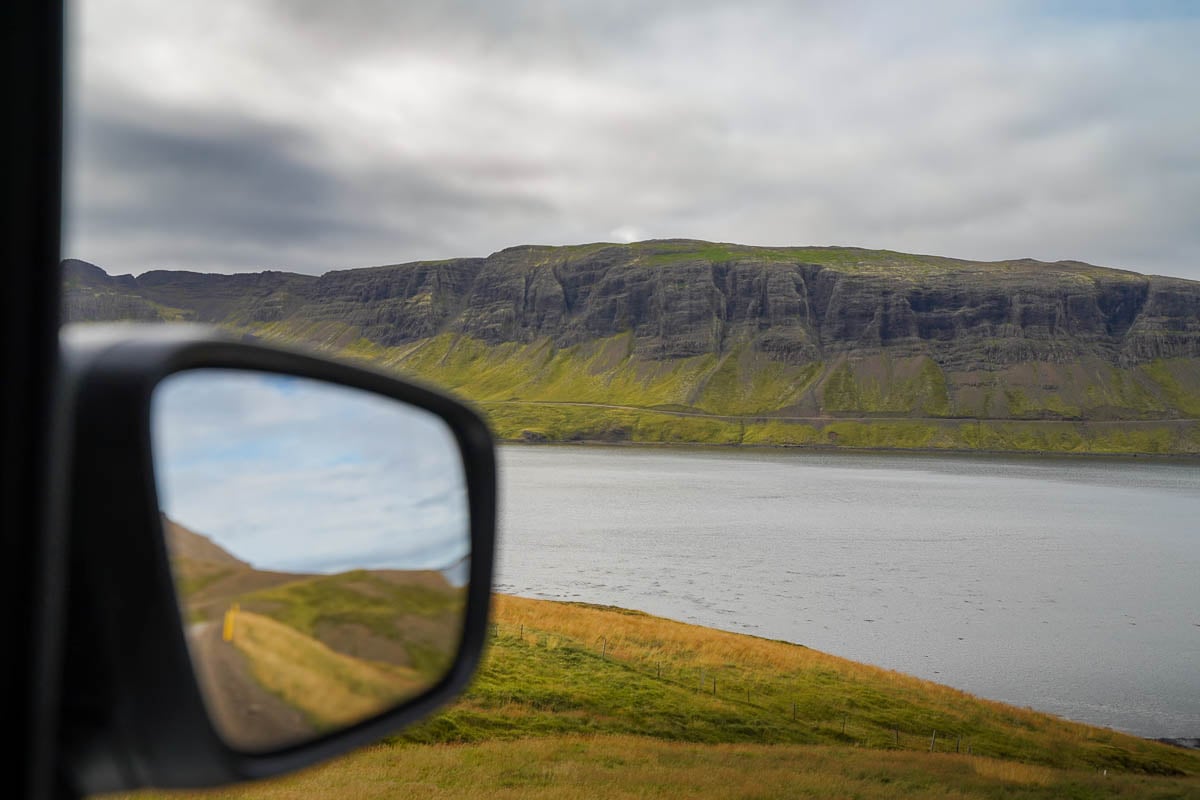
So pick up your set of wheels for the next week and let’s hit the road!
Pick up groceries
If you’re campervanning or using a tent around Iceland, I’d suggest stopping en route at a Bonus grocery store, which is a chain that is known for having decent quality food at the cheapest prices in the country. This Bonus location, in the town of Hafnarfjörður, should be along your route.
Kirkufjell
Head to Kirkufjell, located on the Snæfellsnes Peninsula. Kirkufjell is said to be the most photographed mountain in Iceland, thanks to its unique, triangular shape. There’s a lot of local lore surrounding Kirkufjell, including that mystical creatures, like elves and trolls, used the mountain as a gathering place.
Many travelers head to Kirkjufellsfoss, a waterfall with several streams, with Kirkufjell sitting in the background. It’s absolutely beautiful, but, as of fall 2025, the bridge leading to the iconic viewpoint was actually closed for renovations—plus, given the parking here is quite steep (it was around $12 USD when we visited), I personally think it’s okay to skip this particular viewpoint.
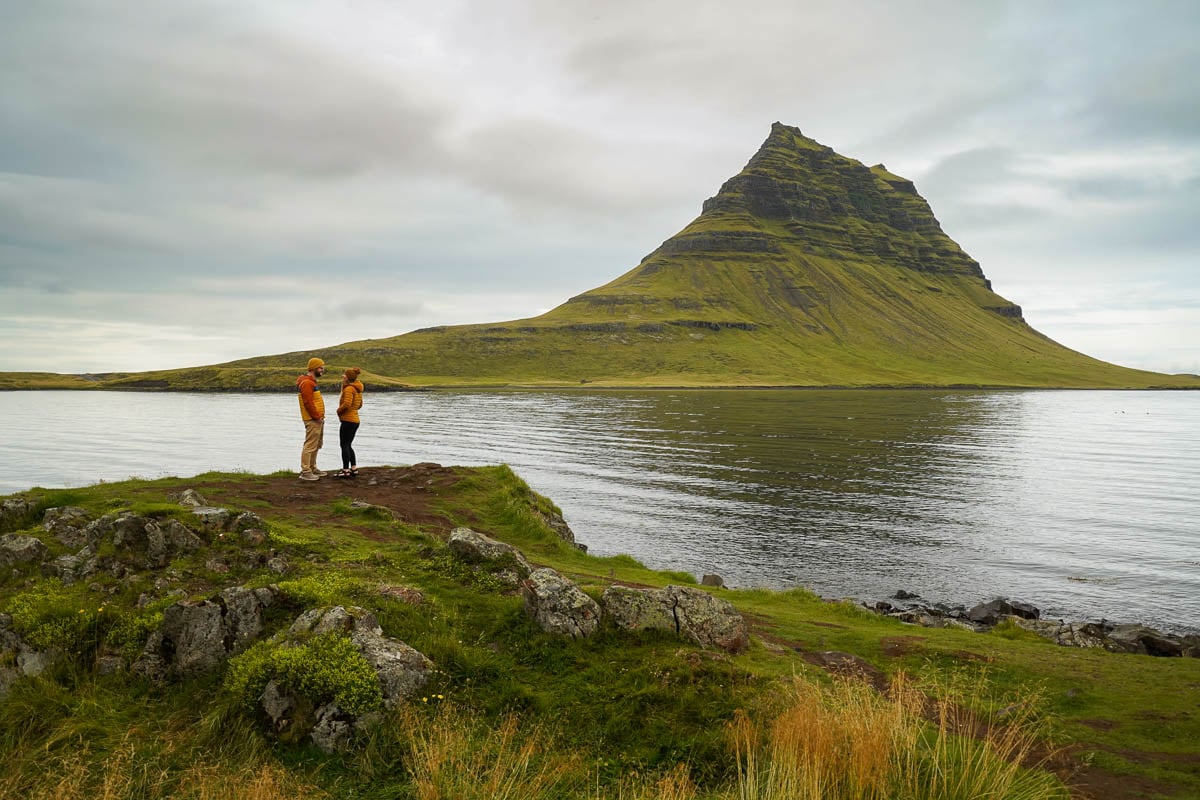
There are thankfully several other viewpoints of the mountain that you can enjoy for free, like this option, this option, or this option.
Insider tip: In the past few years, most tourist attractions around Iceland have started charging for parking. Fees generally range from 750 to over 1000 ISK per vehicle and can usually be paid through the Parka app, which I’d recommend downloading before you hit the road.

As a one-off expense, these fees aren’t too bad, but, given you can stop at four or more places per day, they can really add up over the course of your road trip! So be sure to account for these when budgeting for your trip.
Head to Arnarstapi for a coastal hike
To be honest, I think Kirkufjell is a wee bit overhyped, but the surrounding area of the Snæfellsnes Peninsula is absolutely GORGEOUS, with glaciers, volcanic fields, and cliffside waterfalls, and remains relatively under the mass-tourism radar.

So drive southward in the peninsula towards the tiny fishing village of Arnarstapi to close your day out with a coastal hike. Alongside the craggy cliffs here, you’ll find a walking path that weaves through the mossy volcanic fields and rocky outcroppings that leads for about a mile (1.6 km) one-way to the nearby town of Hellnar. The views here are SO stunning—this is definitely one of the best bang for your buck hikes in Iceland!
If you’re hungry, consider stopping in Hellnar at the Fjöruhúsið Café for dinner, which has incredible soup and homemade bread and an awesome patio for you to enjoy the sun setting over the Atlantic Ocean crashing against the volcanic cliffs.
Where to stay the night
If you’re camping in a tent or an RV, I’d suggest staying in the Arnarstapi Campground, which has nice, clean bathrooms and stellar views of Mount Stapafell, towering above.

If you’re staying in more formal accommodations during your Iceland road trip, head to Arnarstapi Hotel, which is just a few steps from the coastline. The rooms here are clean and spacious and have thoughtful amenities, like a small refrigerator and drying rack, if you happen to encounter any rainy weather today (which, knowing Iceland, is definitely a distinct possibility!).
Day 2: Waterfalls, hot springs, and hiking
- Drive time: 4 hours and 40 minutes
- Distance: 333 km (207 miles)
Hike to Glymur Waterfall
Make the two hour drive back to the mainland to the trailhead for Glymur waterfall, otherwise known as the second tallest waterfall in the country!
If you’re looking for a place to stop along the way for breakfast, we stopped in Geirabakarí Kaffihús for some ástarpungar (Icelandic fried balls of lemon-y dough) and had a lovely time chowing down while taking in views of the nearby fjord, Borgarfjörður.
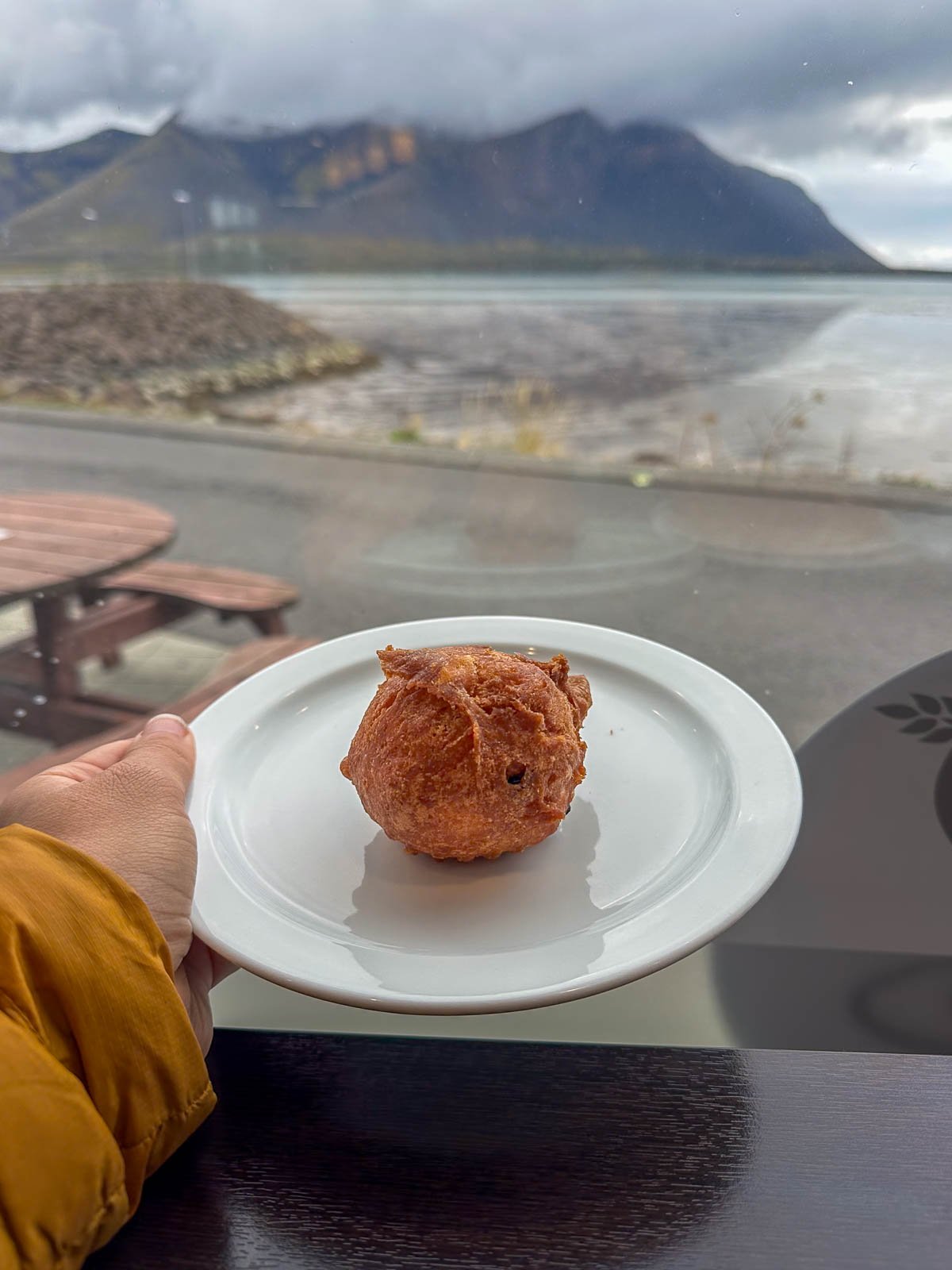
Once you’ve fueled up with fried dough, the hike up to the waterfall is on the steep side, but the payoff is worth it, with hundreds of Arctic birds swooping through an impossibly lush canyon and a towering waterfall cascading down a cliffside.
If you want to hike the full loop trail, it’s 4.4 miles (7 km) roundtrip and includes two stream crossings, one of which has a log that you can use to cross over the water, from June through October, and one that does not. Accordingly, I’d recommend bringing a second pair of shoes, like hiking sandals (I have this pair and Justin uses these ones), to walk through the second water crossing (as you might imagine, the water is freezing here!).
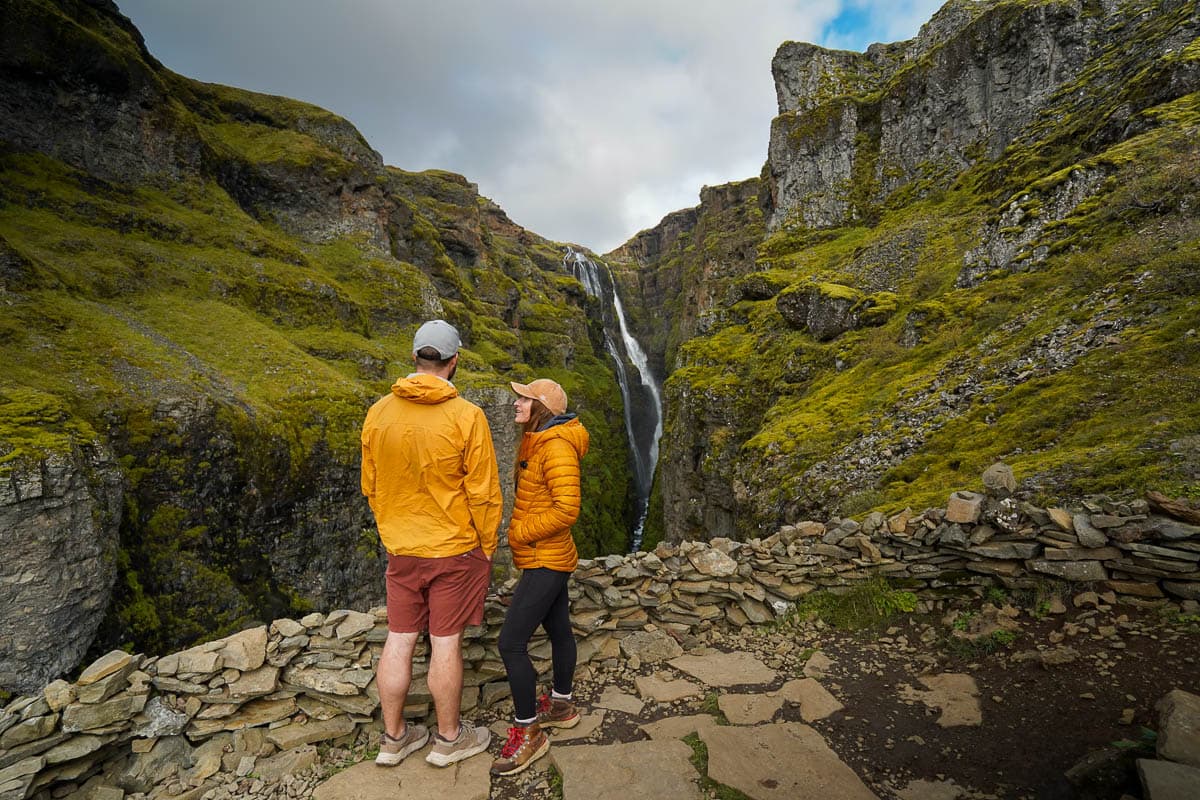
Otherwise, you can simply hike the trail as an out-and-back hike after you reach the viewpoint for the waterfall, which cuts the total mileage down to about 3 miles (4.8 km).
Soak in Hvammsvík Hot Springs
Just 20 minutes west of Glymur is Hvammsvík Hot Springs, a commercialized hot spring that has done a really good job of balancing making its pools more clean and comfortable while retaining its natural beauty.
The property has eight natural hot springs, each of which offer GORGEOUS views of the surrounding green mountains and the nearby Hvalfjörður (which translates to “Whale Fjord”). There’s a small black sand beach in the middle of the pools, where you can opt to do a cold plunge into Hvalfjörður (I did it a couple of times and can confirm—the water is FROSTY!). Between the black sand beach and the surrounding views of the fjord, Hvammsvik seriously has to be one of the most beautiful hot springs in Iceland!
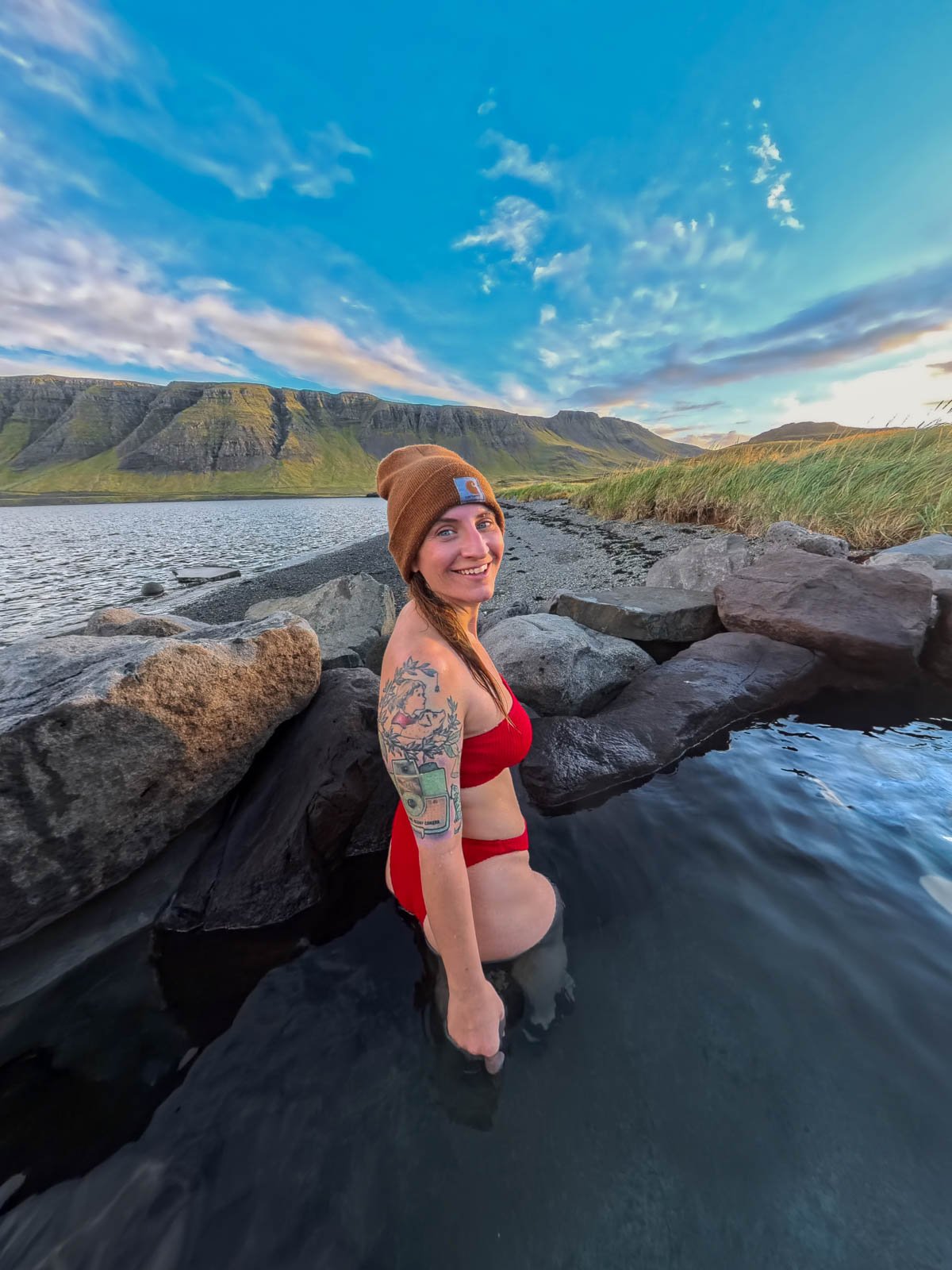
We REALLY enjoyed our time at Hvammsvik. There’s a swim-up bar, a cute bistro with soups and sandwiches if you’re hungry, and a ton of different pools, with varying temperatures to choose from. Just be prepared for some sticker shock here—it cost us about $80 USD per person for the cheapest package.
If that’s not in your budget, not to worry—we’re actually going to be headed to a (mostly) free hot spring next!
Hike to Reyjkadalur Hot Springs
After a few hours soaking in Hvammsvik, hop back in the car and head an hour and 15 minutes south to the trailhead for Reyjkadalur Hot Springs, a thermal river surrounded by lush green hills. There’s a parking fee at the trailhead (1000 ISK), but, otherwise, you can enjoy these hot springs for free!
The hike is about 5.6 miles (9 km) roundtrip, with some steep sections, but I promise it’s worth it! Along the way, you’ll pass hot pots, spewing steam; massive waterfalls; and a hearty number of weathered Icelandic sheep.

At the endpoint, you’ll find a wooden boardwalk, lining the tiered walls of the thermal river. Walk along the boardwalk, find a pool that’s the right temperature for you, and soak in the steamy warm water to your heart’s content.
Get pizza at a geothermal brewery
Every time we go to Iceland, we make it a point to stop in Ölverk Pizza & Brewery, which offers wood-fired pizzas with unique toppings (try the dulse or seaweed—it’ll change your life!) and beer that’s brewed with geothermal power. Definitely a fun and delicious way to end the day!

Where to stay the night
You’re going to want a bright and early start for tomorrow’s activity, so I’d suggest making the drive up to Thingvellir National Park, where we’ll be kicking things off tomorrow.
If you’re camping, consider a stay at Camping Thingvellir, which is on the more affordable side, offers free hot showers and heated bathrooms, and is just a 10 minute drive from the national park. Plus, we got to see the Northern Lights here!
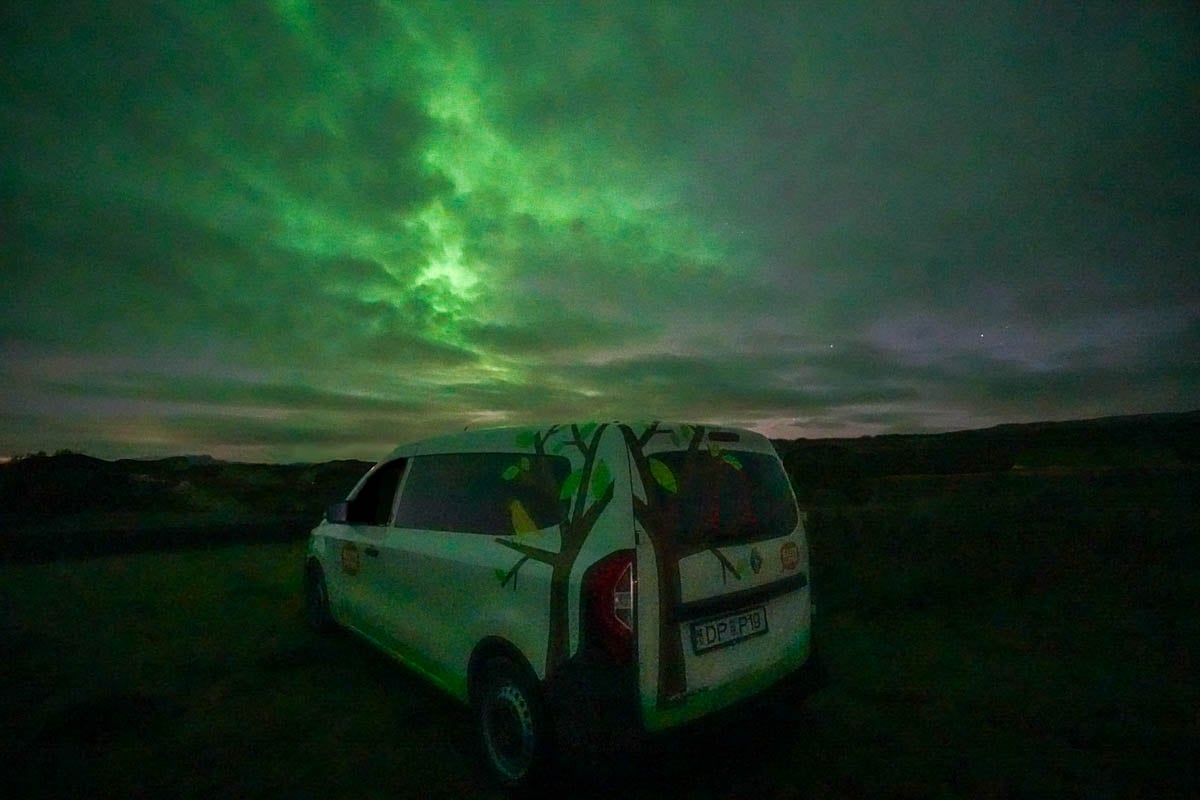
Alternatively, Hotel Grimsborgir has spacious rooms, an excellent complimentary breakfast, and two outdoor hot tubs that are perfect for enjoying if you’re visiting during Northern Lights season!
Day 3: Golden Circle
- Drive time: A little over three hours
- Distance: 200 km (124 miles)
If you’ve done any research into visiting Iceland, you’ve probably stumbled across the “Golden Circle”, which are three of the most popular stops in Iceland, especially with daytrippers from Reykjavik:
- Thingvellir National Park, which is known for its unique geological and cultural history;
- Geysir, which is known for its active geothermal features; and
- Gullfoss, one of the most powerful waterfalls in the country.
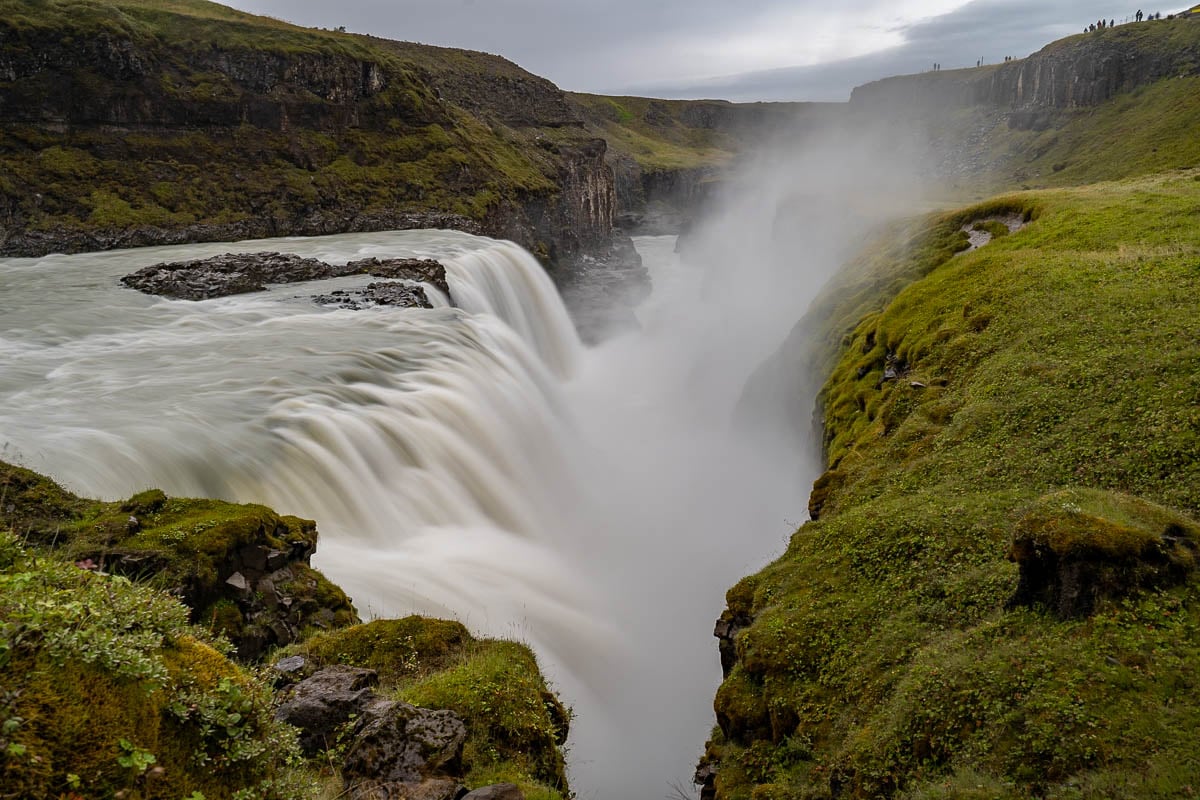
Beyond these sites alone, this area has SO much to do and see, from electric blue waterfalls and Icelandic horses to delicious foods, and is well worth a day of your Iceland road trip itinerary!
Snorkeling at Silfra in Thingvellir National Park
First up in the Golden Circle—Thingvellir National Park. The national park is remarkable, due to its unique location between the North American and Eurasian tectonic plates and the fact that it was used as a meeting place for Alþing, the very first national parliament on the planet, founded by Viking settlers.

There are some neat trails and overlooks in the park, but I’d suggest doing one of the most unique activities in Iceland—snorkeling in Silfra, a fissure formed by the two tectonic plates pulling apart.
Silfra is a crack between the two tectonic plates that’s filled with glacial runoff that’s been filtering through the volcanic bedrock for up to 100 years. Accordingly, it’s some of the clearest and purest in the world, allowing you uninhibited views of the underwater basalt formations, technicolor algae, and brilliant turquoise water.
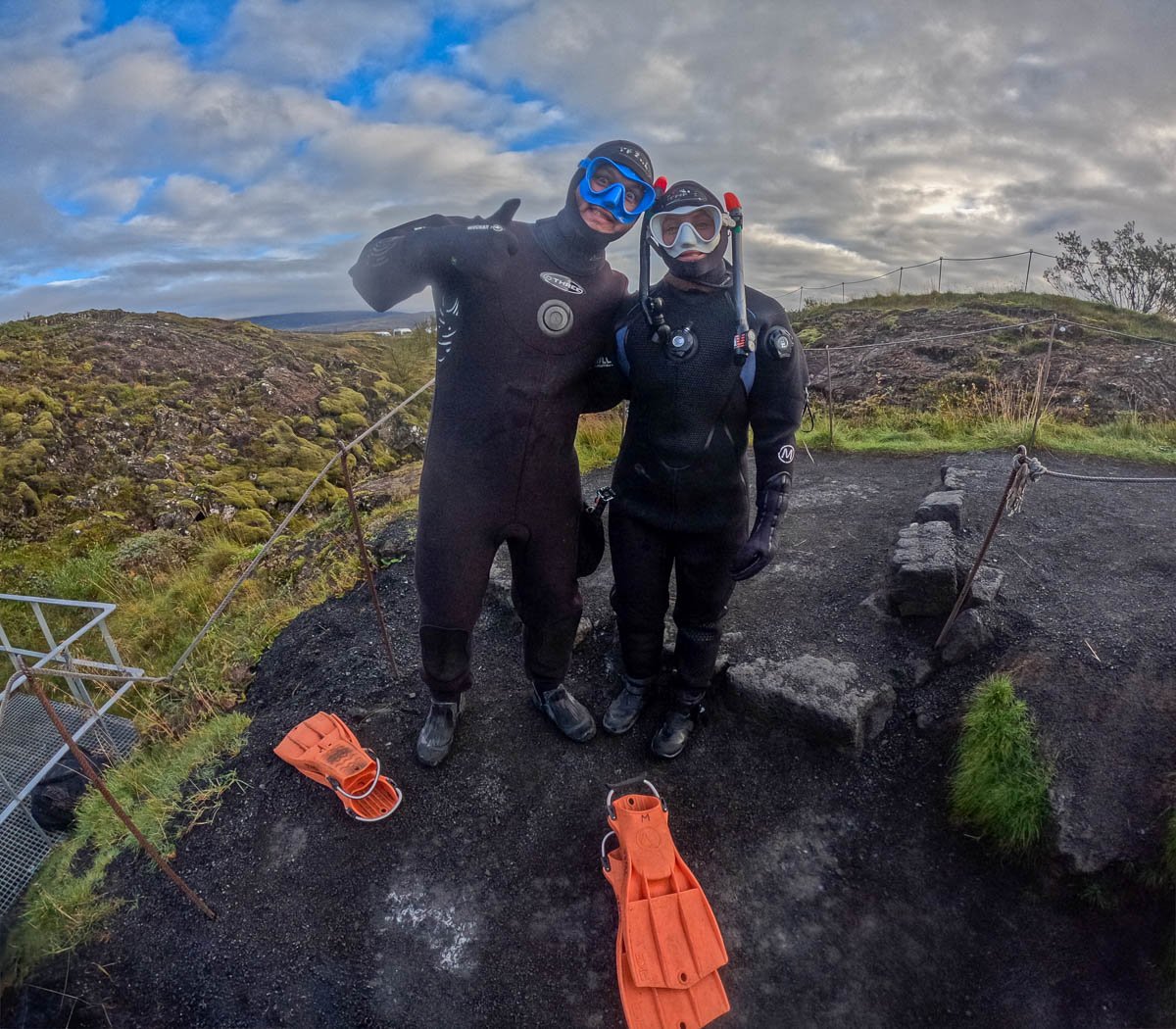
In order to snorkel here, you’ll need to go with a tour, who will outfit you with a drysuit and all your snorkeling gear.
We went with this tour and, while we were initially a bit nervous, it was actually a breeze to snorkel here. The drysuit makes you extremely buoyant (and, indeed, keeps most of you nice and dry!) and the glacial runoff is constantly filtering through the nearby volcanic rocks, creating a kind of lazy river that you just get to float down. It was SUCH a fun experience, getting a glimpse underwater at this otherworldly place—plus, how often do you get to snorkel between two tectonic plates?!

Insider tip: I HIGHLY recommend booking the earliest tour here that you can, which is typically around 8:30 AM. There are a lot of tour groups here and, if you don’t go with one of the earlier options, you’ll wind up sitting around in your drysuit, which can feel a bit uncomfortable, for long periods of time, waiting for your turn.
Get geothermally baked rye bread from Laugarvatn Fontana
I’d suggest holding off to get breakfast until you get to Laugarvatn, a lake with geothermal hot springs along its shores.
There is a geothermal hot spring here that you can relax in, if you want, but I’d suggest partaking in something a bit more delicious—rye bread!
Rye bread is an important part of Icelandic cuisine, given that the grain is uniquely well-suited to grow in the country’s cold and wet climate and the fact that it can be baked underground using geothermal heat. This technique, which dates back over 300 years, involves placing the dough in a metal pot and burying it underground, surrounded by water heated by geothermal energy. After about a day, you can dig up the pot and you’ll have delicious rye bread, just waiting for you to slather butter on it.

You can try some of this geothermally baked rye bread on this tour, where you’ll get to learn all about geothermal baking, dig a hole in the ground to start baking a new loaf of bread, and, of course, get to try a hearty amount of rye bread for yourself that’s been baking underground for a day.
The rye bread at Laugarvatn Fontana is SO good—moist, dense, and sweet. It seriously almost tastes like a dessert!
Stop at Brúarfoss
Brúarfoss is often called the bluest waterfall in Iceland—and for good reason! The waterfall has a spectacular turquoise color, given the fact that it’s fed by glacial melt from the nearby Langjokull Glacier. It’s one of the most unique waterfalls we encountered in Iceland and is easily one of our favorites in the country.

You can either hike an easy 4.2 mile (6.8 km) trail or just park in a lot for 750 ISK and walk just a hundred meters or so to the waterfall. Since this day is so action-packed, I’d suggest doing the latter.
Watch geysers erupt
Drive about 20 minutes down the road to Haukadalur Geothermal Area, more commonly referred to simply as “Geysir”. There’s a 1000 ISK parking fee here.
The Great Geysir is one of the most famous geothermal features on the planet and is actually where the English word “geyser” comes from, meaning “to gush”. It’s actually not very active anymore, but there’s still plenty of geothermal action you can enjoy here.

Most tourists congregate around Stokkur, a geyser which spews steaming hot water up to 40 meters, about every 10 minutes or so. There is a wooden boardwalk and some other trails nearby, that wind past dozens of other bubbling hot pots and smaller geothermal features.
Feed Icelandic horses
One of our favorite stops—and, surely, a hit with any kiddos—is just a short drive down the road at Bru Horsefarm. Here, there’s a little self-serve kiosk where you pay 500 ISK (via a QR code) to get two small cups of “candy”, which you can then feed to the horses that are patiently waiting nearby.

While you’ll drive through tons of farmland with horses grazing on it during your Iceland road trip, it’s actually quite hard to get up close and personal with any of these beautiful creatures. So this is a great opportunity to get a little Icelandic equine therapy in!
Gullfoss
Gullfoss is a dramatic two-tiered waterfall that’s one of the most powerful waterfalls in the country AND one of the largest by volume in all of Europe.

While the waterfall is beautiful, one of my favorite things about it is the plethora of educational signage about Sigríður Tómasdóttir, who is recognized as Iceland’s first environmentalist. In the early 20th century, she fought to protect Gullfoss, which would’ve been destroyed by a nearby hydroelectric dam. Ultimately, her work resulted in Gullfoss being named a national nature reserve to permanently protect it, making it a free site for visitors from around the world to marvel at.
Enjoy all things tomatoes at Friðheimar
If you’re hungry, this might be a good time to stop at Friðheimar, which is arguably the most famous restaurant in the country. The restaurant has become a culinary icon for its use of greenhouses to grow tomatoes, which are used in an array of dishes, from its hearty tomato soup to more offbeat offerings, like a shot of Icelandic birch schnapps served out of a hollowed out tomato.

The main restaurant is housed in one of the greenhouses, with plump tomatoes festooning seemingly every surface. It has limited hours, though—11:30 AM to 4 PM daily—and limited seating, so be sure to book a reservation ahead of time.
Alternatively, if you want a bit more flexibility, there’s an onsite bistro and wine bar in one of the oldest greenhouses on the property that offers much of the same tomato-y goodness, but longer opening hours and usually more availability.

This restaurant is definitely on the pricier side—expect to pay around $28 USD for a tomato soup and homemade bread buffet. While I think it’s one of the most memorable dining experiences in Iceland, feel free to skip it if you’re on a tighter budget.
Hrunalaug Hot Spring
Spend a couple of hours of the late afternoon soaking in Hrunalaug, a rustic hot spring with three small pools carved into rolling green hillsides. Between the moss-covered rocks that line the pools’ edges and the Icelandic turf house on the property, it feels like you’re soaking in toasty warm water in the Shire!

Up until recently, Hrunalaug used to largely fly under the radar and was relatively affordable, with visitors paying a modest entrance fee into an honesty box. But, with a recent surge in tourism, Hrunalaug is now gated, with an entrance fee of 3000 ISK. The pools are on the smaller side, so you may have to wait a bit to get in them—visitors are limited to spending an hour and a half in the pools, due to their size constraints.
Watch sunset at Seljalandsfoss
Drive a little over an hour south to Seljalandsfoss (1000 ISK per vehicle parking fee), one of the tallest and most famous waterfalls in Iceland.

It has a wide cavern that’s been carved behind its curtain, by millenia of erosion, that you can actually walk behind. Just to include waterproof outer layer on your Iceland packing list and throw them on while you’re here, as you’ll get absolutely SOAKED. I used this raincoat while in Iceland, while Justin used this one, and I have these rainpants, while Justin uses these.
It’s gorgeous at any hour, but if you can time your visit at sunset, DO IT! The cavern behind the waterfall faces west, so you get the most spectacular display of the sun, sinking beneath the green fields of Iceland while the sky explodes into punchy colors. Justin and I have watched sunsets all over the world and the one at Seljalandsfoss is easily one of the best ones we’ve ever seen!
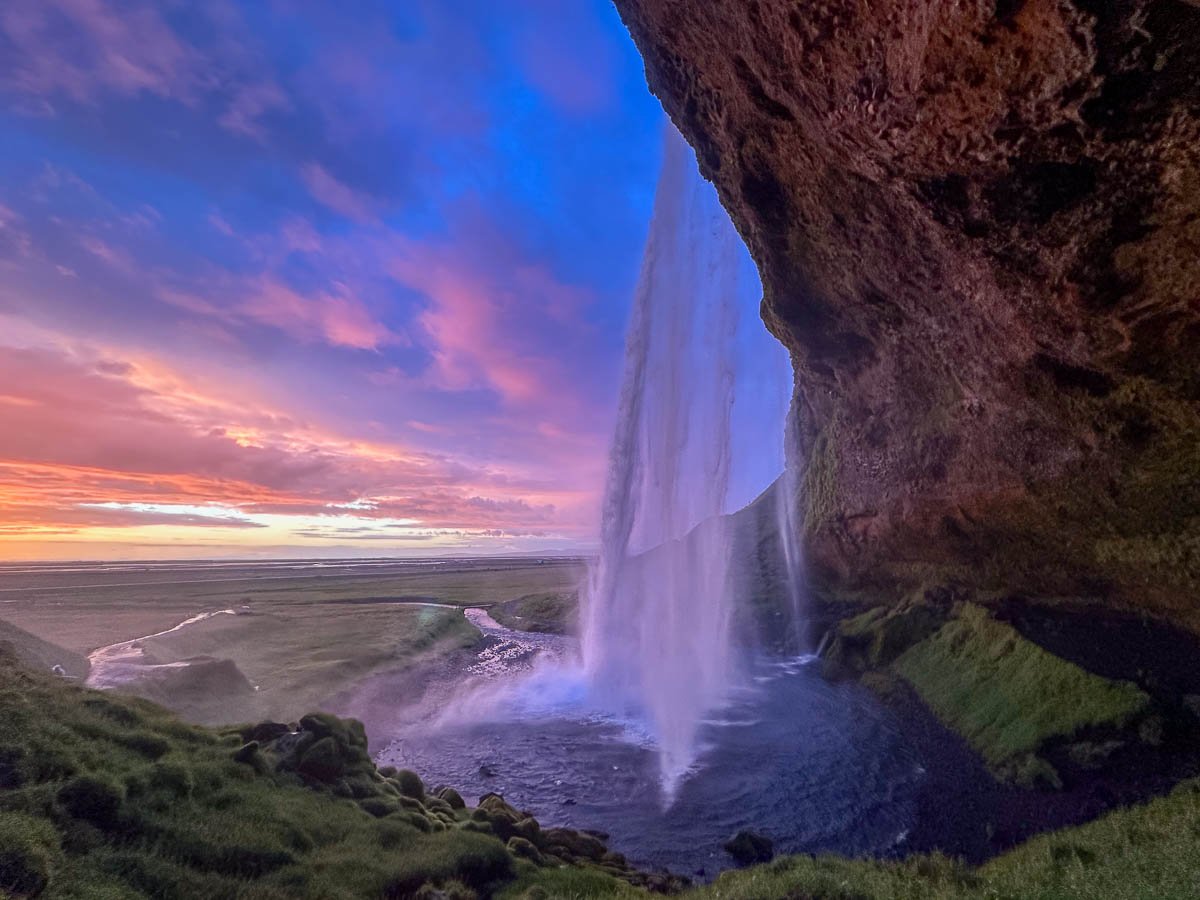
If you have extra time, be sure to pop in Gljúfrabúi, a waterfall, tucked inside a towering lush canyon, that’s accessible via a short walking path down from Seljalandsfoss.
Where to stay at night
If you’re camping, drive east to the Skogar Campground. To be honest, it has very little amenities (e.g., not very clean bathrooms and showers that only accept Icelandic coins), but it does have one MAJOR draw—it’s at the base of Skogafoss, one of the other most famous waterfalls in Iceland!
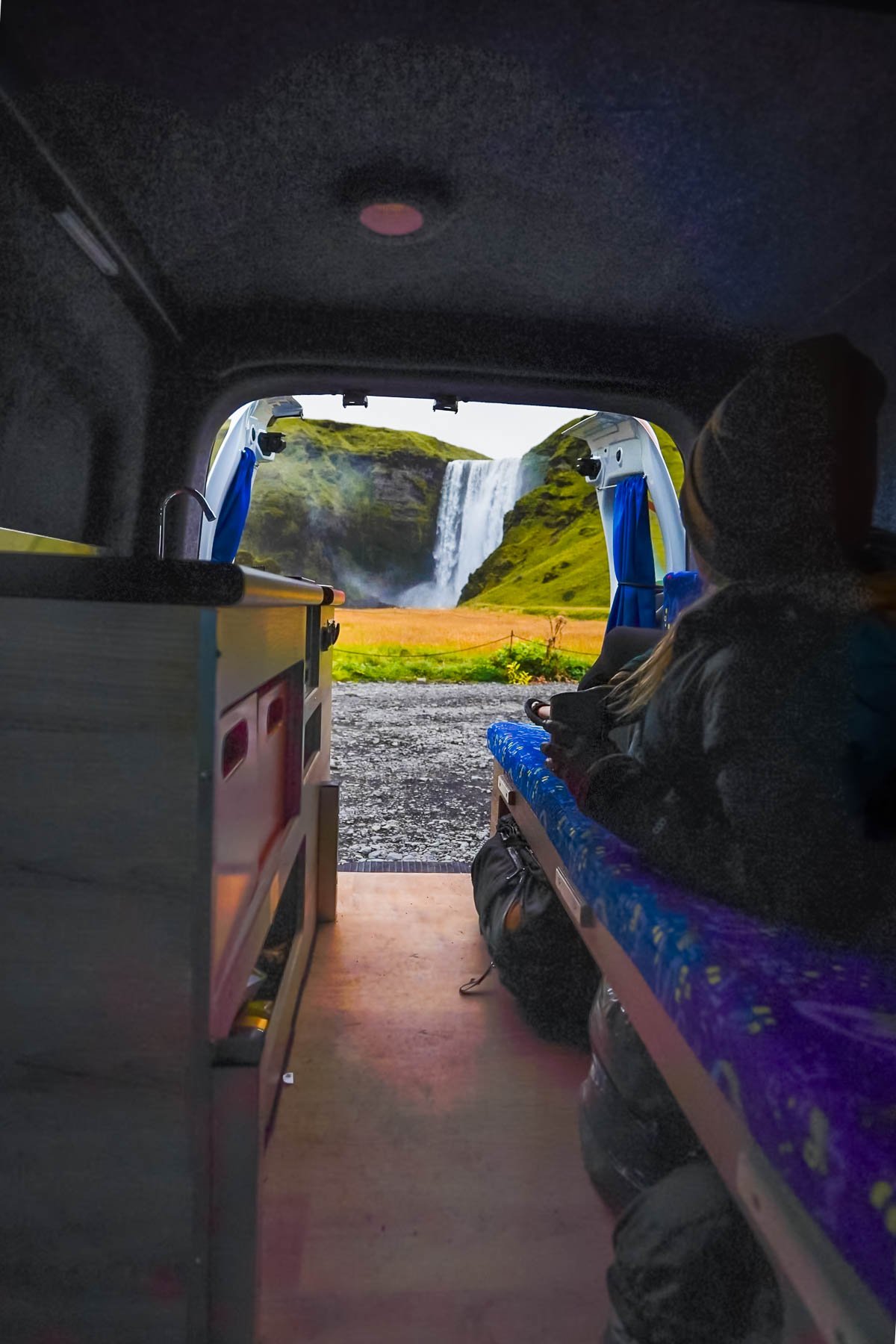
Despite Skogar’s shortcomings, we actually wound up staying here twice during our recent Iceland road trip, thanks to its central location along the country’s southwestern coastline and the fact that you get to wake up to one of the most spectacular waterfalls on the planet in your backyard.
Alternatively, Hotel Skogafoss is an excellent option, just steps away from Skogafoss and with nice features, like a complimentary breakfast (which can be boxed up if you want to leave early!), an onsite bar, and spacious rooms.
Day 4: More waterfalls and a derelict plane
- Drive time: 1 hour
- Driving distance: 29 miles (47 km)
The last few days have been action-packed, so today is going to be just a wee slower.
Explore Skogafoss
Skogafoss is one of the tallest and widest waterfalls in Iceland, clocking in at 25 meters wide. The landscape leading up to the waterfall is totally flat, so you can walk up pretty close to its curtain (although be prepared to get SOAKED!) and, when the sun comes out, you’ll be treated to a rainbow emerging from its mist.
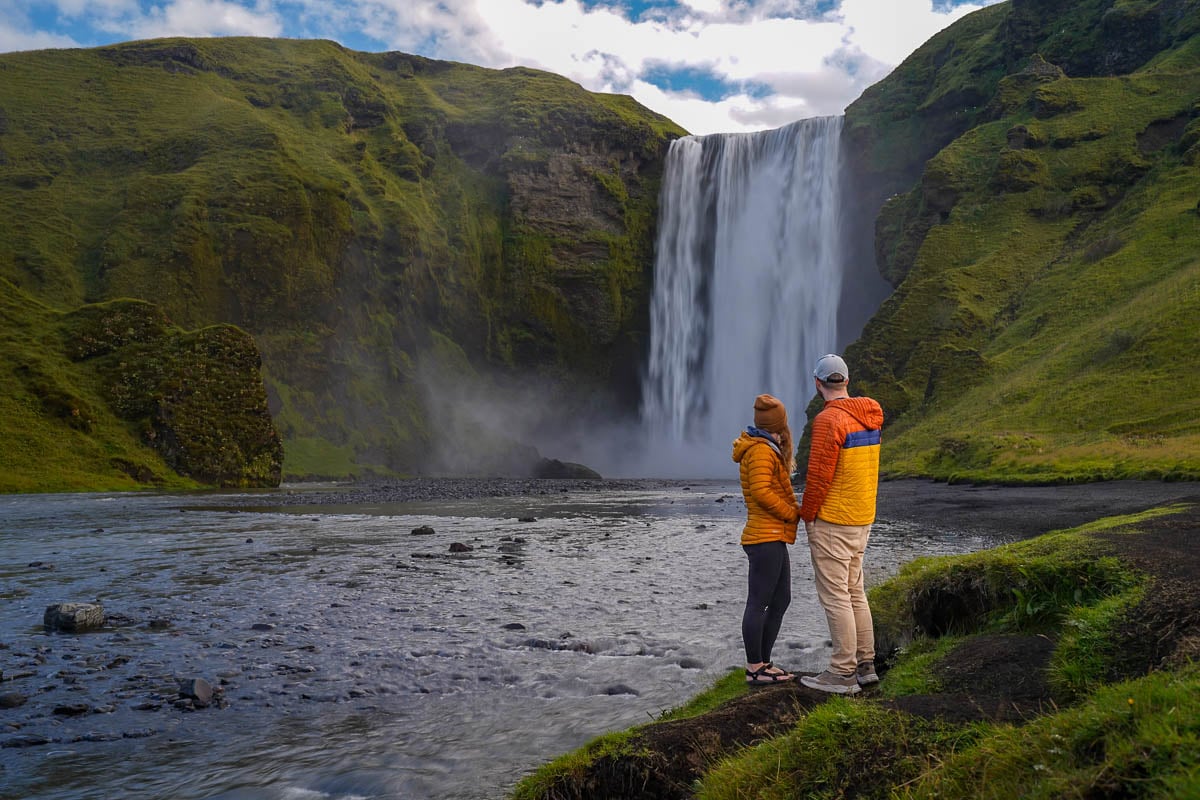
You can simply admire Skogafoss from its base or, to get your blood pumping, you can climb up the surrounding green hill to an observation platform, overlooking its brink. For something even more adventurous, you can actually follow the pathway here back along the Skógá River for up to 8 km (5 miles), where you’ll pass countless waterfalls, canyons, and the Solheimajokull glacier, off in the distance.
Hike behind Kvernufoss
Directly to the east of Skogafoss, you’ll find Kvernufoss, a 30 meter high waterfall that’s tucked into a volcanic gorge. Like Seljalandsfoss, there’s a short loop trail that you can take that actually leads into a cavern behind Kvernufoss’s curtain—just remember to bring along your waterproof layers!

Even though Kvernufoss is less than two kilometers away from Skogafoss, one of Iceland’s most popular waterfalls, it somehow flies under the mass tourism radar. So, depending on how early you get here, you might actually have a decent chance of getting the waterfall largely to yourself!
Get a cinnamon roll at Faxi bakery
If you’ve worked up an appetite, make the short drive over to Faxi Bakery. They produce a ton of homemade delicious pastries every day, but be sure to give their cinnamon rolls a try (we LOVED the pistachio raspberry kind!).

Cinnamon rolls are deeply ingrained in Nordic cultures, including Icelandic, due to the Nordic tradition of fika, a coffee and snack break that’s taken with friends. So you basically HAVE to try a cinnamon roll—y’know, for the cultural experience (wink, wink).
Soak in the Seljavallalaug Swimming Pool
Built in 1923, Seljavallalaug is believed to be the oldest swimming pool in Iceland. The man-made concrete pool is tucked away, deep into a bowl of lush green mountains, with seemingly endless waterfalls cascading down their slopes.

To reach Seljavallalaug, you have to hike a little over half a mile from the gravel lot, across lots of uneven and slippery stones. I wore hiking sandals here and really wished I had worn proper hiking boots instead—some of the rocks along the way were really slick!
The water temperature is definitely more akin to a heated swimming pool, as opposed to a hot spring, given there’s just geothermally heated water piped into one corner of a pretty massive pool. And, since it’s enclosed and isn’t replenished with new, clean water, the way that Reyjkadalur is, the water is definitely on the murkier and algae-y side. Still, I really enjoyed our visit to Seljavallalaug and thought it was one of the most stunning places we stopped at along our Iceland road trip.

Just be sure to wear your swimsuit from the trailhead to the pool. There’s three changing rooms in the building behind the pool, but they’ve unfortunately been absolutely destroyed by disrespectful visitors and are, for lack of a better word, disgusting. If you want to help leave Iceland a little better than you found it, consider bringing along some gloves and a garbage bag to haul out some of the nasty junk other visitors have left laying around here!
Hike to the Solheimsandur Plane Wreck
Along a black sand beach along the country’s southern coastline, you’ll find the wreckage of a Douglas C-117D transport aircraft that was once operated by the U.S. Navy. Back in 1973, the plane crashed at this site, due to severe icing conditions, although thankfully all seven of the crew members survived the crash. The rusting fuselage is still left on the beach today and has become something of a beloved landmark—it was even featured in a Justin Bieber music video!

To reach the aircraft, you have to walk a little over two miles (3.2 km) one-way down a flat and dusty road or, alternatively, you can book a shuttle to and from the wreckage site. Either way, along the road, you’ll have beautiful views of the surrounding green mountains and, in the distance, the Solheimjokull glacier.
The airplane itself is super photogenic, with the interesting juxtaposition of the decaying aircraft fuselage and the wild and raw beauty of Iceland, from the rugged black sand beach to the pounding waves of the Atlantic Ocean, off in the distance.
Where to stay at night
There aren’t a ton of camping options in this area, so I’d suggest heading back to the Skogar Campground for the night.

Or, if you’re going the hotel route, I’d suggest staying in Hotel Skogafoss for a second night. At least you’ll have one day of your Iceland road trip where you won’t have to schlep your luggage in and out of your car!
Day 5: Glacier Climbing and Exploring around Vik
- Drive time: 2 hours and 35 minutes
- Driving distance: 106 km (69 miles)
Go on a ice climbing tour of Solheimajokull
About 11% of Iceland’s land mass is covered by glaciers, which are unfortunately shrinking at an unprecedented rate. So be sure to experience this beautiful masses of ancient ice while you can—and what better way than to try your hand at ice climbing?!

The Solheimajokull Glacier is a massive 8 km (5 miles) long glacier that flows from the Myrdalsjokull ice cap. In order to safely hike on—or climb up—this glacier, you should go with a reputable guide, who can provide the necessary safety gear, like a helmet, crampons, ice ax, and harness, and will have the expertise to be able to identify thin ice or other unsafe areas on the glacier.
There are a ton of companies that offer guided tours here, but we took this 4 hour ice climbing and glacier trekking tour with Icelandic Mountain Guides. Even though ice climbing was DEFINITELY a workout, our guides were absolutely fantastic, providing us helpful tips to improve our climbing skills, and even offered to extend the tour and hike around the glacier longer, given how much they love being out here!

If ice climbing sounds a bit too intense, you can alternatively go on a regular ol’ glacier hike, like this small group option by Icelandic Mountain Guides, where you’ll still get to climb up icy slopes, skirt around crevices, and get to see stunning turquoise pools of meltwater on the glacier’s surface.
See puffins at Dyrhólaey
Drive about 25 kilometers east to Dyrhólaey, a nature preserve that’s known for its dramatic rock formations and plentiful seabird inhabitants.
There are two different viewpoints here—a lower viewpoint that overlooks the famous Reynisfjara beach and an upper viewpoint where you can wander around a lighthouse and have stellar views of the nearby iconic arched rock formation (note that this upper viewpoint is closed from mid-May to June to protect the puffins that use this as breeding grounds).

Speaking of puffins, from mid-May through mid-August, Dyrhólaey is one of the best places in Iceland to see these adorable birds here, which are affectionately referred to as the “Clowns of the Sea.” Their nesting areas, near the grassy cliffsides, are roped off to protect the puffins, you can still see them from just a few meters away.
Get coffee at Skool Beans
Head to the cute coastal town of Vik. Since we started visiting Iceland in 2018, Vik has seemingly exploded with a ton of bars and restaurants, but my favorite stop here is definitely Skool Beans, a micro coffee roastery that’s housed in a converted school bus.
I love the vibes in Skool Beans—there’s an adorable wood-burning fireplace and a three legged cat that’s often lurking around. Plus, the drinks here are so creative and unique, like hot chocolate with wasabi or a biscoff cookie latte.

I’m not the only one who loves Skool Beans, though. It’s been visited by the Icelandic president and Brad Pitt himself!
Reynisfjara
Reynisfjara Black Sand Beach is one of the most famous landmarks in Iceland, thanks to its jet black sand, columnar basalt cliffs, mysterious caves, and dramatic sea stacks. It’s a great place to look for sea birds (you can see puffins here too!) and just generally enjoy the stunning views.
It’s worth mentioning that Reynisfjara underwent a major erosion event in February 2026, which swept away a large chunk of the beach and rendered some of its most popular areas (like the rocks pictured below) inaccessible to visitors.
It’s still worth stopping here, but just be aware that the beach now looks a bit different than the photos and videos that you’ve seen of it on social media for years.

And remember to be extremely careful here. Since 2007, at least six people have drowned here, due to the powerful and unpredictable “sneaker” waves that take visitors by surprise and sweep them out to sea.
This definitely isn’t the place to swim or really go anywhere near the water—and, with so much other cool stuff to look at on the beach, there’s really no reason to!
Explore Vik
If you have any extra time, Vik is a good place to stock up on groceries or grab a solid dinner. Black Crust Pizzeria has cool pizza options, including some, as you might imagine, with a black crust or, for a more budget friendly option, The Soup Company offers FREE refills of their hearty soups.

Where to stay for the night
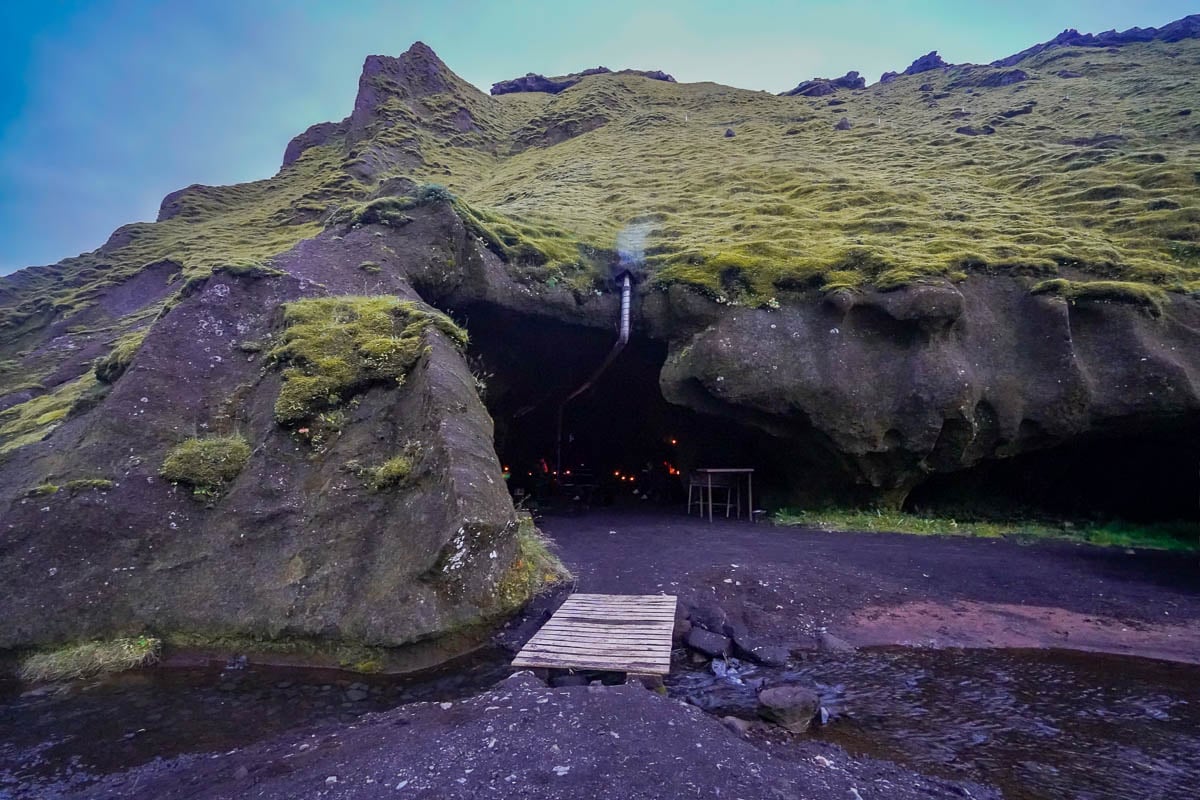
If you are camping, I’d highly recommend heading to the Þakgil Campground, which is as close to the Highlands as you’ll be able to get with most non-4WD rental cars in Iceland. The drive there is absolutely stunning (although it also has plenty of potholes and washboarding, so brace yourself!), passing riverbraids, the enormous Kötlujökull glacier, and towering green mountains.
And the campsite itself is REALLY cool. There’s a neat cave that serves as a kitchen and dining room with a wood-burning fireplace and moody candles at night; a bunch of epic hiking trails that leave from the campground; and hot showers. It was definitely our favorite campsite in Iceland!
If you’re staying in more formal accommodations, Hotel Vík í Mýrdal, conveniently located in Vik, is housed in a modern building that still manages to feel warm and comfortable. They also offer all kinds of nice perks, like in-room coffee makers and complimentary breakfast.
Day 6: Epic canyons and the biggest glacier in Iceland
- Drive time: 3 hours and 30 minutes
- Driving distance: 259 km (161 miles)
Fjaðrárgljúfur Canyon
This canyon has been carved by the Fjaðrá River, leaving behind walls that tower up to 100 meters above the water below. It’s so unique looking, with layers upon layers of rugged, mossy walls—it seriously looks like fairies or trolls should live there!

There’s a short hike that allows you to follow along the canyon and peer under its rim, with the final viewpoint offering a stunning turquoise waterfall. Alternatively, if you need a break from hiking, you can just park here and walk a short distance to its final viewpoint over the waterfall.
Hofskirkja
As you drive along the southern coastline, pull over to snap a quick photo of Hofskirkja, one of only six remaining turf churches that remain in Iceland. Turf buildings were once extremely common in Iceland, to offer natural insulation against the bitter cold of the winters here, but eventually fell out of favor in the 20th century, due to the availability of concrete.

Dating back to 1884, Hofskirkja was the last turf church built in Iceland and is actually still a practicing parish today.
Mulagljufur Canyon
One of the most stunning hikes along the southern coastline of Iceland is along the rim of the Mulagljufur Canyon, where you’ll climb past snow-capped mountains, massive glaciers, and rushing rivers. The hike ends at Hangandifoss, one of the tallest waterfalls in Iceland at 123 meters tall.

Jökulsárlón Glacier Lagoon
Jökulsárlón has a lagoon that’s filled with hunks of ancient ice that have cleaved from the Vatnajökull ice cap, the largest ice cap in all of Europe. The icebergs are stunning hues of blue, ranging from azure to electric turquoise, and look even more spectacular against the backdrop of the nearby Breiðamerkurjökull glacier and surrounding green mountains. This is also a great place to spot seals—we saw tons of them while we were visiting!
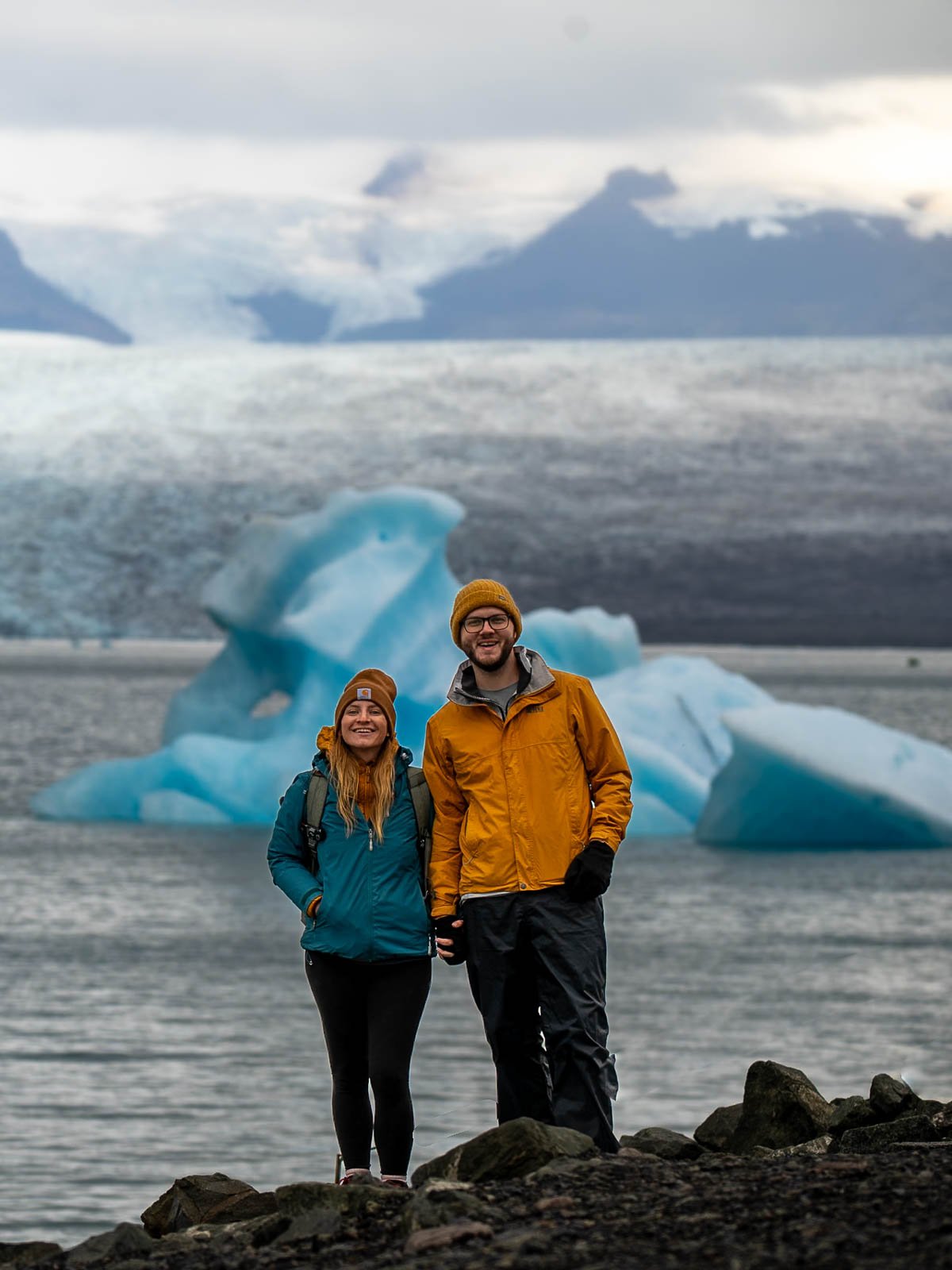
If you have room in your budget, I’d highly recommend joining a kayaking tour, like this option, where you can paddle up close and personal with some of these stunning ice formations and, with any luck, maybe get to see a seal friend from the water!
Diamond Beach
Walk across the street to the Diamond Beach, which is littered with tiny hunks of ice. The icebergs from the glacial lagoon are pushed out to sea and smashed to pieces, eventually washing on this black sand beach’s shoreline. If you can time your visit with sunset, it’s absolutely breathtaking here.

Where to stay the night
If you’re camping, head to the Skaftafell Campground, which has hot showers (for free!), a nice covered cooking area, and spectacular views of the surrounding glaciers.

If you’re staying in hotels, the Fosshotel is an excellent place to relax for the evening, with a sauna and hot tub that offers expansive views of the surrounding landscape; options for rooms that have private hot tubs, balconies, and complimentary breakfast; and wake-up calls for the Northern Lights.
Day 7: Head to Reykjavik and hit the Blue Lagoon
- Drive time: 5 hours and 20 minutes
- Driving distance: 399 km (248 miles)
Reykjavik
Since our trip is sadly coming to an end, it’s time to make the looong (but beautiful!) drive back to Reykjavik.
Iceland’s capital city is a quirky town that has an interesting mix of colorful Scandinavian buildings, coastal beauty, and edgy modern design. It’s totally worth spending a few hours (or more!) to explore here, including:
- Heading to the top of the tower at Hallgrímskirkja, the city’s iconic church that also holds the title to the second tallest building in the country
- Trying some of the city’s best food, like a caramel pecan roll from Braud & Co (this is a MUST!), rye bread ice cream from Cafe Loki, or a bread bowl of hearty soup at Icelandic Street Food (which comes with free waffles!)
- Going on a walking tour, like this option, to learn more about the history and culture of Iceland’s biggest city or a food tour, like this option or this option, to learn about unique Icelandic foods from a local

Blue Lagoon
Drive an hour to the Blue Lagoon, Iceland’s most famous hot spring.
There’s a LOT of chatter on social media about whether the Blue Lagoon is worth it. Yes, it’s expensive and yes, it’s touristy, but I ABSOLUTELY think it’s worth it, with its electric blue water, the craggy volcanic rock formations that surround its pools, and the many perks of visiting here, like a complimentary drink from the swim-up bar and silica mud mask. Justin and I have stopped here during each of our trips to Iceland and plan to keep the tradition alive and thriving on any future trips here!

It’s truly one of the best ways to wind down from a busy and action-packed Iceland road trip over the last week.
Where to stay for the night
From our experience, many of the flights in Iceland take off in the later evening, so perhaps you need to head to the airport tonight.
If not, though, spend your last night camping at the Grindavik Campground, a small, well-maintained campsite with epic views of the surrounding lava fields.

For travelers staying in hotels, the Northern Lights Inn offers beautiful views of the surrounding landscape, a complimentary shuttle to the Blue Lagoon, and a fireplace to relax around during your last night in Iceland.
Or, if you want to end your trip with a bang, you can always stay at the Silica Hotel, which is onsite at the Blue Lagoon, which comes with its own private hot spring, complimentary breakfast, and views of the surrounding volcanic fields.
How to adjust this Iceland road trip itinerary if you have more or less time
This one week itinerary around Iceland allows you to experience some of the most incredible natural beauty Iceland has to offer.
Here are some suggestions, though, if you have more or less time in the country.
If you have more time in Iceland
You have tons of options!
- After Day 6 of the road trip itinerary proposed above, you can drive further east to explore areas along the eastern coastline, like Stokknes, a gorgeous peninsula with black sand beaches, sweeping coastal views, and snow-capped mountains, or Hengifoss, a very striking waterfall with dramatic red rings that are etched into its cliffside that looks straight out of Game of Thrones.
- If you’re adventurous and have room in your budget to rent a 4WD vehicle, you can add on some time in the Highlands, a remote area in the heart of Iceland that’s only accessible via unpaved and unmaintained roads. There is otherworldly scenery, tucked away in this corner of the country, like the technicolor rhyolite mountains of Landmannalaugar or the Askja volcanic crater lake.
- If you have at least four extra days to play around with, consider driving the entire Ring Road, which circumnavigates the entire country.

If you have less time in Iceland
If you have less than a week in Iceland, I’d suggest either cutting off Day 1, suggested above, to the Snæfellsnes Peninsula, or Day 6, to the two canyons and the Jökulsárlón Glacier Lagoon.
When to plan your Iceland road trip
As mentioned above, the best time to visit Iceland is during its summer months from June through August, when the days are 20+ hours long and the weather has a better chance of being clear. The biggest drawback of visiting during this timeframe is that you won’t be able to see the Northern Lights, given that the night sky is not dark enough to spot them.
May and September can be great options, as well, with slightly cheaper hotel and rental car prices than peak summer offerings and even a chance of seeing the Northern Lights.
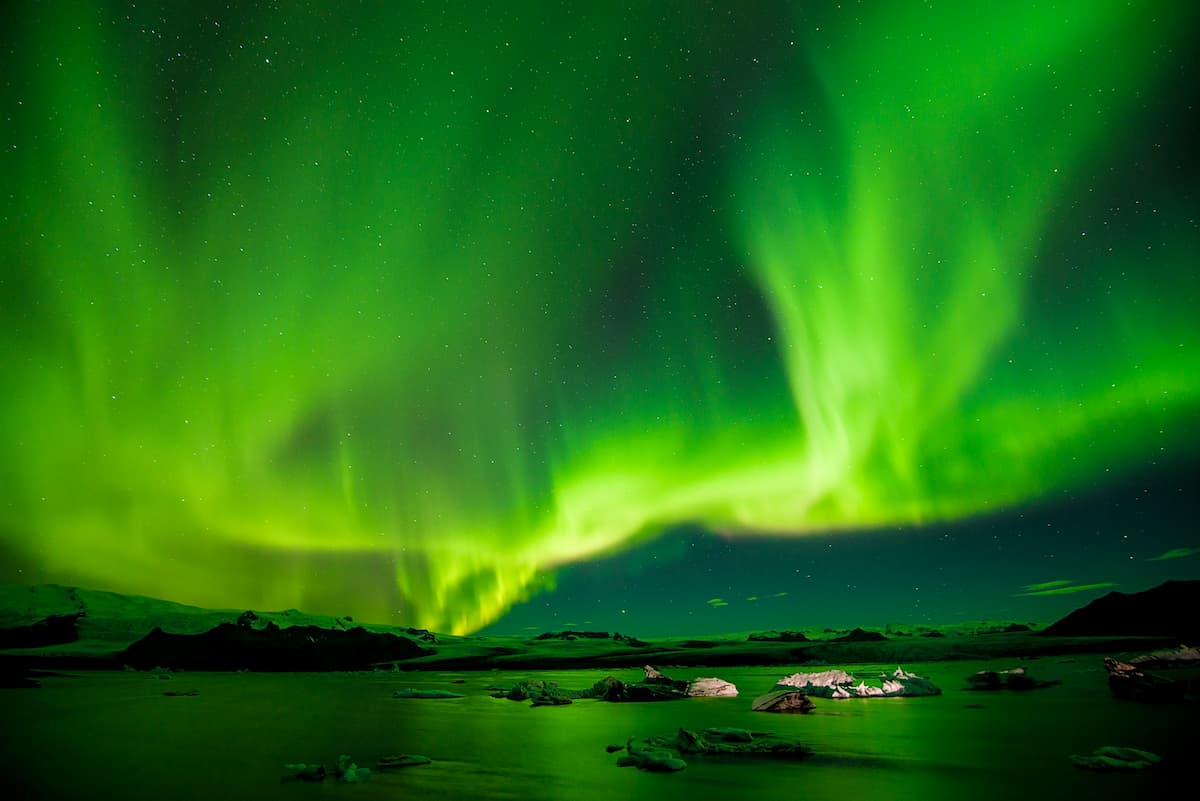
From October through April, Iceland has limited hours of daylight; cold and unpredictable weather conditions; and extensive closures throughout the tourist industry, from hiking trails and campsites to restaurants and tour operators. If you’re keen to see the Northern Lights, this is the best time to schedule your visit, but, otherwise, I’d suggest trying to visit during the warmer months.
I hope you have an incredible time on your Iceland road trip—it’s truly one of the most spectacularly beautiful and unique places on the planet! Do you have any questions about planning your visit? Let us know in the comments below!
Thank you for reading our post! Check out our latest stories here and follow us on Instagram (@JustinAndJess_), YouTube, TikTok, or on Facebook to see what we’re up to next!
