

Tourism to Antarctica has exploded in the last few years, with up to 50 operators currently offering expeditions to explore the most remote corner of our planet. Aurora Expeditions is one of the most unique players on the Antarctica cruise market, offering adventurous itineraries that balance education, sustainability, and a hint of luxury.
My husband, Justin, and I recently spent 14 days sailing around the Antarctic Peninsula with Aurora, surrounded by limitless ice, jaw-dropping landscapes, and an almost unbelievable abundance of wildlife. If you’re considering doing the same, here’s our honest review of our experience on our Aurora Expeditions Antarctica cruise, from what kind of activities we got up to every day to what to expect from the onboard staff.
This post may contain affiliate links. If you make a purchase through them, we may receive a small commission, for which we are extremely grateful, at no extra cost to you.
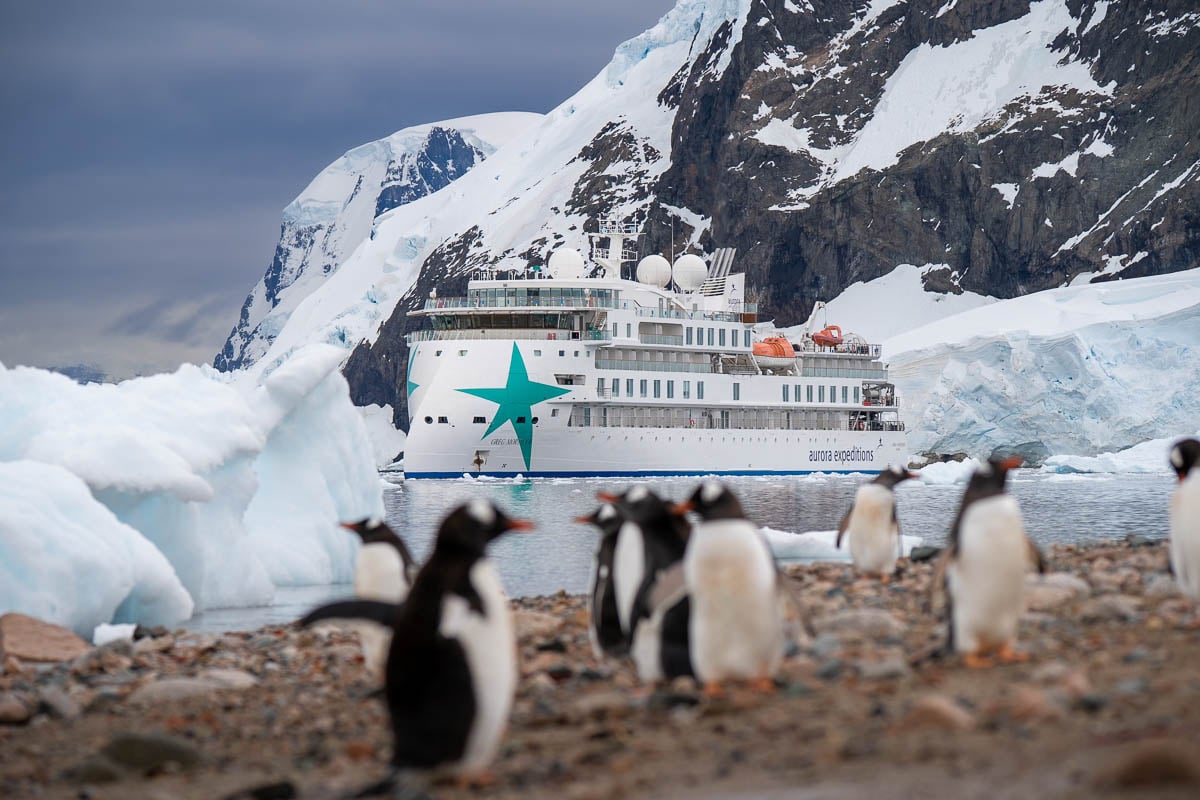

Thanks to Aurora Expeditions for hosting us on this cruise. All opinions are our own.
How do you get to Antarctica?
Before we dive into our experience with Aurora, I thought it might be worth backing up and looking at why you’d be cruising to Antarctica in the first place. If you want to get straight to the review, you can skip to the good stuff here.
There are no commercial airports on the White Continent so, if you’re interested in exploring it, the vast majority of travelers reach it via ship.
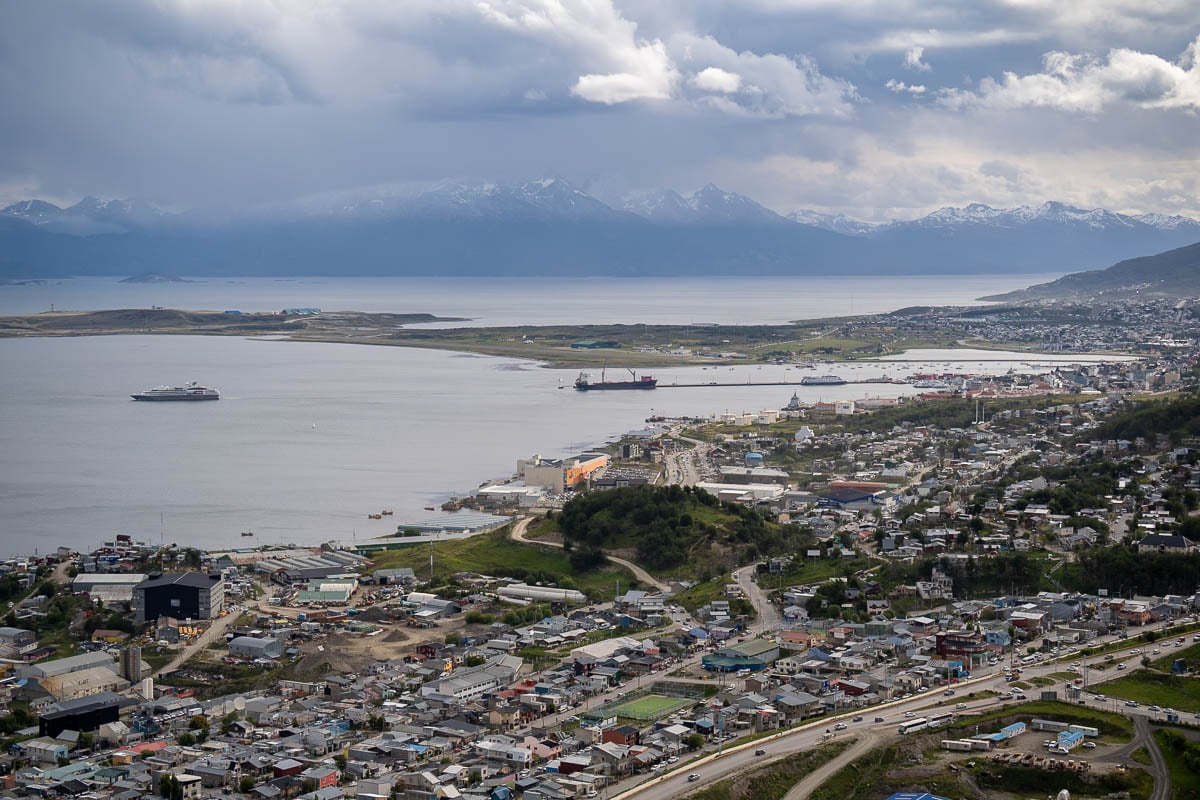
There are a couple of different departure ports for Antarctica cruises. However, the most popular–and the shortest–route is between Ushuaia, Argentina (otherwise known as the southernmost city in the world!) and the Antarctica Peninsula, which is estimated to be about 1,000 km apart.
It typically takes about two days to sail from Ushuaia to the Antarctic Peninsula along the Drake Passage, an infamous stretch of open ocean, where the convergence of the Atlantic, Pacific, and Southern Oceans creates notoriously nasty waves.
In recent years, it’s become more popular for operators to offer an option for tourists, who are concerned about crossing the Drake Passage or who are short on time, to fly between Punta Arenas, Chile to the Antarctic Peninsula, usually landing at a rustic airstrip on King George Island in the South Shetland Islands.
Still, since there are no roads leading around Antarctica, even if you fly here, the only way to get around and explore the area is via ship.
So, with all that in mind, if you want to see and experience our southernmost continent, you’ll need to be on a ship, with knowledgeable staff to guide you around.
What is Aurora Expeditions?
Aurora is an Australian company, founded in 1991, by an intrepid traveler named Greg Mortimer.
Greg initially rose to fame for his impressive climbing career, being the first Australian to summit Everest without supporting oxygen, the first Australian to climb Antarctica’s highest peak, and a host of other laudable titles. Throughout his outdoor adventures, Greg fell in love with the remote corners of our planet, like Antarctica, and started chartering ships to show his friends and family the incredible places he’d seen along his travels. Eventually, those adventures evolved into the Aurora Expeditions that exists today.
Over the years, Aurora’s fleet has morphed from one repurposed Russian research vessel (that is fondly remembered by much of Aurora’s staff) to three purpose-built expedition ships—the Greg Mortimer, Sylvia Earle, and Douglas Mawson—complete with hot tubs, panoramic observation lounges, and saunas.
Although their ships are decidedly more bougie now, Aurora has retained its original adventurous spirit, prioritizing getting guests off the ship and having incredible adventures in the wild, beautiful places that you’ve sailed to, as compared to some of the more superfluous onboard extras, like an after-dinner pianist or dedicated butler service.
And there’s definitely still a concentration on education and science, with most onboard activities revolving around informational lectures and options for guests to participate in citizen science projects. These projects range from counting bird populations to observing cloud formations, to help scientists gather data in these extremely remote and hard-to-reach places.
Finally, while no Antarctica cruise can be categorized as truly environmentally friendly, Aurora is inarguably one of the leaders in the cruise industry for sustainability, as one of the few cruise operators that’s certified carbon neutral AND a certified B Corp. Plus, they support ocean regeneration—for every passenger, Aurora funds the planting of some form of life, like kelp or coral, plus the removal of one kilogram of waste in the ocean, which is pretty darn cool, if you ask me.
What kind of Antarctica cruises does Aurora Expeditions offer?
At the time I’m writing this, Aurora offers a whopping 28 different Antarctica cruise itineraries, ranging in duration from nine to 34 days.
They have options departing from Argentina, Chile, and New Zealand; ones where you fly to the Antarctic Peninsula; ones where you visit other sub-Antarctic Islands, like South Georgia and the Falkland Islands—really, quite a wide array of offerings, depending on what kind of expedition you’re looking for, how much time you can dedicate to the trip, and what budget you’re working with.
If you feel overwhelmed by choices (I know I did, when we first started researching Antarctica cruises!), I’d suggest thinking about whether you want to do any special activities while you’re here.
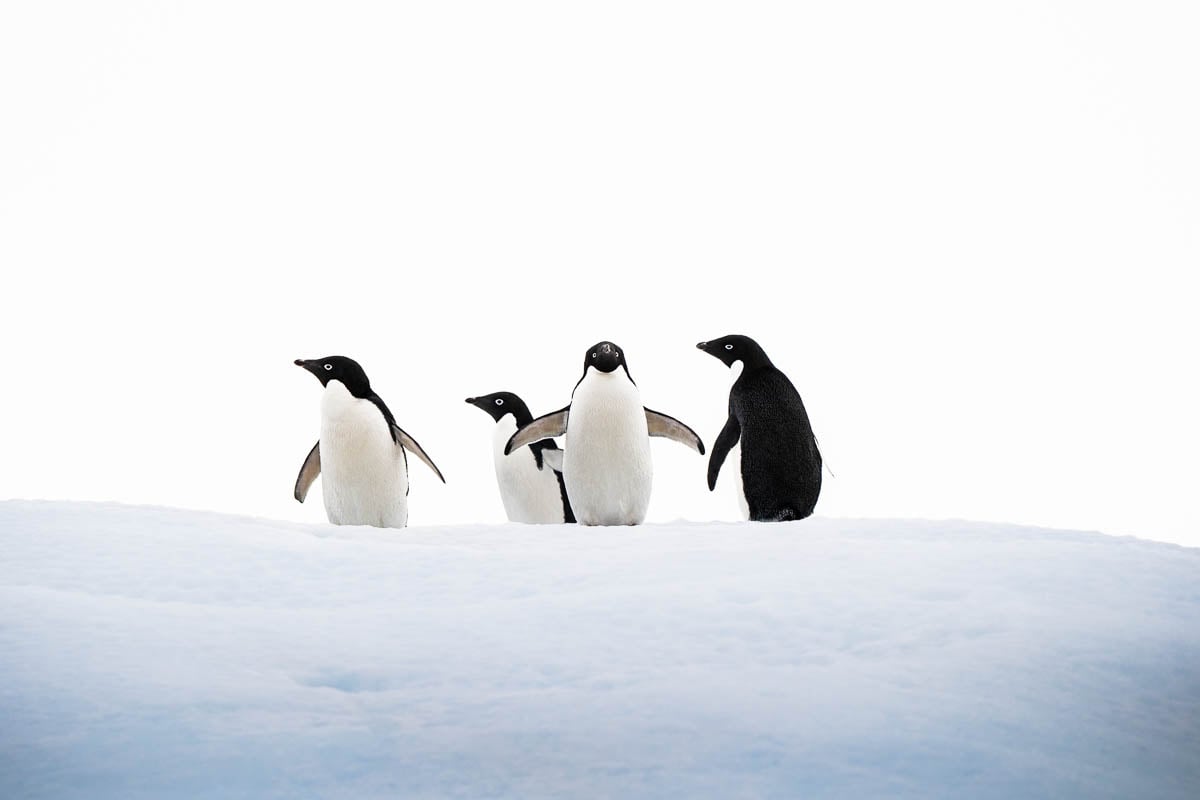
Aurora also offers a whole slew of different activities in Antarctica, from skiing and scuba diving to alpine trekking and kayaking. Certain activities are only offered during specific parts of the year, based on snow and ice conditions, which can help whittle down the itineraries that make sense for you.
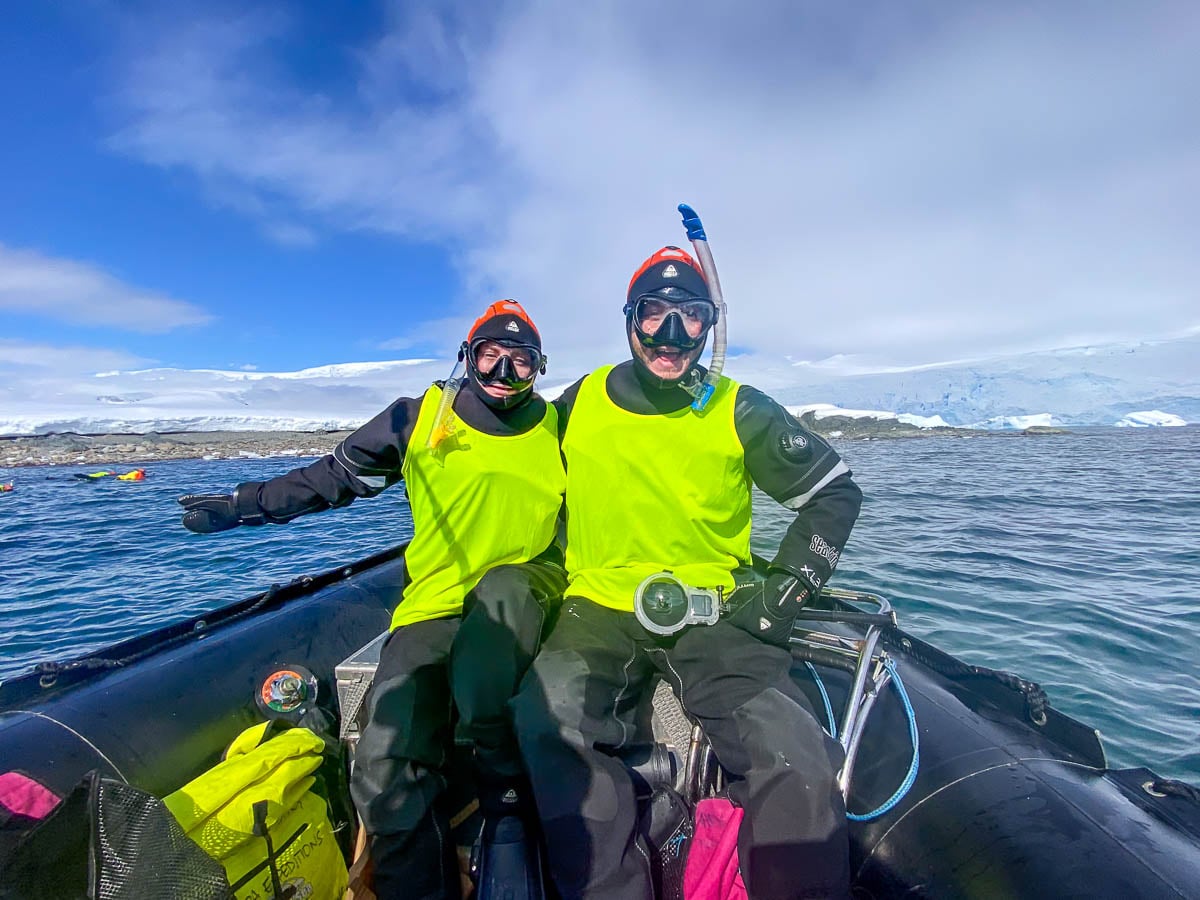
Justin and I REALLY wanted to camp, kayak, and snorkel while we were in Antarctica, so the Antarctica Active: All Inclusive Activities itinerary, which included ALL of those activities PLUS snowshoeing, was the perfect fit for us.
Finally, it’s worth mentioning that Aurora has a few unique itineraries, like ones for people interested in photography, women, and more science-focused offerings that highlight the ice and geology of Antarctica.
I know there’s a LOT of things to consider when choosing an Antarctica cruise, but, if at all possible, I’d HIGHLY recommend choosing an itinerary that gives you as many days on the continent as possible.
Exploring Antarctica can be tricky. Between the weather, waves, and ice, it’s an extremely dynamic environment and it’s not uncommon to have a few excursions be cancelled, due to the conditions.

During our Antarctica cruise with Aurora, we had a glorious EIGHT days to explore the continent. Only one afternoon excursion, on our very last day on the continent, was cancelled, due to encountering a larger-than-expected ice field that delayed our return to Ushuaia.
Since we had SO much time to explore Antarctica, one cancelled outing wasn’t a big deal, at all—but, imagine if you get unlucky with some nasty weather during an itinerary where you have just three days there. That becomes a MUCH harder pill to swallow, especially with a trip that requires such a huge time and financial commitment.
Aurora Expeditions Antarctica Cruise Review
Okay, with all of the logistics out of the way, let’s get into what our experience on our Aurora Expeditions Antarctica cruise was actually like.
Overview of our experience on an Aurora Expeditions Antarctica cruise
If you want the TLDR, here goes.
I have been DREAMING of going to Antarctica for years and years—to the point where it had almost a mythical quality in my brain. I went into our cruise being a bit concerned that no experience could possibly live up to the unrealistic fantasy that I had built it up to be—and somehow, Aurora Expeditions managed to FAR exceed my expectations. In fact, I’d go as far as saying this was my favorite travel experience ever (big words, I know!).
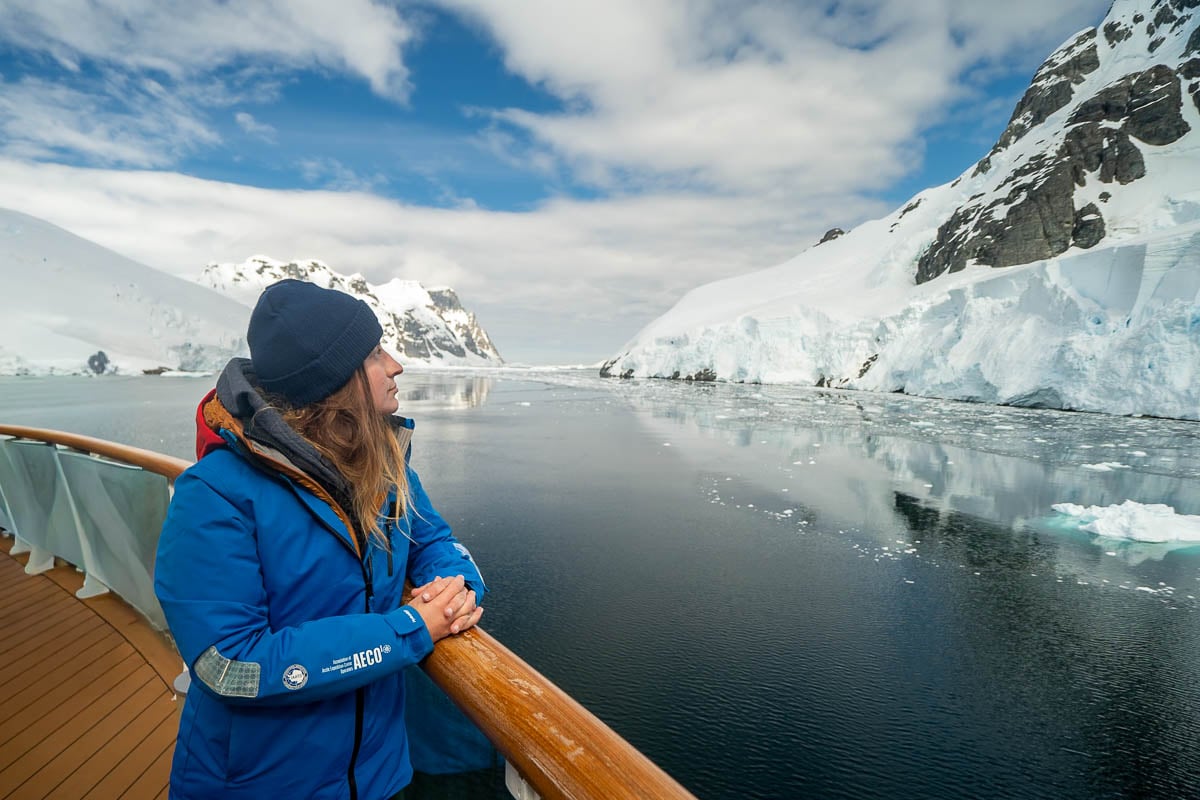
I’d highly recommend this experience to any travelers that are looking to experience the gorgeous landscapes and incredible wildlife of Antarctica, all while having an extraordinarily comfortable onboard experience.
We were lucky enough to go on an Aurora Expeditions Svalbard cruise earlier this year and, similar to that experience, I am BLOWN away by their expedition team.
I went into this cruise, expecting that some of our days may be negatively impacted by the harsh Antarctic weather. While I’m sure there’s a bit of luck sprinkled in there, our expedition leader, Catherine (side note—how cool is it to have a woman expedition leader?!?) did a FANTASTIC job, clearly communicating the conditions we were working with and deftly finding bays and harbors that sheltered us from any nasty weather, so that we could get off the ship every single day(!!!) that we were in Antarctica.
And, beyond Catherine, the rest of the expedition team was the perfect mix of being friendly, laidback, and professional—an atmosphere that I attribute to Aurora’s Australian roots.
Additionally, our guides were so impressively knowledgeable, packed with information about everything from the lichen that clung to rocky cliffsides and the geology of volcanic islands to the esoteric factoids about penguins’ anatomy—like having our own walking, talking teams of Antarctic encyclopedias with us!
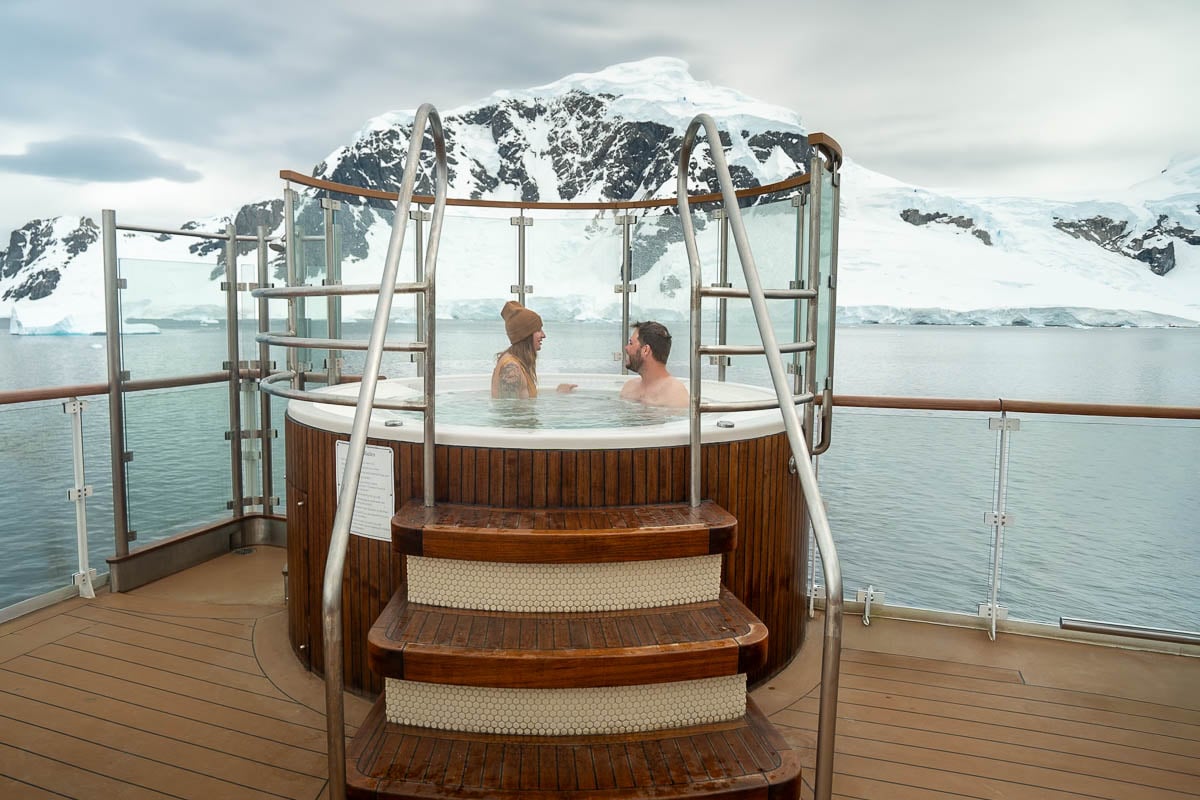
Aurora’s biggest selling point, in my book, is their ability to get you off the ship to explore absolutely unreal places—but our experience onboard the Greg Mortimer was nothing to sneeze at, either! The cabins are spacious; the hotel staff are friendly and totally on top of their game; and there are tons of facilities to keep you comfortable while exploring the polar regions (a beautiful sauna! two hot tubs! outdoor igloos!).

Aurora does not bill itself as a luxury operator, so if you’re expecting an onboard specialty whiskey bar or personalized butler service, it may not be the right choice for you.
Again, Aurora seems much more focused on providing you with an epic adventure, as opposed to manufacturing a super upscale atmosphere, like enforcing a dress code for dinner (which is something that some of the ultra luxury cruise lines do). I personally would HATE to be told what I’m not allowed to wear for dinner on a pricey cruise, while I’ve met other travelers who think onboard dress codes are a fun excuse to get gussied up.
So just find an operator that matches your style!
Other than some pretty nitpicky things, I truly don’t have very many constructive comments to provide about our experience with Aurora Expeditions during our Antarctica cruise.
The biggest gripe that I can think of is that, as a lady who likes a cocktail, I wish alcoholic drinks were included (house beer and wine are included with dinner, but otherwise, you have to purchase drinks from the bar). However, Aurora is totally up-front about that fact and drinks are ridiculously cheap onboard, anyway (like, almost all cocktails are under $8 USD, which is unheard of in 2026).
So, with all that in mind, if you’re an adventurous traveler looking to have a once-in–lifetime experience in Antarctica, I truly can’t imagine a better experience than the one we had with Aurora.
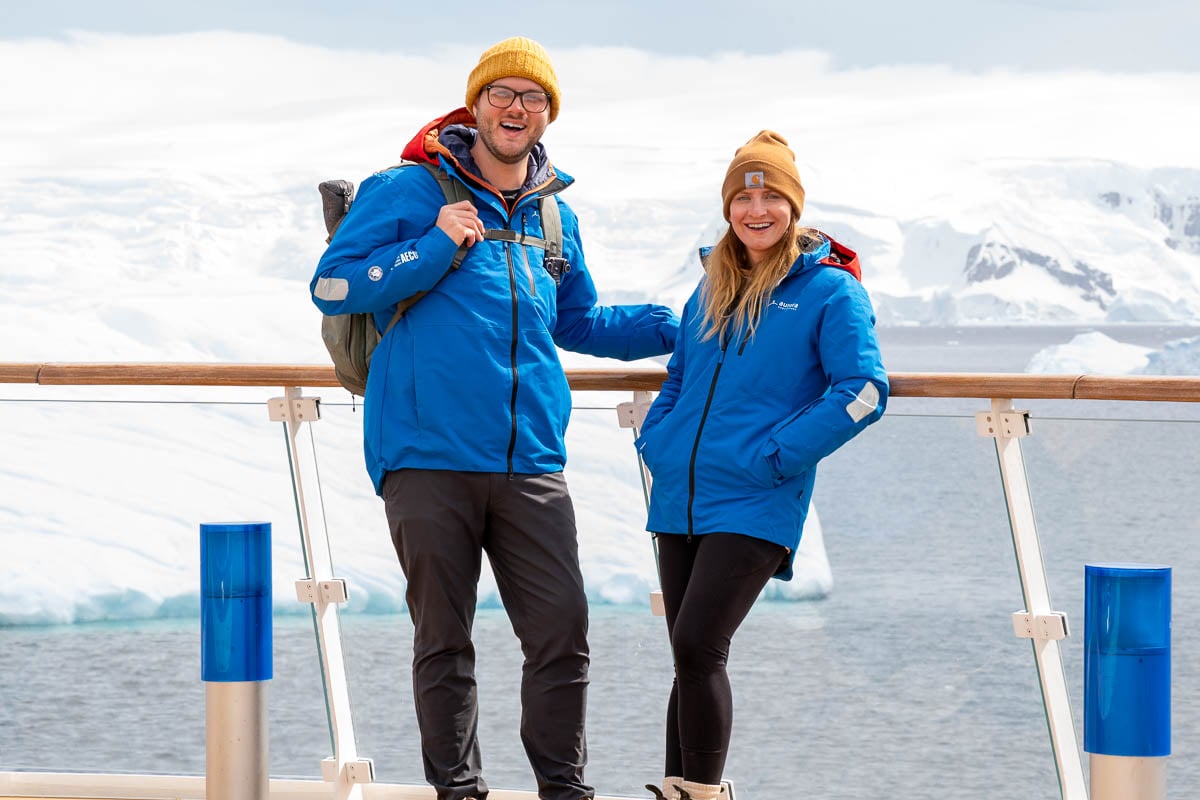
Want to hear even more about our Antarctica cruise? Let’s get into it!
Offboard experience
If you’ve made it this far, I assume you are, like, DEEP in the weeds of researching an Antarctica cruise and are most interested in what our experiences actually exploring the White Continent was like. So let’s get into what our offboard experience with Aurora was like.
Itinerary
Aurora offers expedition cruises to Antarctica, which means, besides generally exploring the Antarctic Peninsula, you don’t really know where you’re going or what you’re doing during your time there.
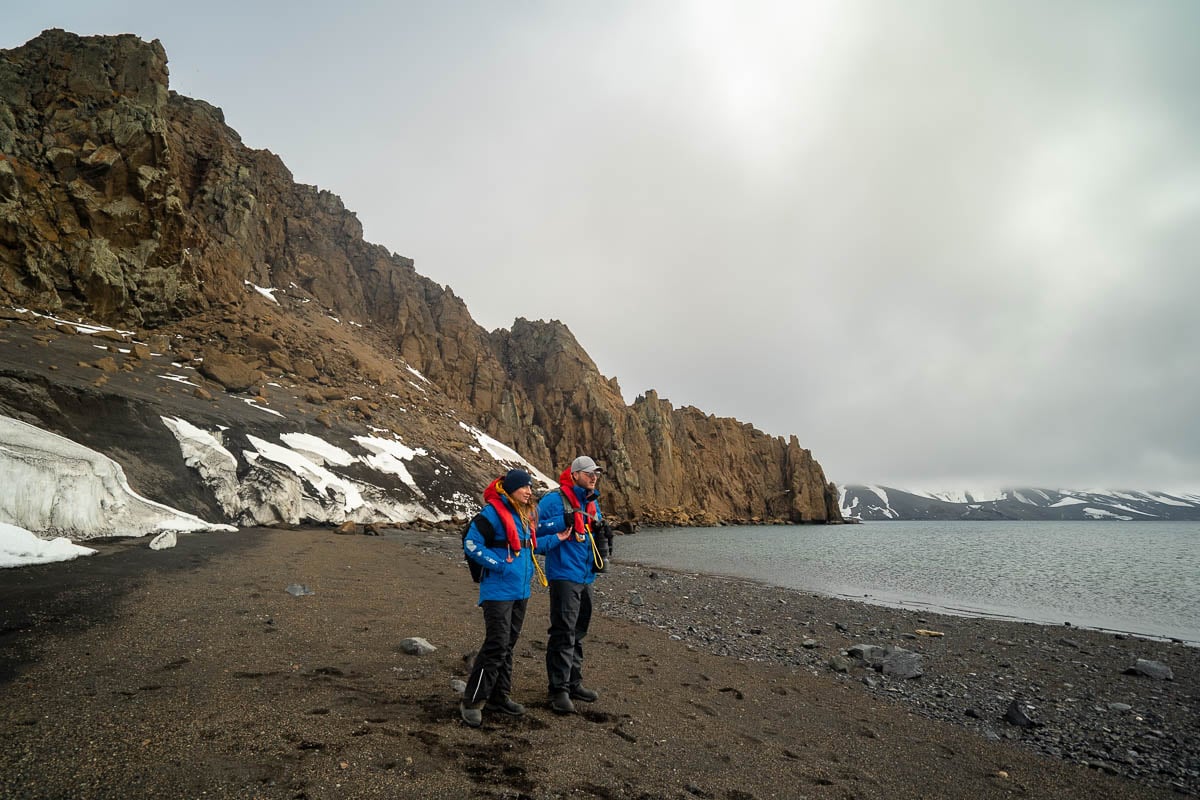
Instead, your expedition leader works with your captain, evaluating wind, waves, ice, and other conditions, to determine where you’re headed each day. This is the case with any expedition cruise operator, not just Aurora.
This approach means you’ll have a MUCH better chance of getting off the ship and experiencing Antarctica, but it also means that there’s no guarantee that you’ll hit any one specific site. I remember having a pretty intense panic spiral when I was initially researching Antarctica cruises, trying to pick between a bunch of operators’ itineraries with different stops listed.
Now, I’d actually strongly recommend not going with an operator that has specific sites listed on their itinerary—it’s misleading, at best (or very poorly operated) if an operator commits to going to any specific site on a certain day.
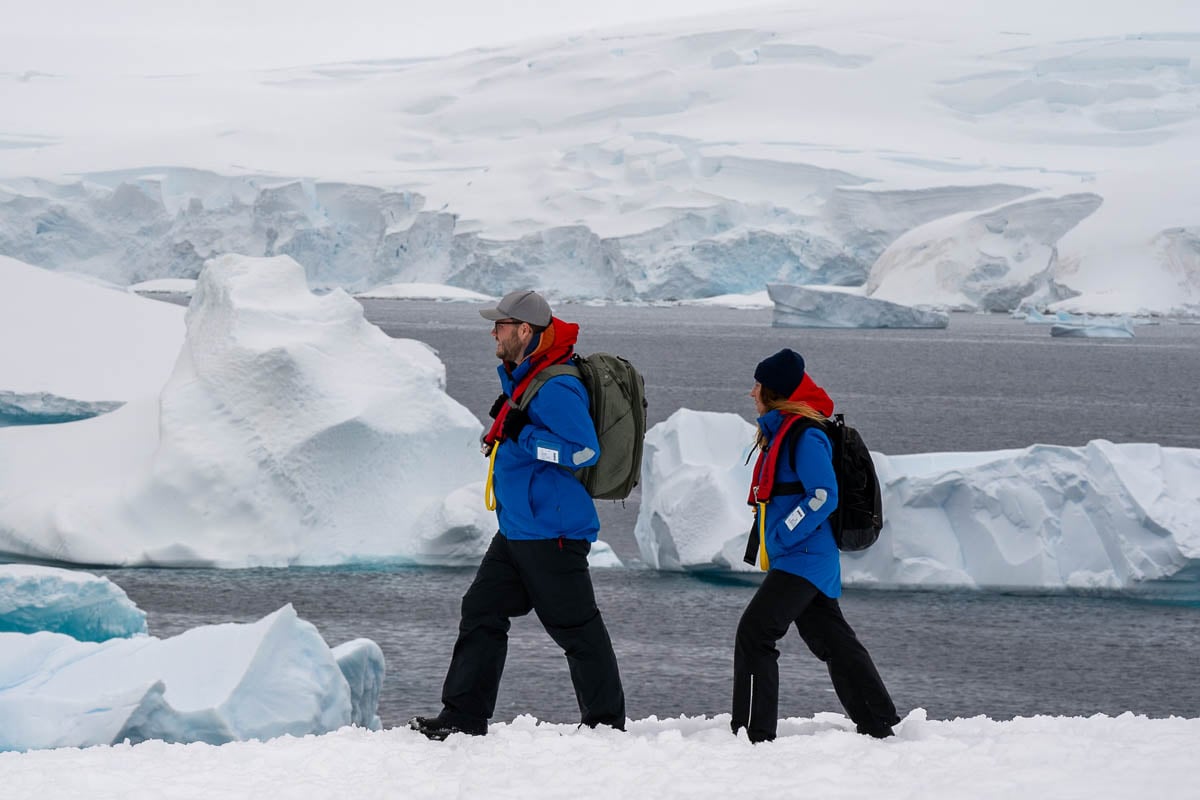
I really enjoyed the pacing of our Antarctica cruise. We were ALWAYS busy, but not in a chaotic, overly exhausting kind of way—our expedition leader woke up with an announcement between 7-7:30 AM every day and we were never off the ship later than around 6 PM (besides our camping trip).
I’ve had experiences on some expedition cruises with other operators that were WAY more chaotic—with regular 5 AM wake up calls and evening outings where we were off the ship past 10 PM (literally!). I am ALL about getting off the ship any time that I can, but having a bit more of a reliable routine was definitely appreciated here.
Even with our steady routine, I enjoyed that the expedition team and hotel staff worked together to prioritize guests’ experiences to explore Antarctica. For example, we had a few stellar opportunities to view humpbacks and orcas during breakfast time, so the staff extended our meal time and moved back our morning excursion time to ensure that everyone had a chance to enjoy the whales, eat, AND join the outing.
We never felt like we were on some kind of strict schedule and, rather, that the staff seamlessly adapted to whatever was happening.
Expedition staff
We’ve gone on a number of expedition cruises and have definitely learned that the expedition staff can make or break an experience. Luckily, as referenced above, we had nothing but positive experiences with Aurora’s expedition staff.
There were 104 passengers aboard our cruise, with 19 expedition staff onboard. Granted, we were on a unique activity-heavy cruise that necessitated having more guides than a “normal” itinerary, but still—a 1:6 passenger to expedition staff ratio is bonkers!
Our expedition staff all came from different backgrounds—geologists, historians, ornithologists, to name a few—so, whenever we rode on a Zodiac boat or chatted with a new guide, we’d always see Antarctica from a new, unique perspective.
I also loved that, when I asked them questions, they’d not only provide a factual response, but also additional historical or scientific context that painted a broader story about Antarctica.
For example, I asked one of our guides what was determined to be historical artifacts in Antarctica (e.g., what a lot of the whaling station remnants are considered nowadays), as opposed to industrial waste. It turned into a really interesting conversation about how humans’ impact on Antarctica’s landscapes and wildlife is complex—as one example, a modern shipwreck has been colonized by a seabird population, so there’s strong debate now about whether the wreck should be removed or not.
These kinds of discussions made our time in Antarctica feel much more vibrant and rich.
It never felt like the guides were on script—they always provided their own thoughtful feedback to whatever question was posed of them, whether it related to whales’ migrational patterns or the impact of tourism on Antarctica. I REALLY appreciated this aspect of Aurora.
Activities
Okay, so our experience on Aurora is going to be a bit different than most people’s, with passengers having the opportunity to go snorkeling, kayaking, camping, and snowshoeing. So let’s cover the more typical activities first.
Landings
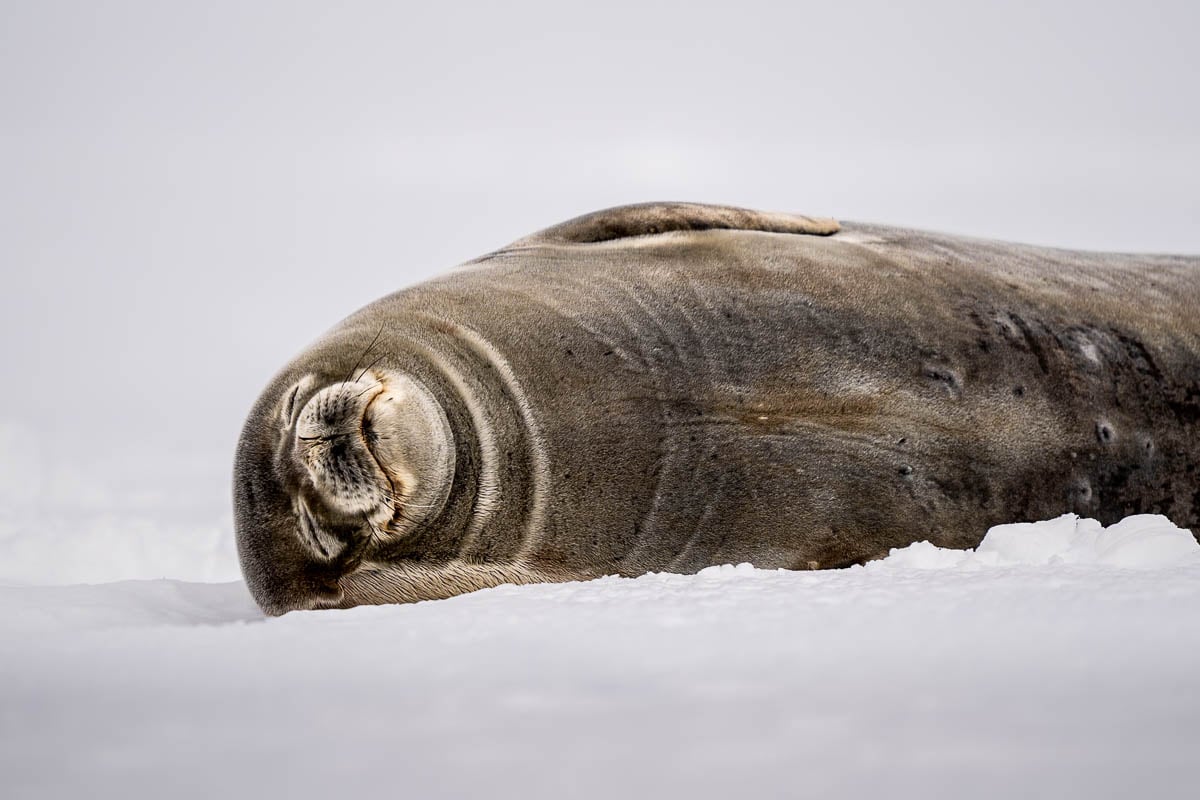
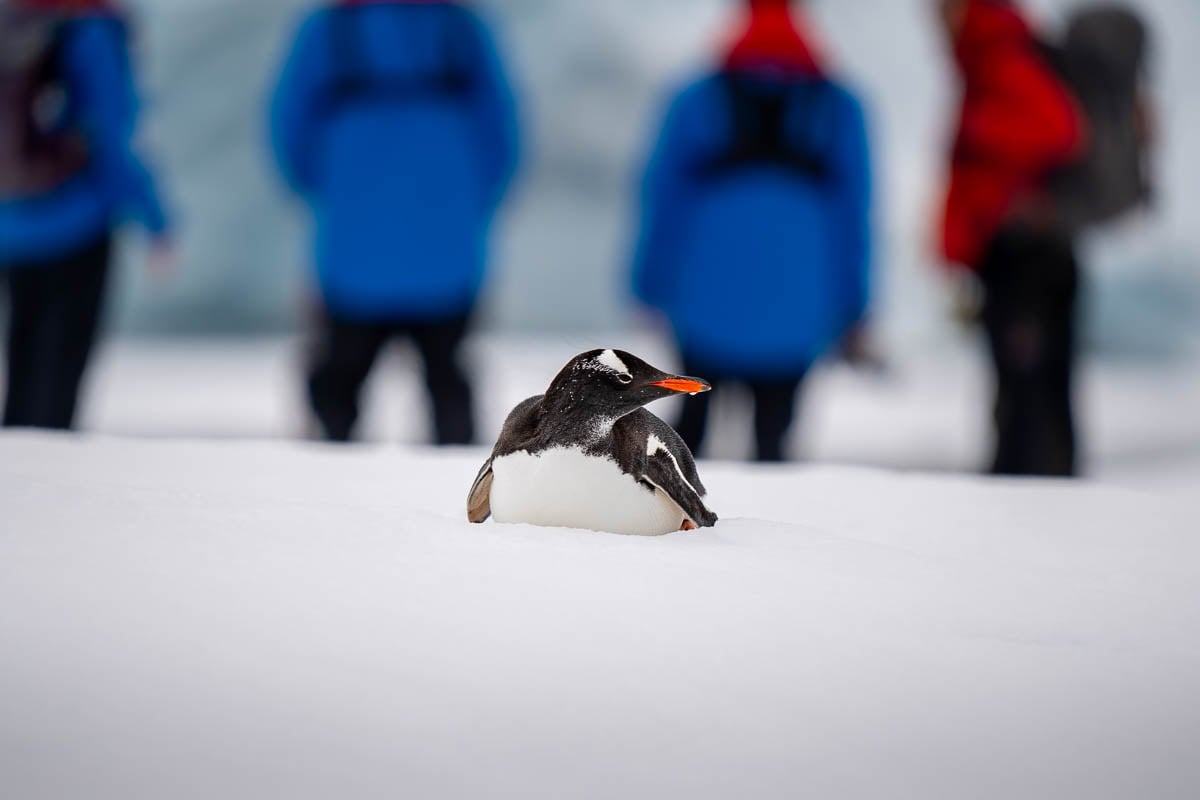
A solid portion of the excursions you’ll do are landings, where you’ll take a Zodiac boat to shore to hike around, admire the surrounding landscape and see wildlife, like penguin colonies and snoozing seals.
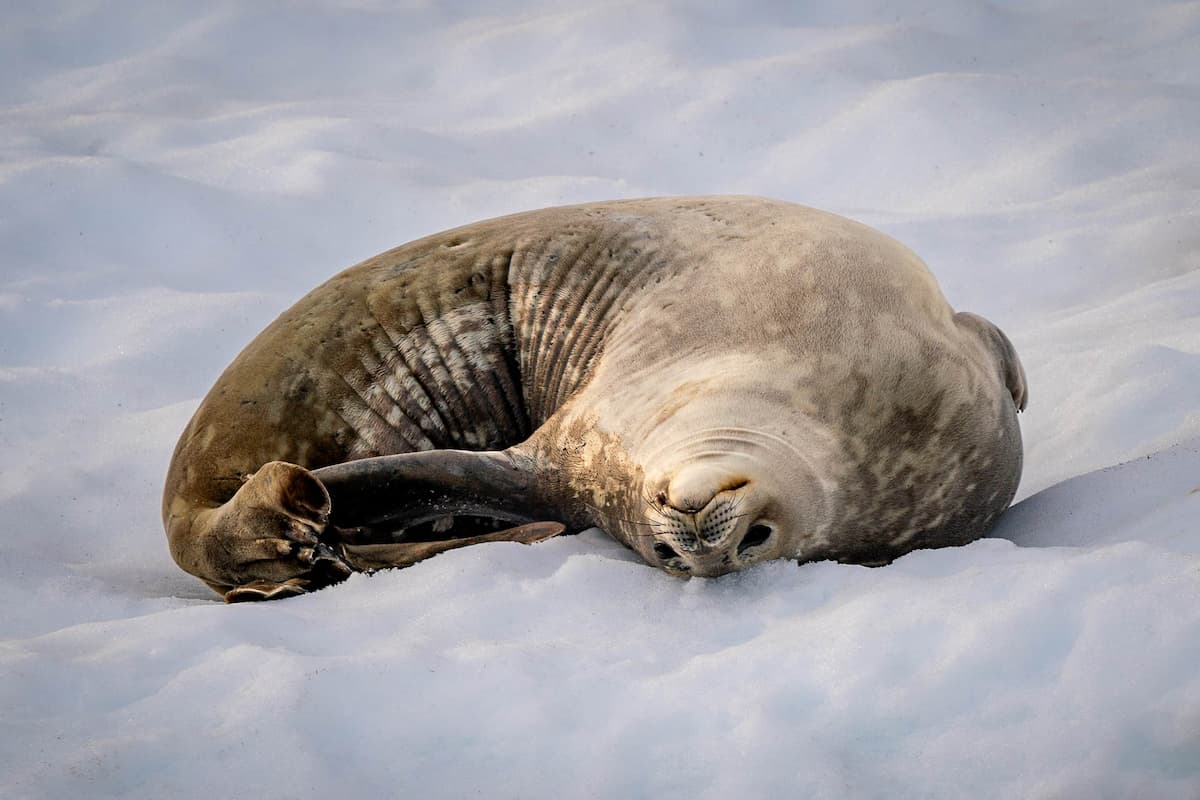
One thing that’s important to highlight is that the number of passengers on your ship will seriously impact your Antarctica cruise experience, as only 100 passengers are allowed on land at any given time—meaning, if you’re on a cruise with more passengers than that, they’ll need to divide you up into groups and rotate who is on land at any given time. This means, if you have more than 100 passengers on a ship, you’ll ultimately wind up being on land less.
The good news is that all of Aurora’s ships are 130 guests at a time, so, even if it’s a completely full ship, it’s unlikely your time is going to be cut too short on land. If you wind up going with another operator, I’d just recommend paying close attention to how large your ship is and going on as small of a ship as possible.
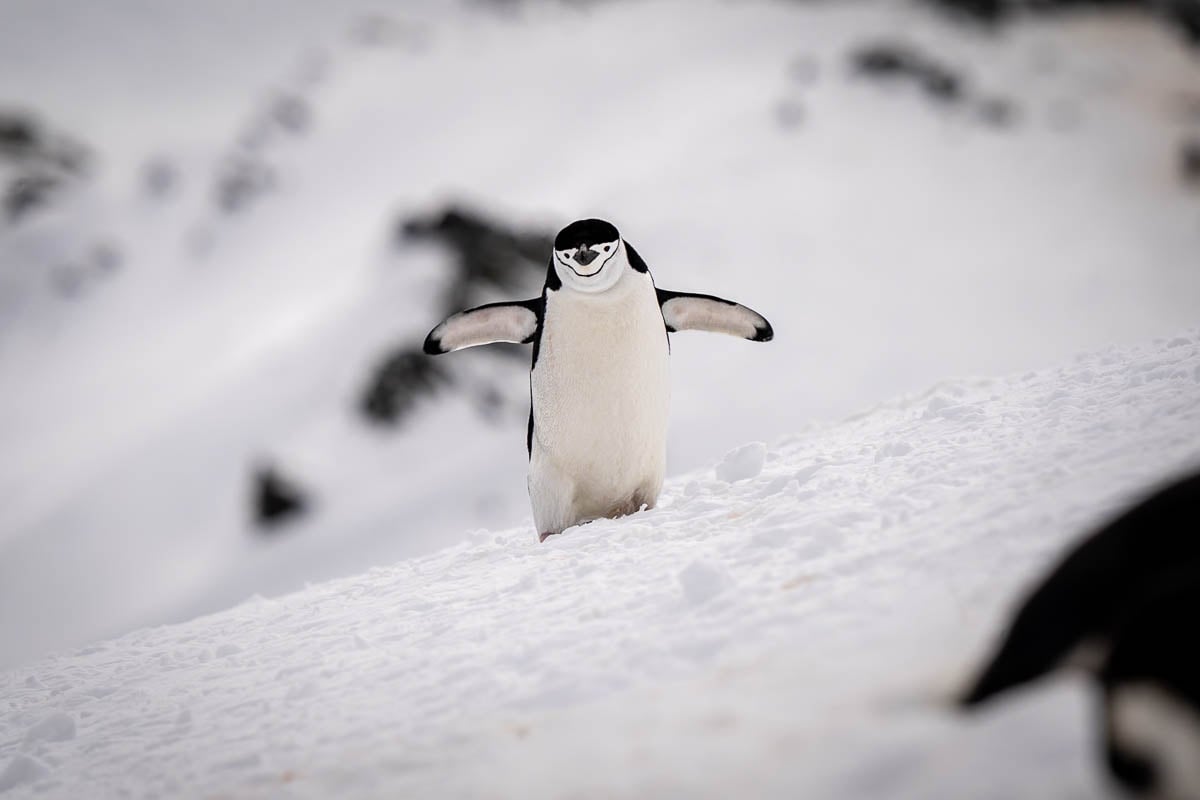
On our ship, because there were always other activities going on, like snorkeling and kayaking, there were never more than 100 guests on land at one time—so our landings were almost always two or more hours of us getting to freely wander around on land to explore the sites, admire the surrounding landscape, and observe the surrounding wildlife.
Of course, this also means, with a bit of luck, you’ll get to actually land on the actual continent of Antarctica, a bucket list item for many travelers. Antarctica is *only* our fifth continent, but, for about a quarter of the passengers on our cruise, it was their seventh continent!
Zodiac cruises
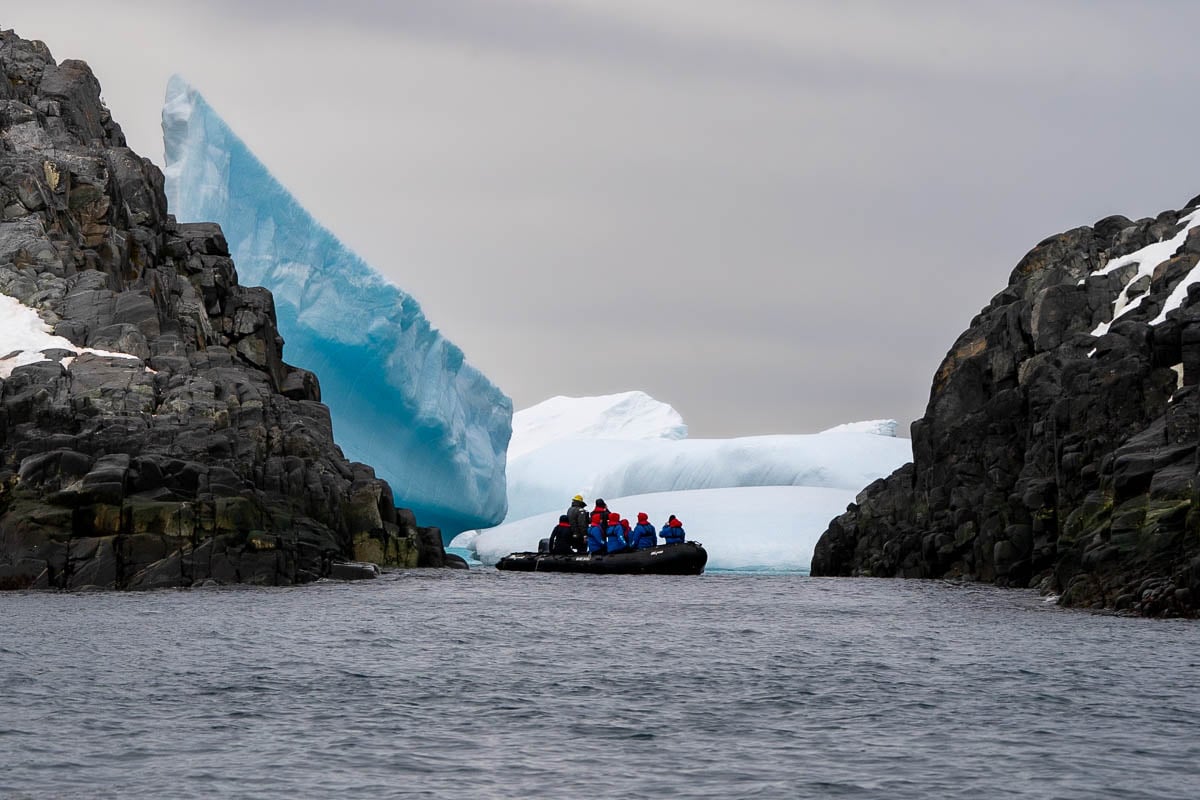
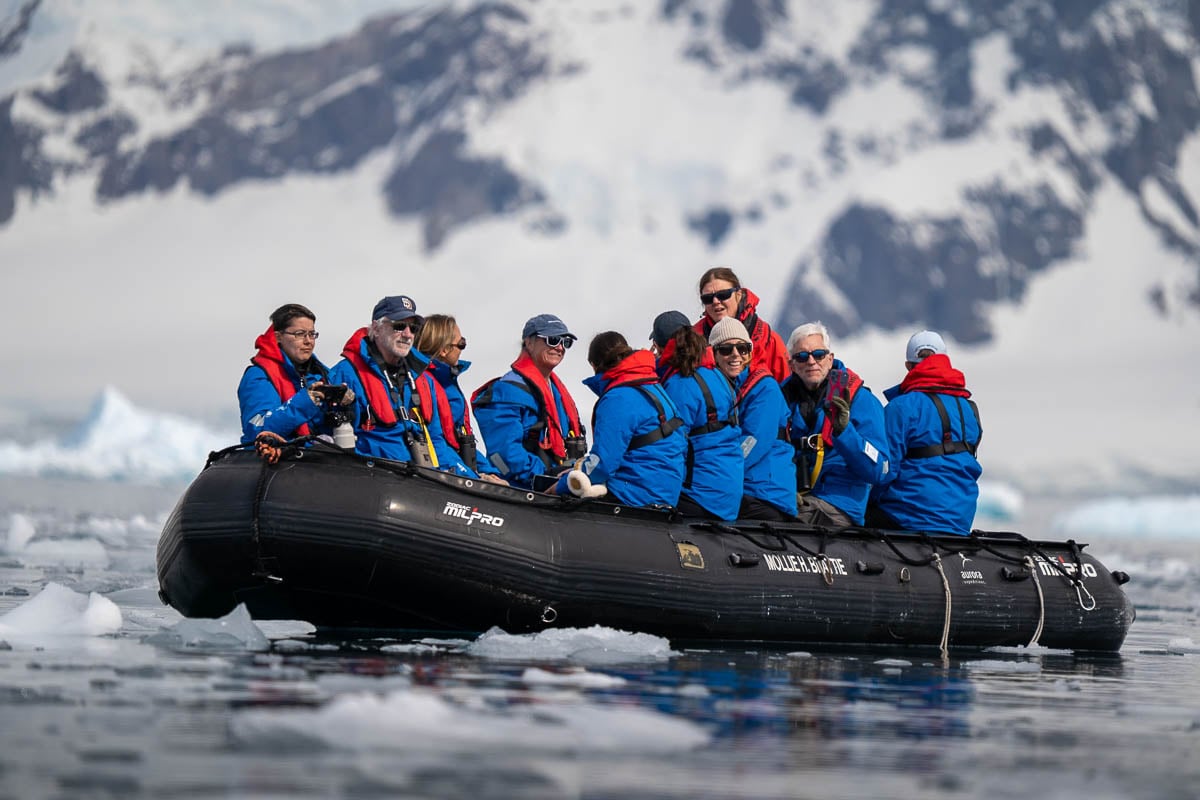
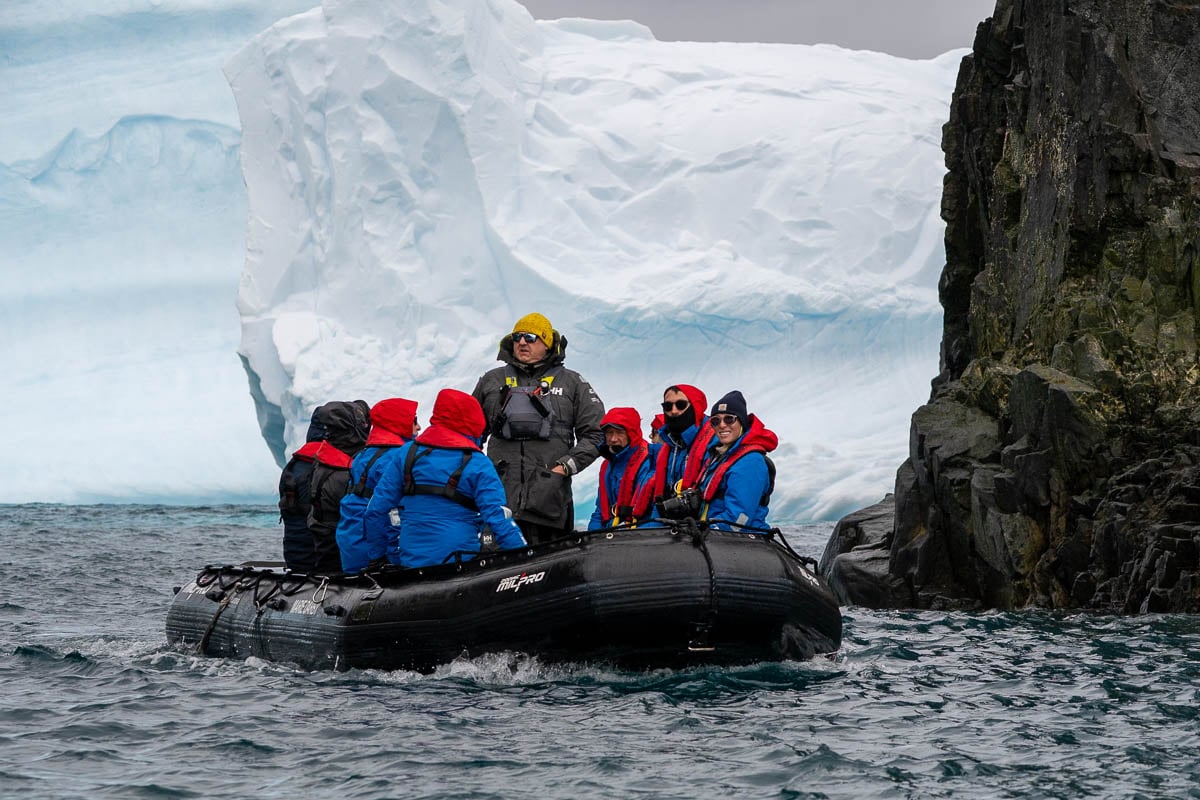
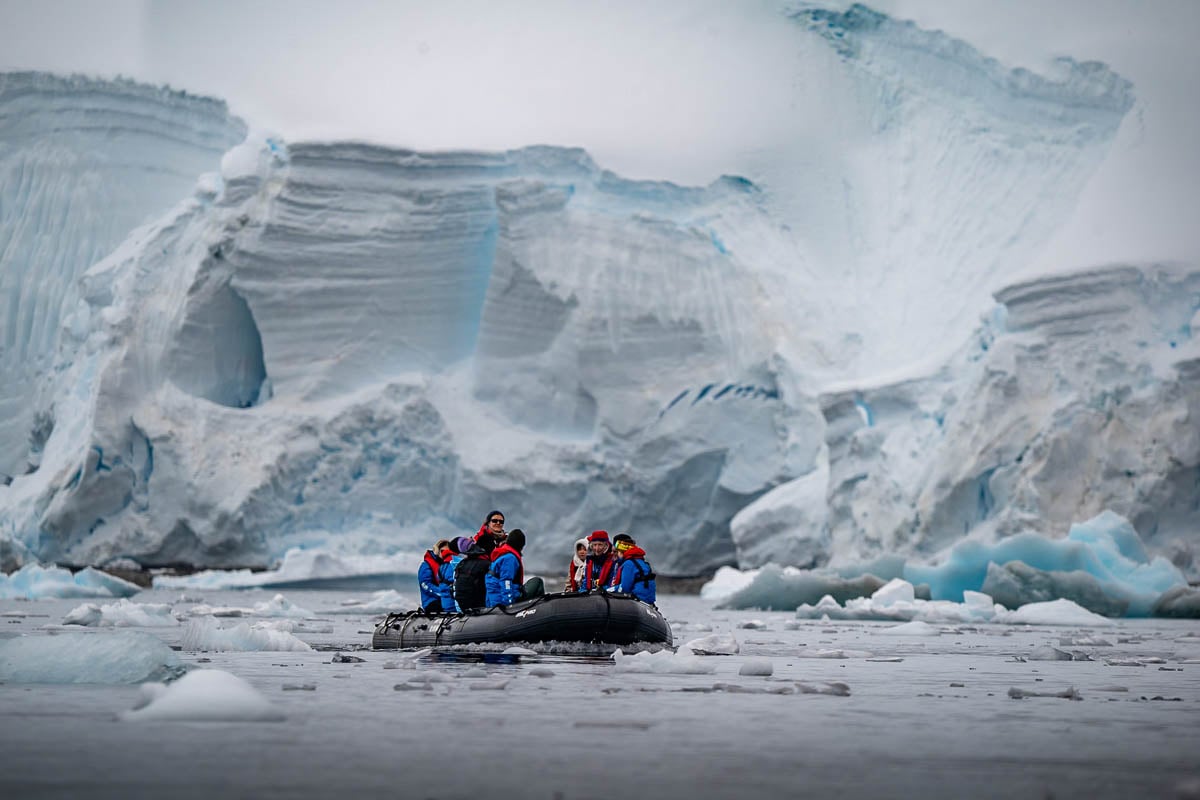
My favorite type of outing in Antarctica is a Zodiac cruise, where we shared a boat with about 10 other passengers and zipped around an area, to cruise past icebergs, listen to glaciers moan, or get a closer look at wildlife, like whales or seals.
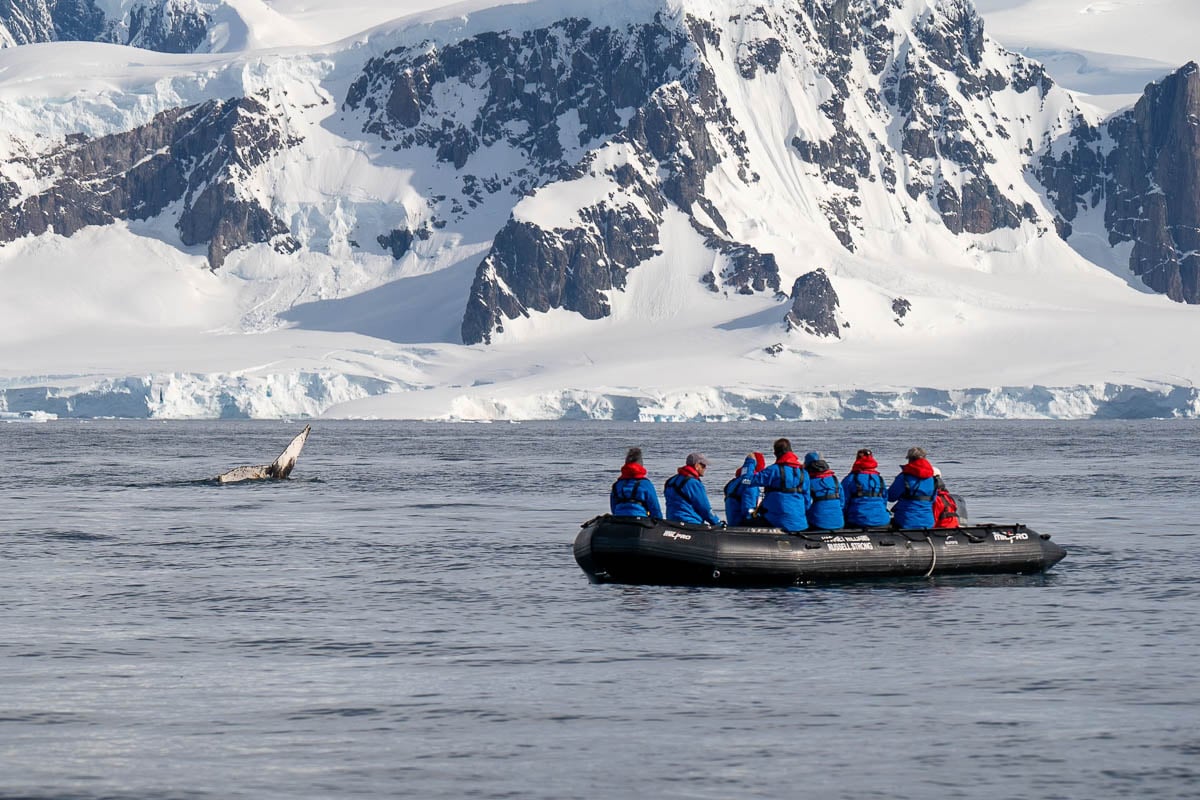
As compared to a landing, where you’re confined to a pretty small area, Zodiacs can cover a significant distance in a short amount of time—so, if a leopard seal is sighted on the other side of an island, your driver can quickly and easily get you there.
Zodiacs also feel really immersive, given you’re at eye-level and in the same environment as the creatures around you. We had SO many incredible whale encounters in Antarctica, with several humpbacks coming within ten feet of us and even diving right under our Zodiac.
Other types of activities
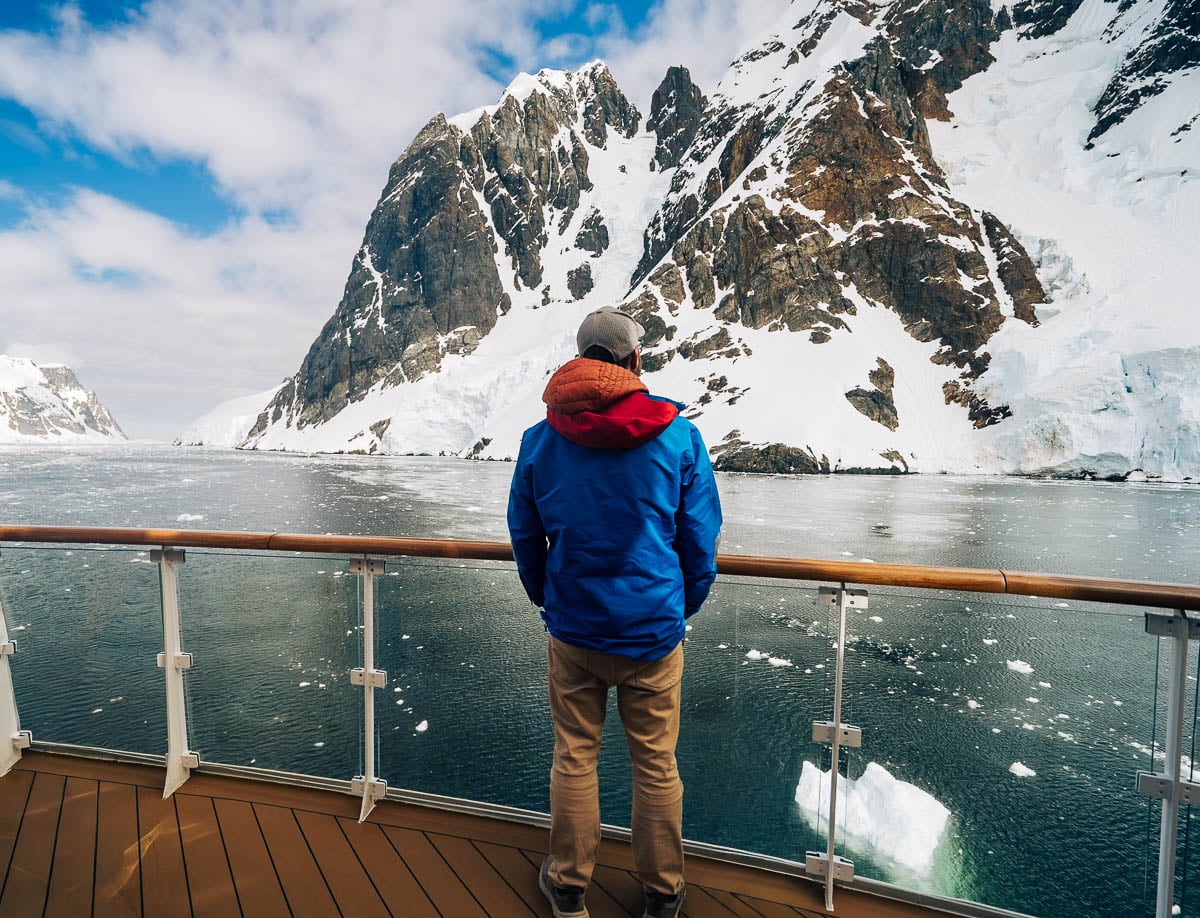
Most of our primary activities were landings or Zodiacs, but we did have a handful of other outliers, like a ship’s cruise through the Lemaire Channel, a famously thin strip of water that’s lined with massive mountains and glaciers, or the infamous polar plunge.
On the itinerary we signed up for, we had the opportunity to do the following activities:
- Snorkeling: Don a drysuit and snorkel to observe ice, underwater plants, and, with a bit of luck, wildlife. We saw a penguin whizzing by in the water!
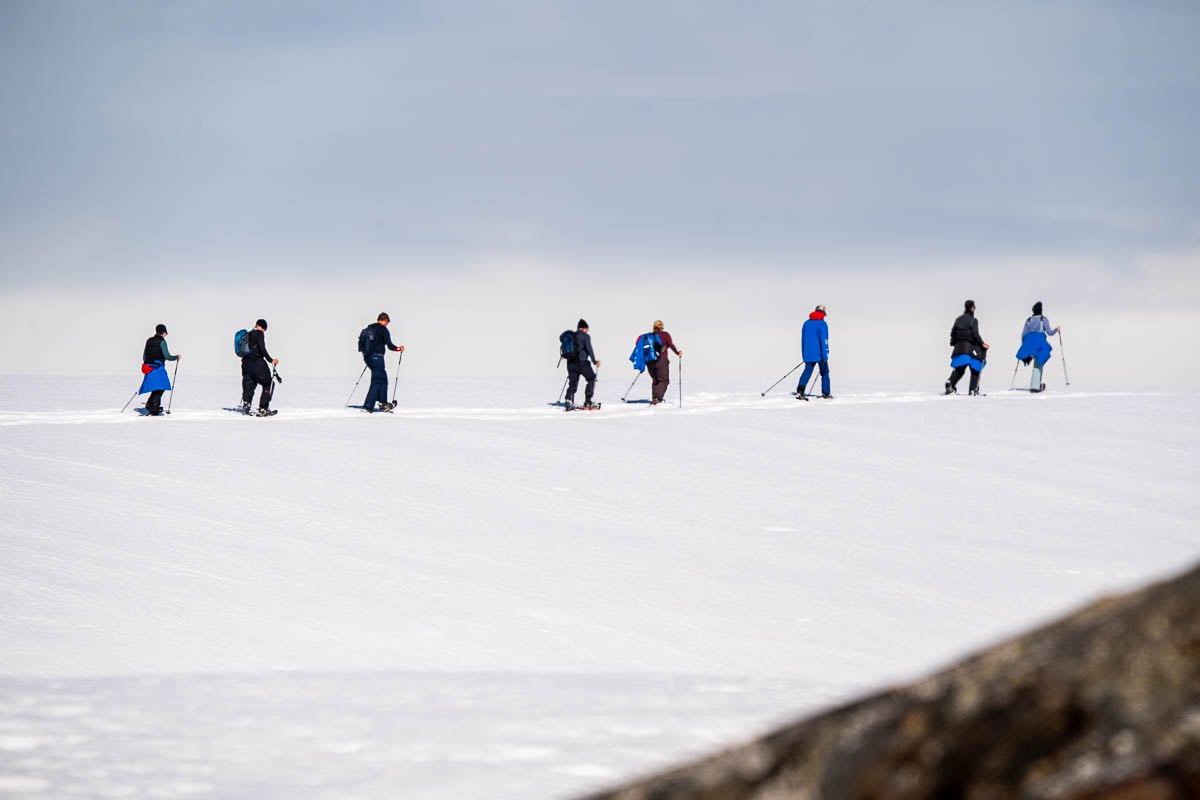
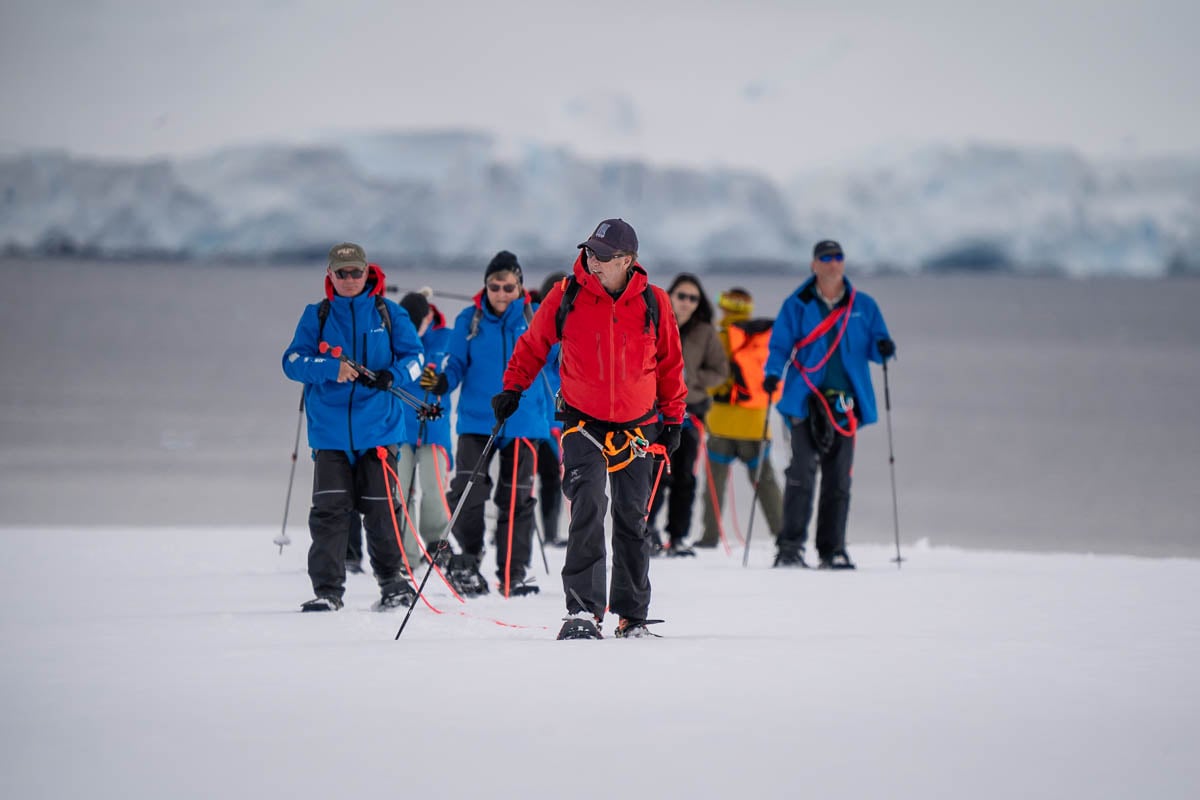
- Snowshoeing: Put on snowshoes to climb up to snowy ridgelines for unique views of the surrounding landscape (and for a decent workout, after so much yummy cruise food!)
- Kayaking: Paddle around hunks of ice and have a unique view of wildlife, swimming in the water around you. We unfortunately didn’t get to go kayaking on our cruise, but some of our friends on the ship did and had rafts of penguins gliding around them!
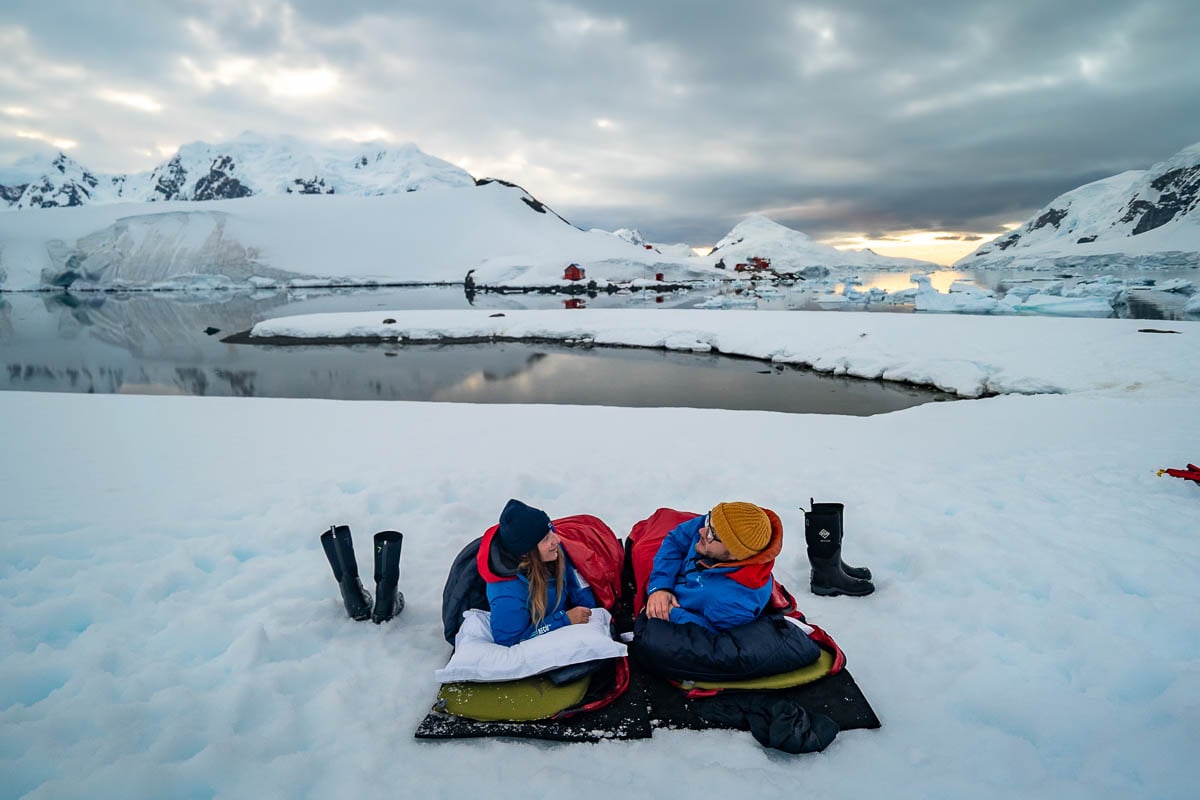
- Camping: Sleep overnight on the ice in a cozy sleeping bag, listening to the sound of the ocean, ice, and wildlife around you. This was my absolute favorite experience of the entire cruise!
Our cruise was quite unique in that all of these activities were included in the price, and we generally had the opportunity to do all of the activities at least once (and we even had the option to camp and snorkel twice!).
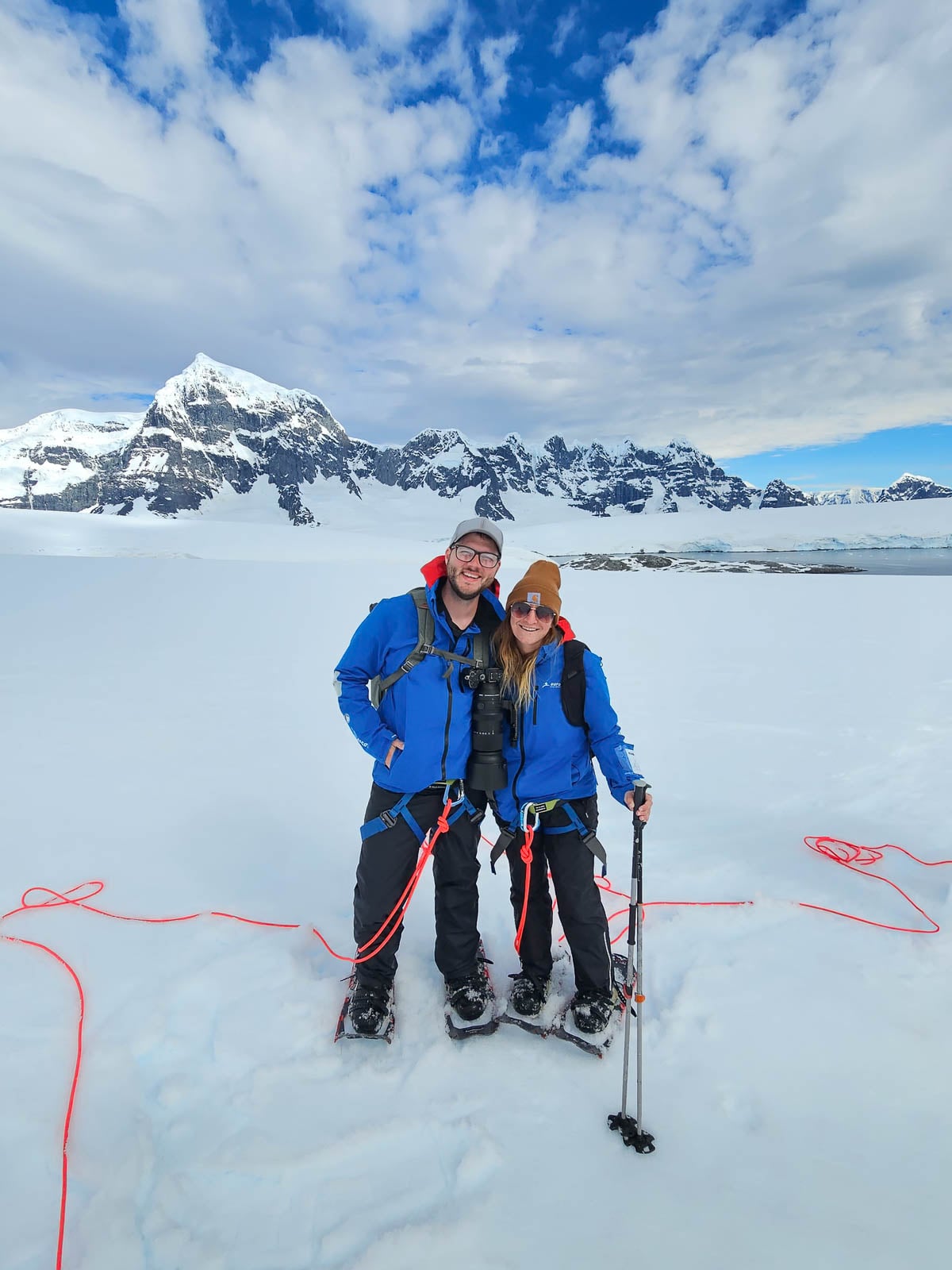
It’s my understanding that, for most of Aurora’s itineraries, you sign up for a particular activity, like snorkeling and kayaking, and you do it for the duration of the trip, as long as the conditions allow. So, for example, if you sign up to be part of the kayaking program, you would have the opportunity to go out and paddle at every outing, where the waves, wind, and wildlife are cooperating.
Our itinerary was the perfect choice for us, as it was a bit of a sampler platter of different activities, while still allowing us to have plenty of opportunities to do landings and Zodiac cruises. However, if you’re REALLY into kayaking, snorkeling, or one of the other activities, you may be able to find a cruise with Aurora that better aligns with your interests.
Expedition gear
On its polar expeditions, Aurora provides a complimentary parka, which has an inner, puffy layer and an outer waterproof layer. Additionally, insulated muckboot rentals are provided for you to use on all of your outings.
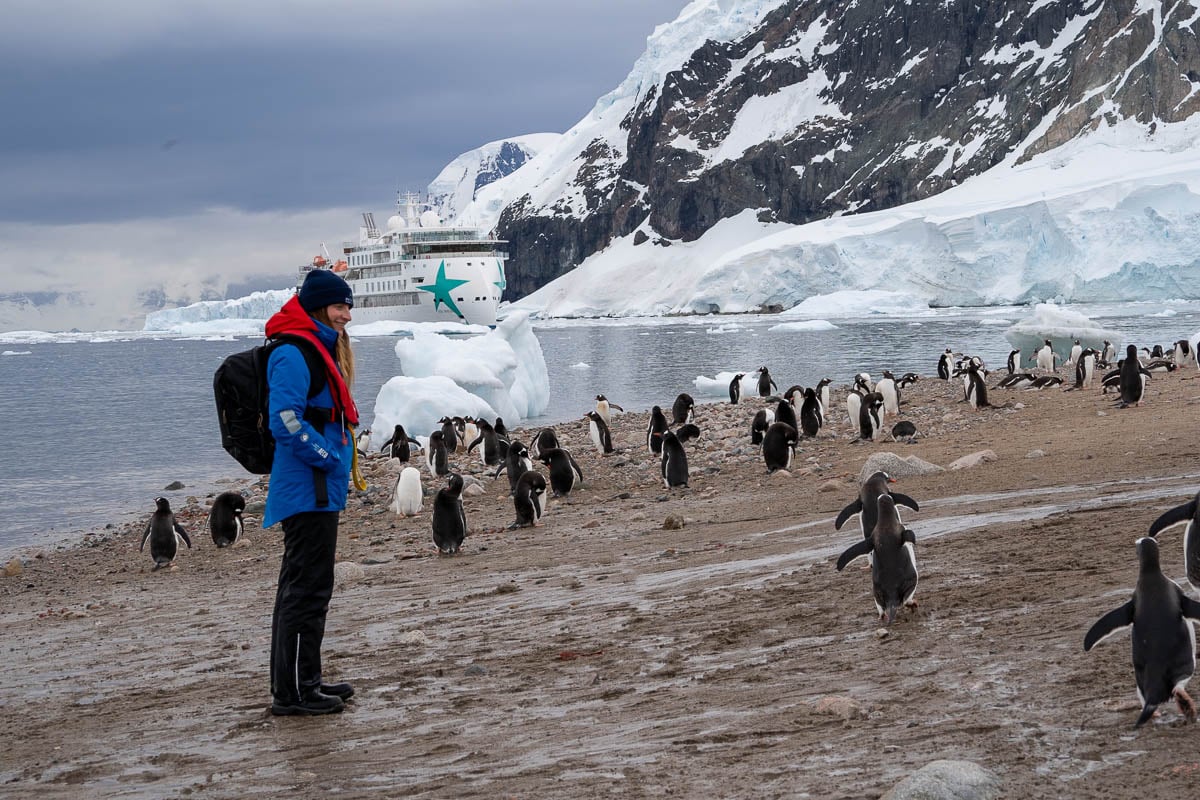
If the parka or boots that you order before getting onboard do not fit, the staff are more than happy to help you find gear that works for you.
We’ve sailed on some operators who require you to bring your own muckboots and on another operator that did not have enough parkas for all of its guests. We love that, with Aurora, it’s always been a seamless experience that’s already included in your cruisefare.
Guests
We love expedition cruises, but we’re always a tiny bit nervous before getting onboard—not only can the expedition staff have a major impact on your experience, but so can the other guests.
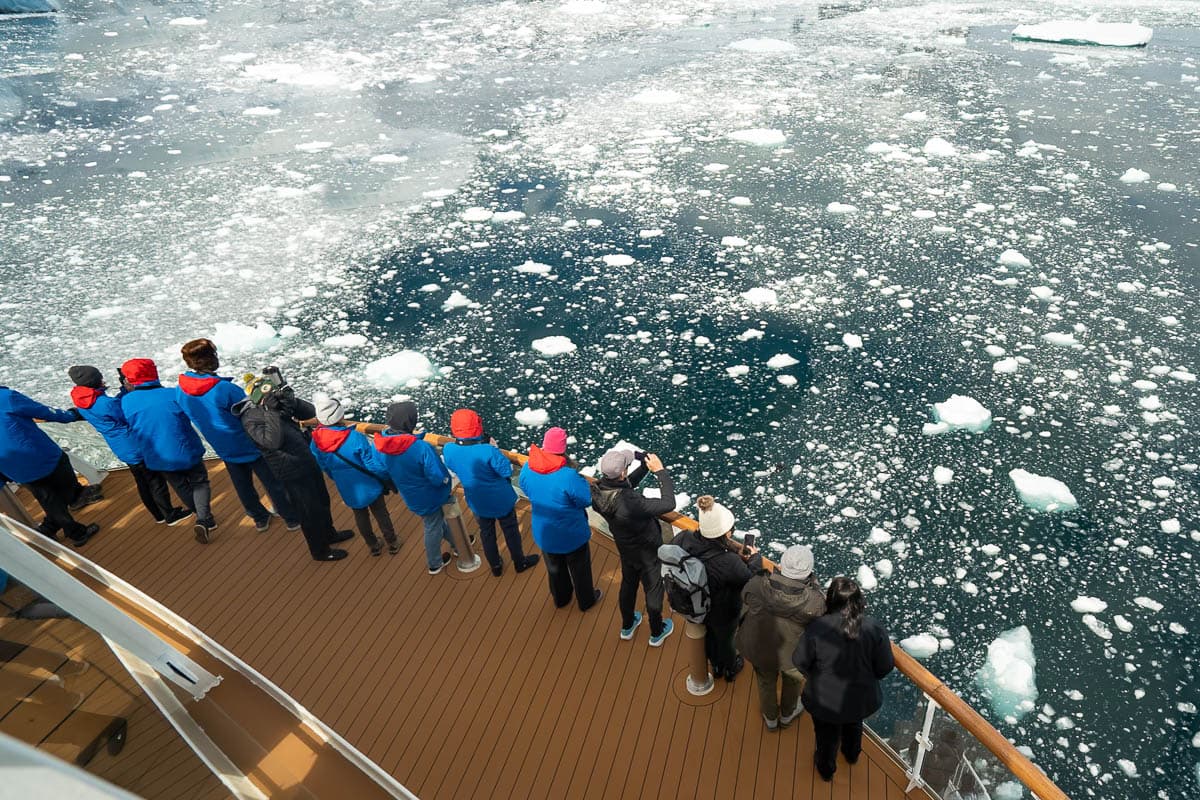
Luckily, I think Aurora’s mixture of chill, yet intrepid vibes attracts an overall very cool clientele. The vast majority of Aurora’s guests have been absolutely lovely—educated, friendly, laidback, curious, and down for the adventure of it all.
Most expedition cruises we’ve been on have heavily skewed older, primarily being retired couples, with some multi-generational and younger families, as well as solo travelers and a handful of younger couples, sprinkled in.
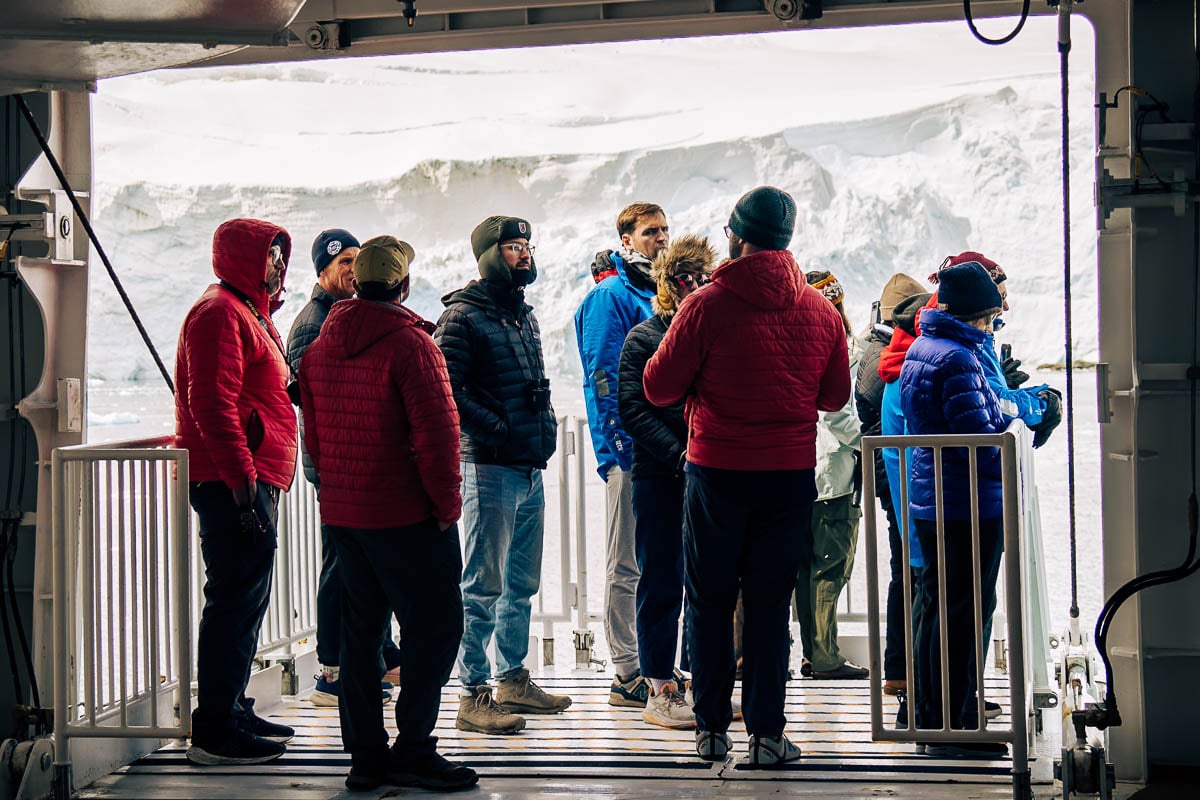
On our Aurora Expeditions Antarctica cruise, though, we were BLOWN away by how young many of the guests were—about a quarter of them were couples in their late 20s to late 30s! I’m guessing our more adventurous itinerary appealed to a younger crowd. The other guests were still a hearty mixture of retired couples, parents with their adult children, and solo travelers.
Overall, unless you’re looking for a wild and crazy party atmosphere (in which case, I don’t think Aurora would be the right choice for you), most travelers will fit in just fine aboard!
Onboard the Greg Mortimer
Okay, let’s move on to what it’s like on the Greg Mortimer.
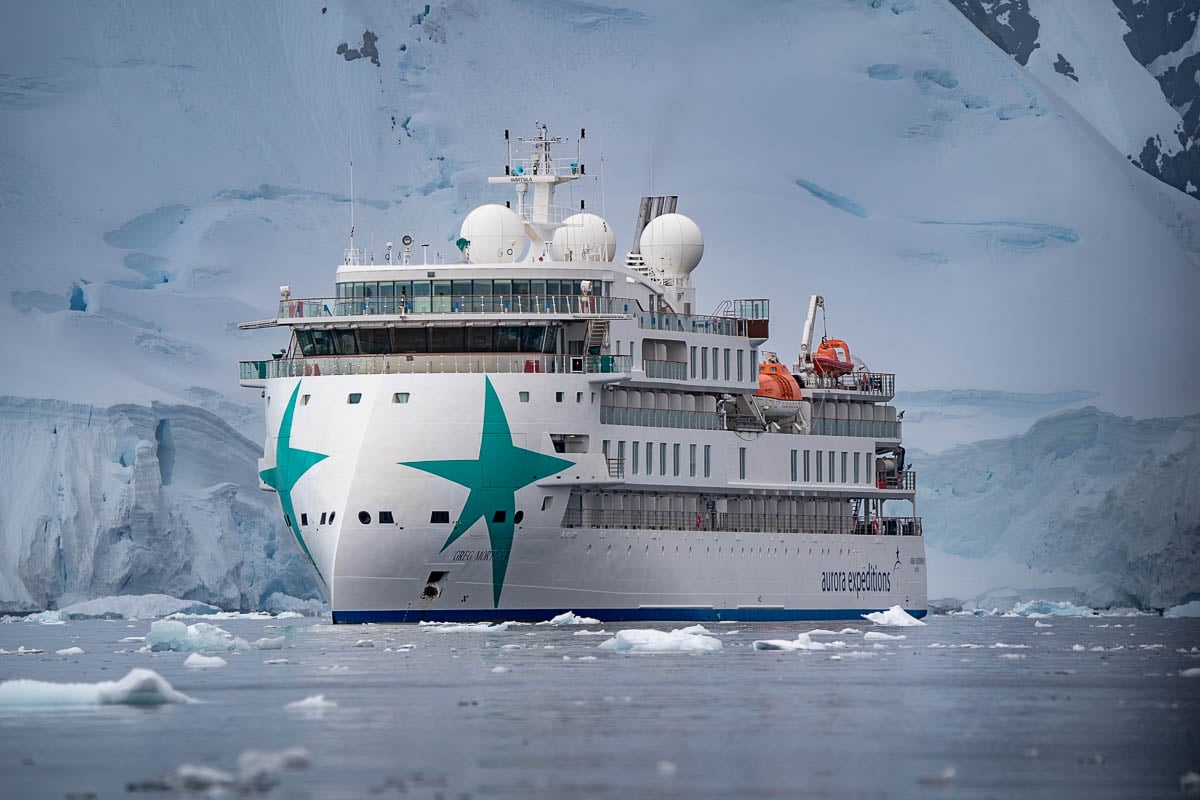
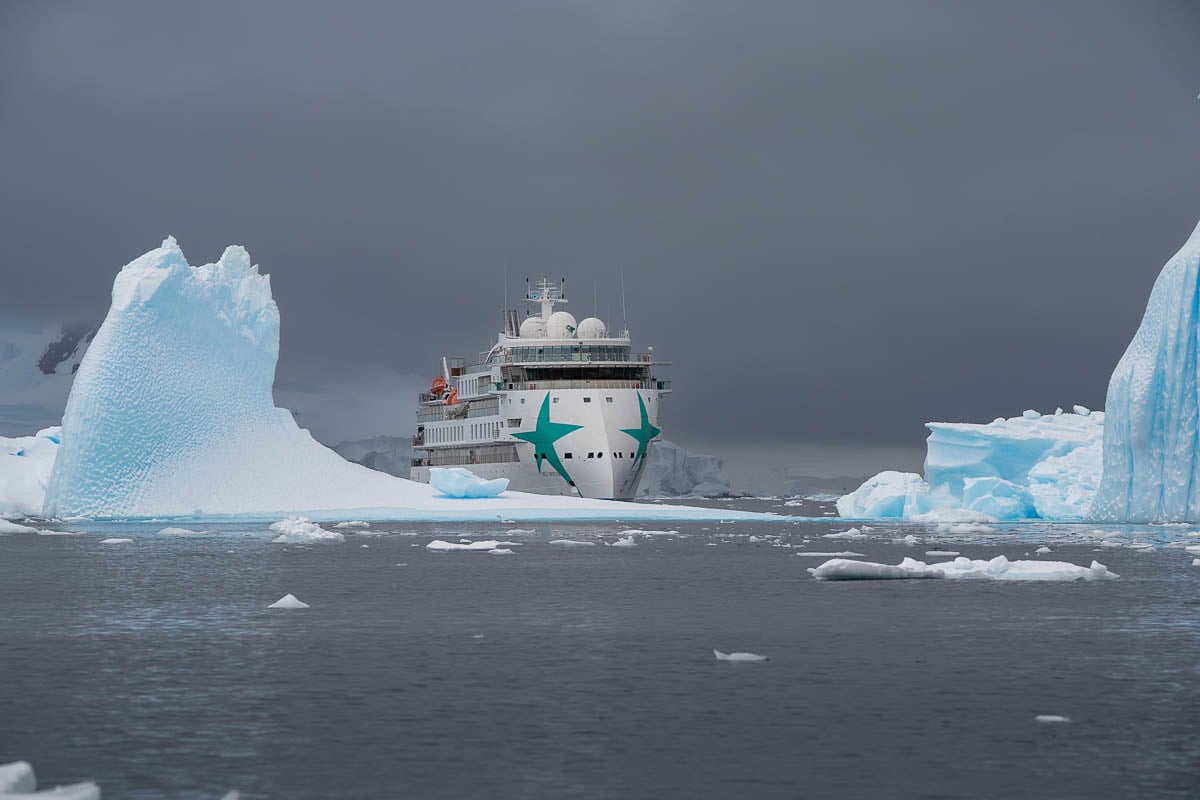
The Greg Mortimer is a 341 foot X-bow ship. If you’ve never seen an X-bow ship, they’re kind of neat-looking, with an almost inverted hull that cuts through water and increases fuel efficiency. We were lucky enough to have pretty calm waves the entire time we were aboard, so I can’t speak too much to how it handles in rockier conditions—but the ship is equipped with stabilizers that decrease motion on the ship.
Despite being the oldest ship of Aurora’s fleet, it’s still quite new (it was only built in 2019), with a sleek, modern, and polar-themed interior, with lots of stunning photos of Antarctic and Arctic wildlife adorning the public spaces.
The cabins
The Greg Mortimer has 76 cabins, which range from cabins that are purpose-built for solo travelers, triple cabins, and all the way up to a captain’s suite, which has a separate lounge area and HUGE balcony. There are also options if you want adjoining cabins or need a wheelchair accessible space.
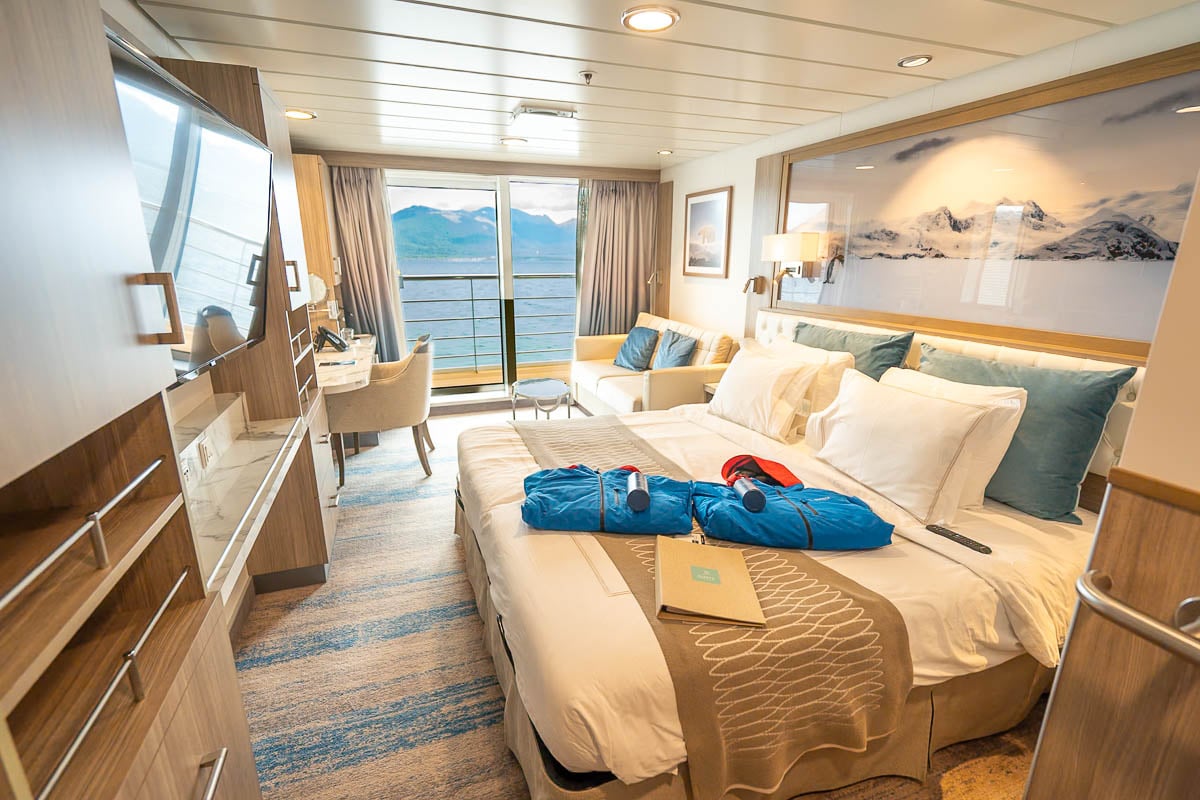
We were in a Balcony Stateroom Category A, which is the most common type of cabin onboard and the more premium of the staterooms, with a small couch, desk, and spacious balcony.
Generally, the cabin was an incredibly comfortable home for the two weeks we were aboard. The room felt HUGE, offered tons of storage, and felt very premium, with marble finishings, plush carpet, and a heated bathroom floor. There’s also lots of thoughtful extras in the room, from an insulated water bottle that you can refill at the water stations throughout the ship to a clothesline in the shower to dry off your clothes.
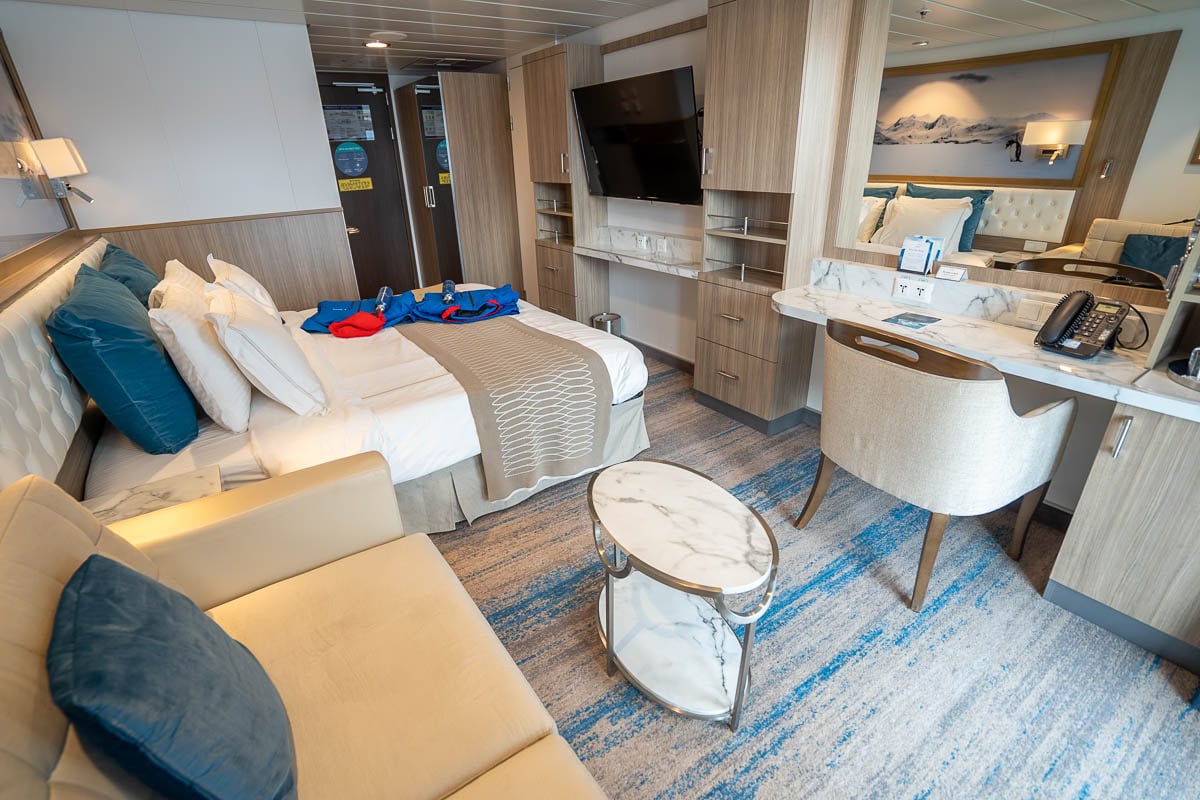
I do have a few nitpicks about the cabin. While there are plenty of universal outlets (yay!), there were no plugs or USB ports near our bed, which made charging our phones at night slightly less convenient. And I wish the black-out curtains on the balcony doors did a better job of totally blocking out the Antarctic Midnight Sun.
Neither of these are particularly big deals and could be easily solved by including a couple of power banks to use on your bedside table at night and a good eye mask on your Antarctica cruise packing list.
Dining room, food and drink
The Greg Mortimer has one main dining room on the ship’s fourth floor, with huge panoramic windows to enjoy the scenery and spot wildlife, even while you’re eating. A small, separate section of the dining room serves as an included, but reservations-only Italian restaurant during dinner.
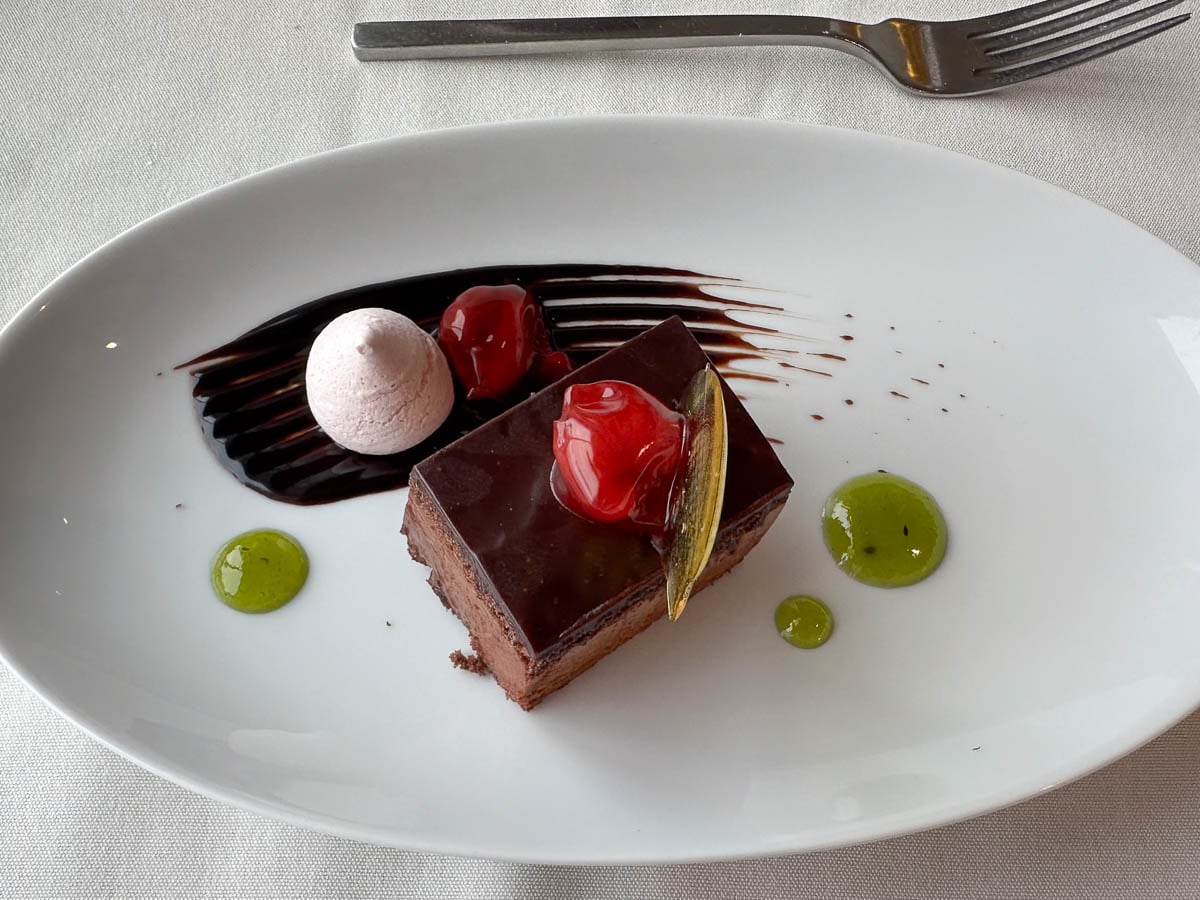
Breakfast and lunch are buffet-style, with a mixture of hot and cold items and Western and international dishes. Dinner is served a la carte, from a three course menu, with more upscale choices than the other two meals.
Food was generally quite good (the breakfast buffet and dessert selection were always the stars!), but, amidst an EXTRAORDINARY onboard experience, it was probably the weakest aspect of our time aboard the Greg Mortimer, at least, in my book.
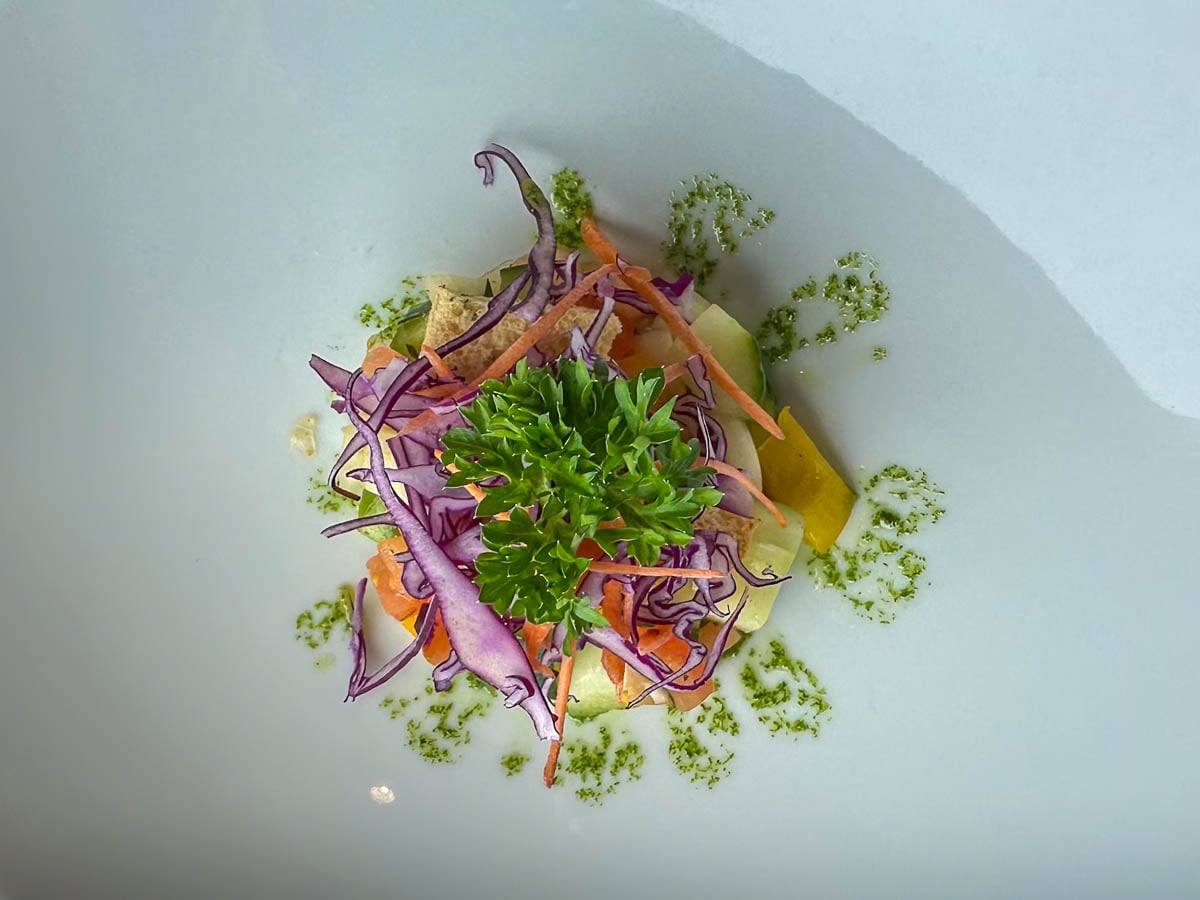
House wine and beer are complimentary at dinner, but all other alcoholic beverages must be purchased separately.
There is no shortage of opportunities to grab a cocktail. There are two bars onboard—The Elephant Bar, near the lecture theater and the Mawson Bar, in the observation lounge on the top floor, both of which serve extremely reasonably priced drinks (usually, $8 USD or less). There’s also always a happy hour before the nightly recap and briefing, where a rotating cocktail of the day is only $6 USD.
It would be my preference to have alcoholic beverages be included in the cruisefare. However, between the generous pours of wine that the servers provided at dinner and how busy we always were onboard, in actuality, we rarely imbibed outside of dinner, maybe having a few cocktails sprinkled throughout the two weeks we were on the ship.
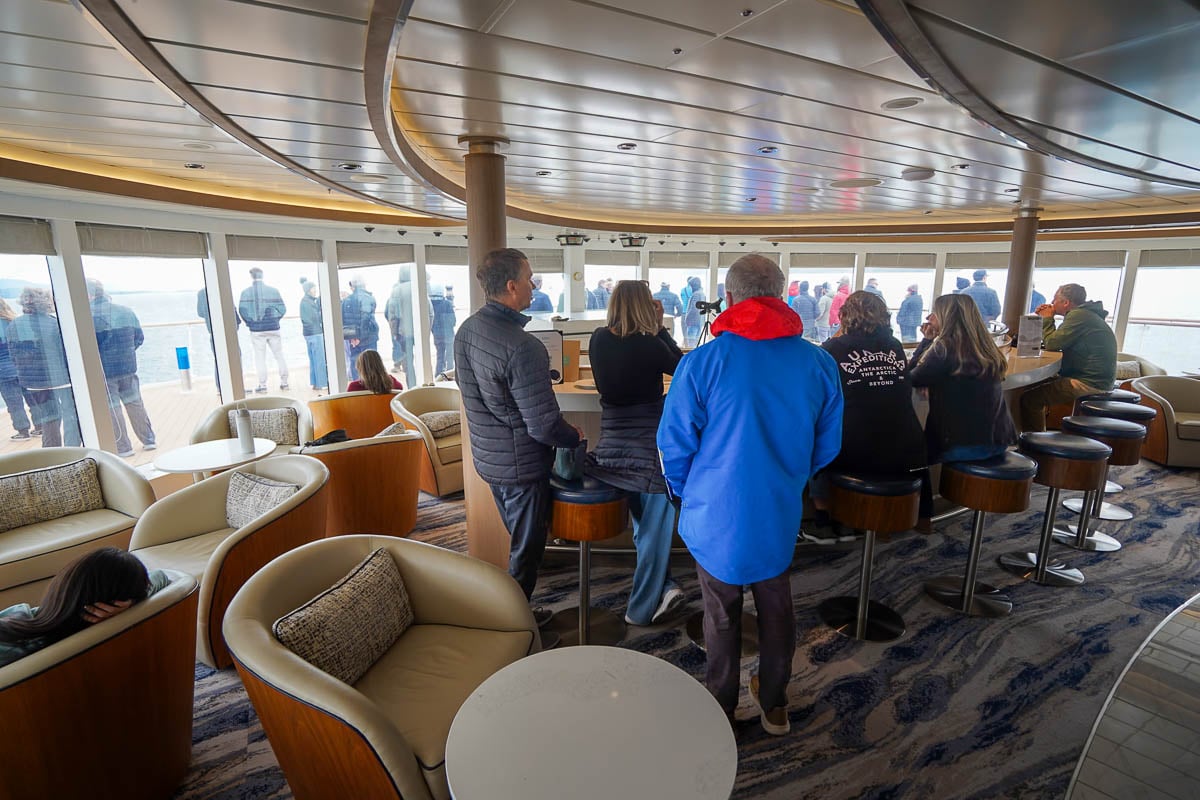
So, if you’re a super heavy drinker (my 30-something year old body simply can’t hang anymore) or are on some kind of cruise where you’re just hanging out onboard for days at a time, this might be a bigger issue. Otherwise, if you’re on an action-packed Antarctica cruise with Aurora, you’re probably too busy hanging out with penguins or whatever, to miss an all-inclusive drink package.
Other areas of the ship
There are several areas of the ship where people can meet and socialize.
There’s a lecture theater, where a nightly recap and briefing was held everyday, to discuss what the plans are for the coming day and to learn more about Antarctica’s history, wildlife, or geology.
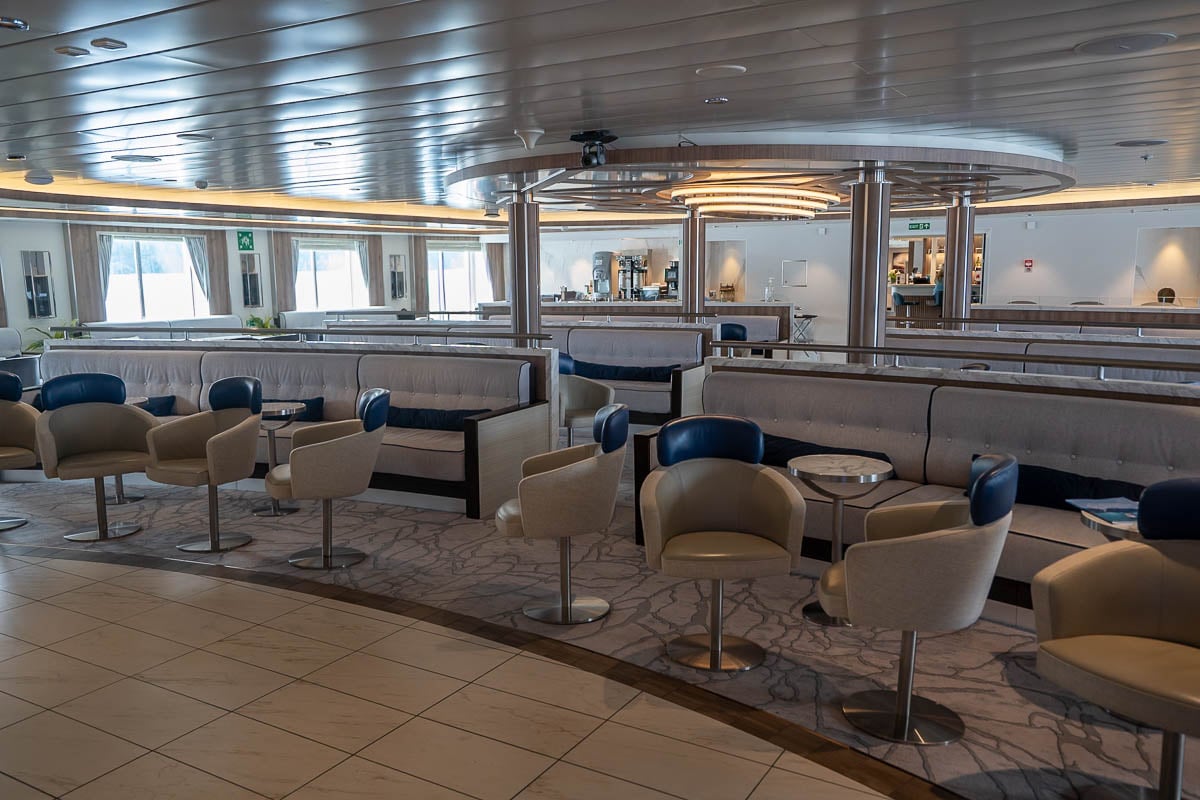
The room has a mixture of couches and swivel chairs around tables, which provides a more social and engaging atmosphere than a typical lecture theater. There’s also an on-demand coffee and hot chocolate machine, lots of different teas to choose from, and cookies and crackers to snack on throughout the day.
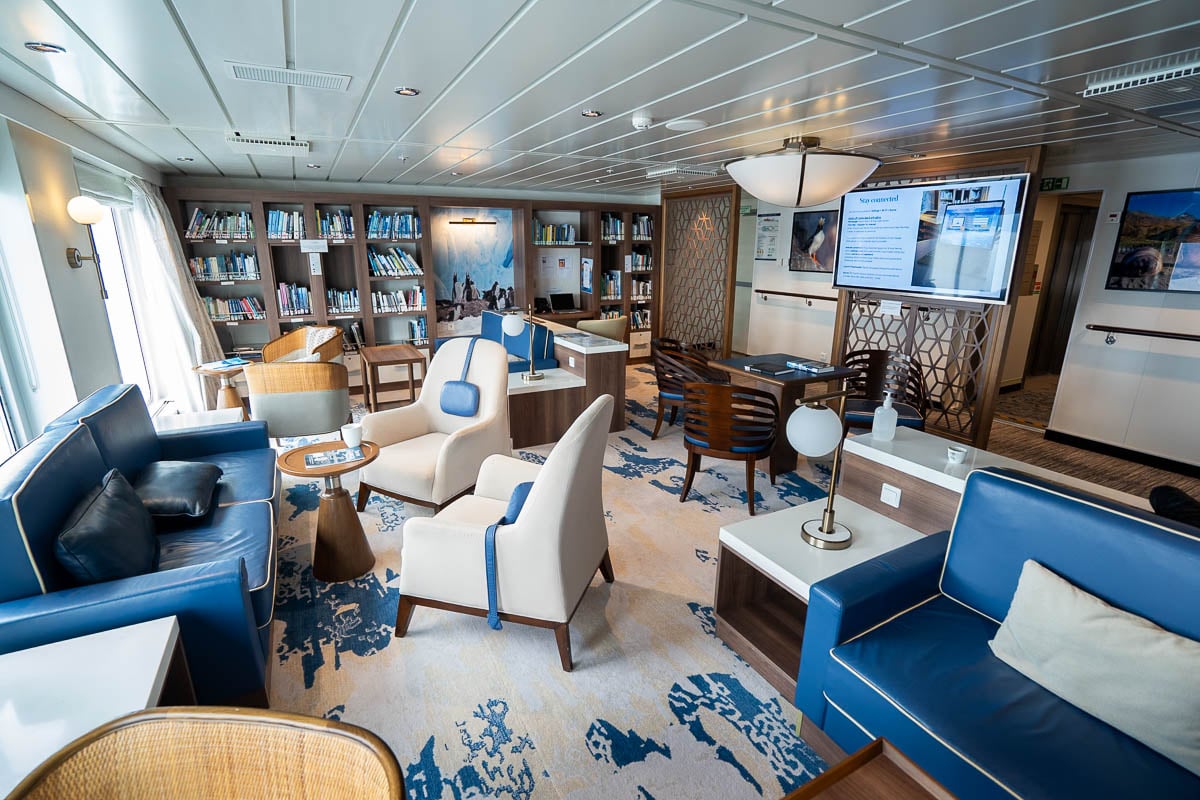
There’s a small library onboard, with laptops to use, cozy couches to curl up on, and lots of books to read at your leisure.
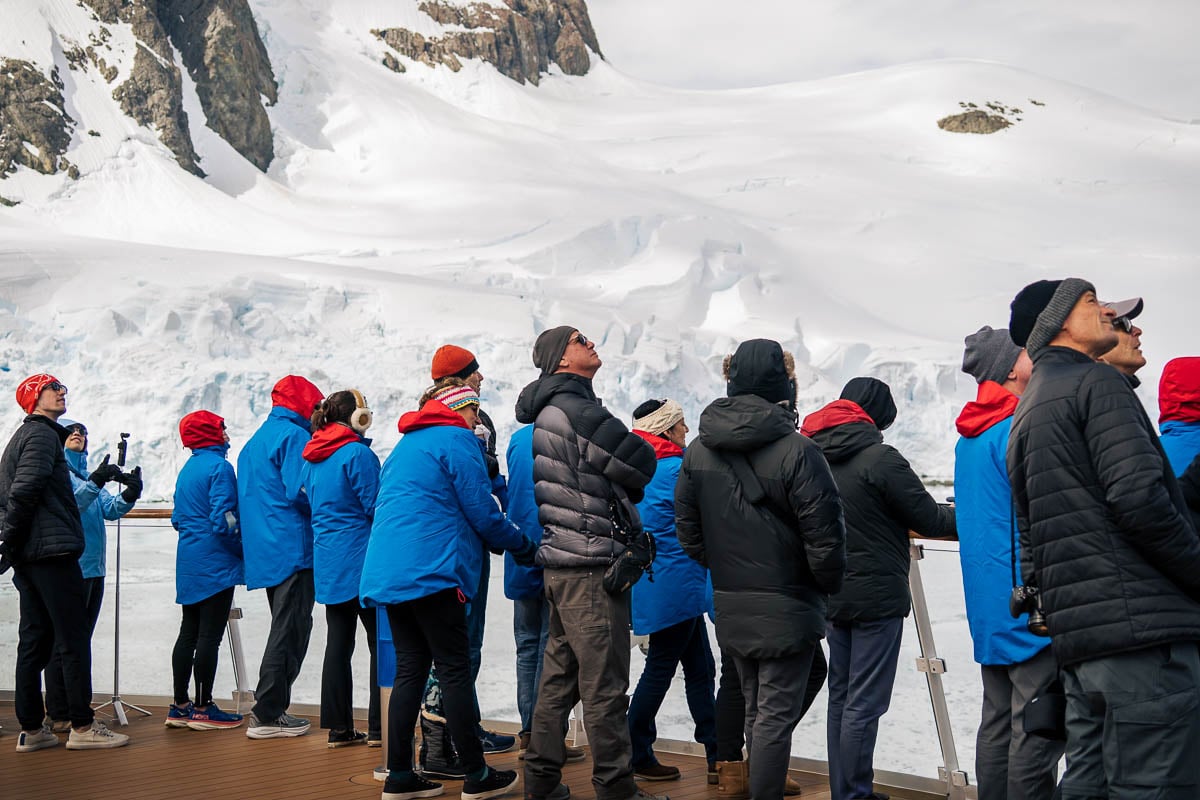
Our favorite place to hang out onboard, though, was the observation lounge on the top-deck, with lots of chairs, gathered around tables, and enormous, panoramic windows. Tons of passengers were always up there, keeping a watchful eye out for wildlife or admiring the surrounding ice formations, so it was always a fun, social atmosphere.
Amenities
While Aurora specifically shies away from calling itself a luxury operator, there are some REALLY nice amenities onboard, including:
- Two hot tubs
- Two igloos with lounge seating
- Sauna, with beautiful window to enjoy the scenery
- Wellness center that offers massages and facials
- Well-equipped gym
- Doctor’s office, who generally provides complimentary treatment
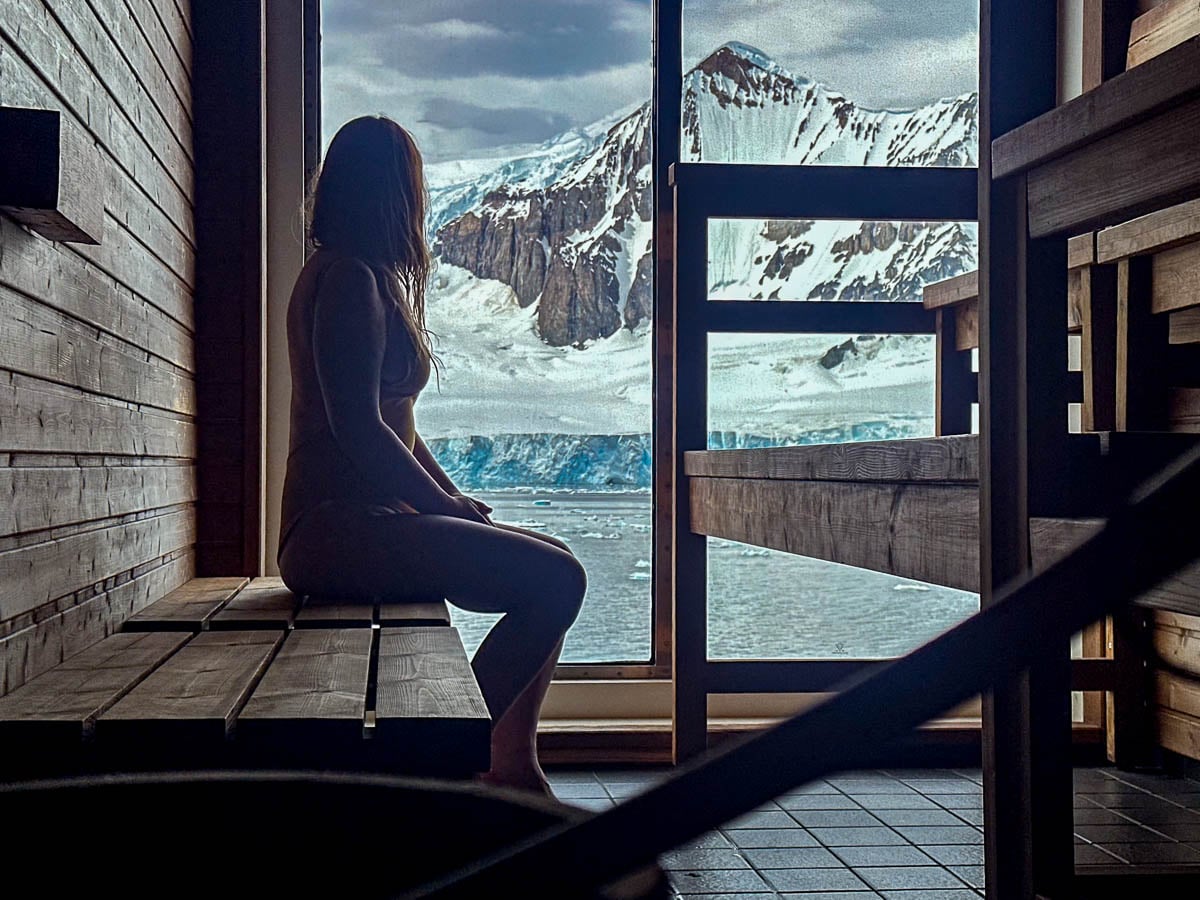
Other than having a heated pool, like Aurora’s two other ships, I can’t imagine any other facilities that would make the ship any more comfortable.
Service
The onboard service was impressive—we were always greeted with a friendly smile and an eagerness to help.
Our steward was a highlight of our trip, cheerily greeting us anytime we passed him and expressing an almost comical (but 100% sincere) enthusiasm for cleaning our room.
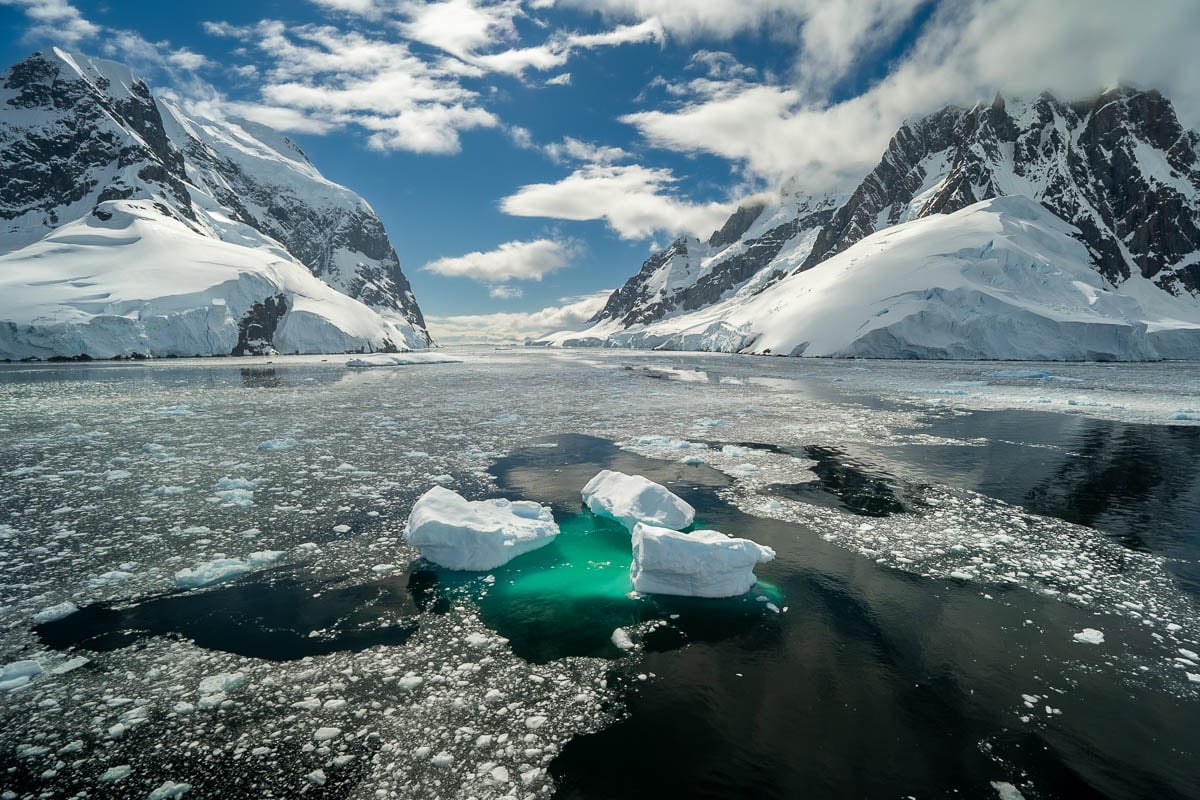
Again, if you sail with Aurora, you shouldn’t expect a personalized butler service or for most of the staff to learn your name. But, for an expedition cruise line, we felt extremely comfortable and well-cared for.
Entertainment
Aurora, like most small expedition cruises, does not have nightly Broadway musicals or Cirque du Soleil acts onboard. Instead of any kind of performances, there are educational lectures during the day, to delve deeper into things like the history or flora and fauna of Antarctica, as well as a handful of other fun activities, like a trivia night or outdoor barbecue night.
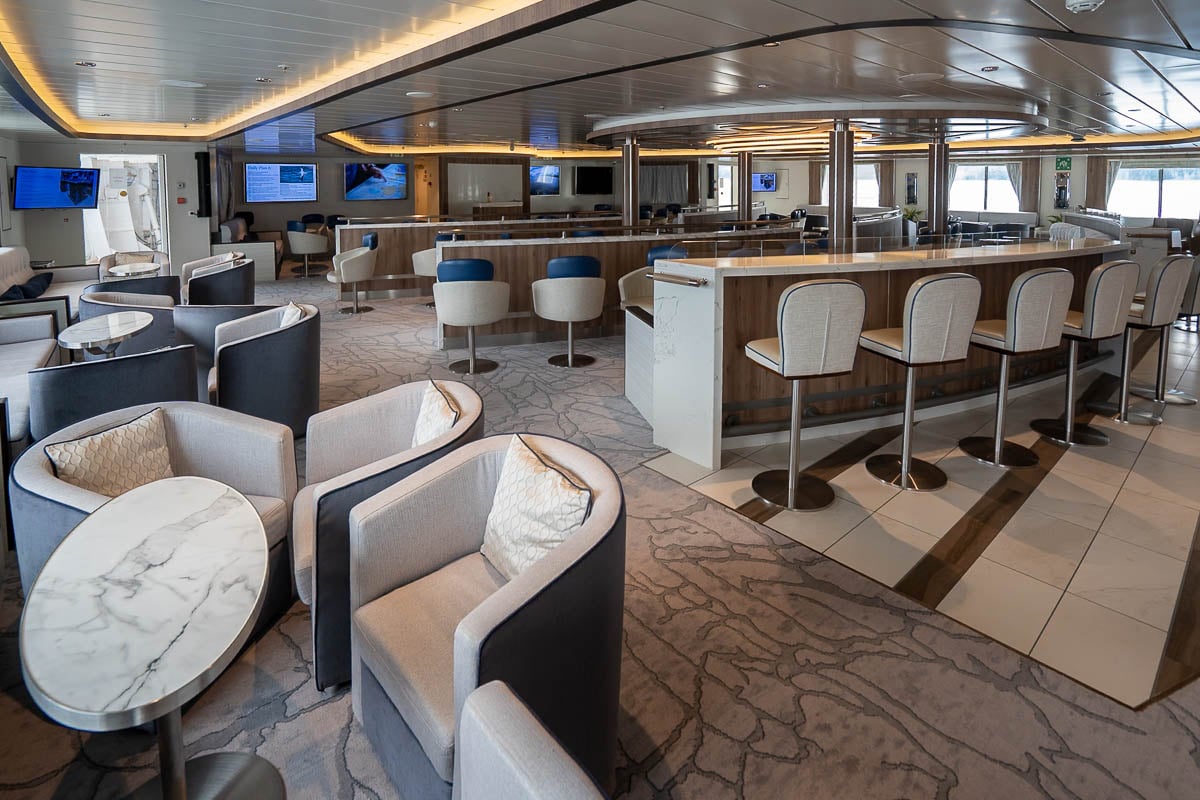
We really enjoyed this aspect of the trip. Call me a nerd, but I’d rather learn more about the different species of lichen that grow in Antarctica, as compared to listening to a dude croon showtunes on a piano after dinner.
Wifi
One thing that I really dig about Aurora is that they provide complimentary Starlink Wifi on their expeditions—no annoying or expensive packages to access faster or more data!
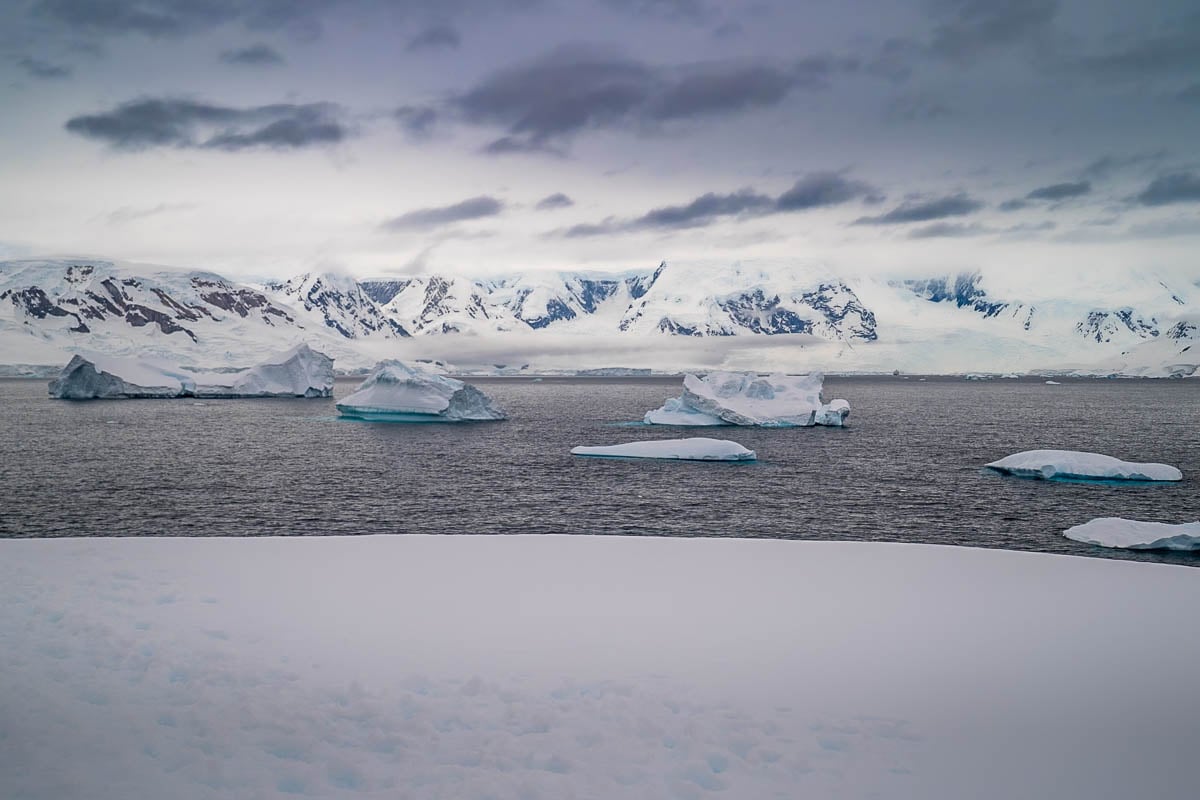
As mentioned above, we sailed with Aurora in Svalbard and found the internet to be a bit spotty, especially during times when lots of other passengers were using their devices.
In comparison, we were BLOWN away by how reliable the internet was on our Antarctica cruise—for example, we regularly streamed Netflix before going to bed, without issue. I imagine the more reliable internet was due to the fact that our latitude was closer to the equator and, therefore, closer to more Starlink satellites (i.e., not something that’s within the control of Aurora).
I still personally would be a bit nervous to schedule any super important Zoom meeting for work while onboard, but we did meet other passengers, who were working remotely without issue!
Would we recommend an Aurora Expeditions Antarctica cruise?
In case it wasn’t abundantly obvious, yes, we would absolutely recommend an Aurora Expeditions Antarctica cruise.
Aurora has really mastered offering the perfect mix of an extremely comfortable onboard experience, competent and friendly staff, and offboard adventure. I’m not speaking hyperbolically when I say that our trip here was the coolest travel experience of my life, thanks, in large part, to Aurora’s competent expedition team.
The only kind of traveler that might not be a perfect fit with Aurora is someone who is looking for a raucous nightlife onboard (I might steer away from going to Antarctica, if that’s your primary MO) or for someone looking for an ultra-luxe onboard experience, like 24/7 room service or hand-crafted coffee drinks. If you’re looking for a super bougie experience, you might want to consider checking out Silverseas, Seabourne, or Scenic, although you may compromise your offboard experience a bit.
There you have it—my honest review of our experience on an Aurora Expeditions Antarctica cruise. Do you have any questions about our experience? Let us know in the comments below!
